Get Full Government Meeting Transcripts, Videos, & Alerts Forever!
Get email alerts on the School Budget topic
No spam. Unsubscribe anytime.
Montgomery County Board of Education adopts $739 million FY2026 budget unanimously
Summary
The Montgomery County Board of Education on Sept. 11 unanimously approved the superintendent's recommended fiscal year 2026 original budget after a public presentation, with total proposed revenues of $739,000,008.62 across all funds and general fund operating expenditures of $294,641,009.21.
The Montgomery County Board of Education on Sept. 11 unanimously approved the superintendent's recommended fiscal year 2026 original budget after a public presentation and budget hearing. The district presented total proposed revenues of $739,000,008.62 across all funds and general fund operating expenditures of $294,641,009.21.
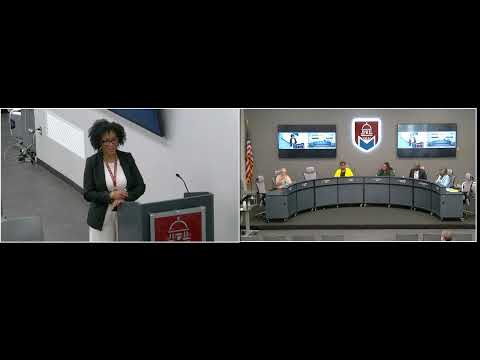
Pamela Watkins, the presenting staff member, opened the hearing by emphasizing the district's role in preparing students for the workforce and military and noting prior financial instability at the district when she arrived. "Funding public education is important because our students are our future," Watkins said during the presentation.
The budget presentation outlined the district's revenue mix, spending priorities and financial reserves. The district said about 67% of general fund revenues come from the state of Alabama and about 32.4% come from local sources. Watkins said the state-funded foundation program is estimated to cost $193,000,000.57 based on units awarded; the state portion the district expects to receive is $156,000,870 and Montgomery Public Schools must provide a local match of about $36,187,000 to reach the program total. The district also noted a capital purchase match of roughly $1,000,003.35.
Watkins described key budget drivers and risks. The district reported projected beginning enrollment funding of 25,226 students for fiscal 2026, down about 125 from 2025; projected funding for fiscal 2027 was noted as about 340 fewer students than 2026. The presentation listed a roughly $35.1 million reserve set aside for capital renovations, technology, security and vehicle replacement and a projected ending general fund balance of $90,032,007.84 for FY2026. Watkins also flagged a roughly 13% increase in PHIP employee health insurance costs and widely escalated construction costs that could delay capital projects, including the Percy Julian high-school project.
The presentation walked the board through fund-level detail: a general fund budget built on state, federal and local revenue; a special revenue fund dominated by federal grant allocations and child nutrition receipts (about $50 million); a debt service fund; capital projects that include state ATF and local capital contributions; and a fiduciary/expendable trust fund for school-level nonpublic accounts. Watkins said the district budgets about $295 million in general-fund revenues and about $294.64 million in general-fund operating expenditures, leaving a small projected excess of revenues over expenditures if all anticipated revenues are received.
The staff highlighted changes in state funding rules, including the new RAISE Act (Renewing Alabama's Investment in Student Excellence). Watkins said the RAISE Act will replace and consolidate prior at-risk, ESL, gifted and "high hopes" allocations and includes an additional $7.7 million allocation that will be broken out by the state.
Board members had one clarifying question from Miss Cloud about continuation of the federal school meal provision (Provision 2). Watkins confirmed the district remains under that provision for breakfast/lunch eligibility.
After the presentation, Superintendent Dr. Byrd formally requested board approval of the FY2026 original budget. A board member moved to accept the superintendent's recommendation; another board member seconded. With no further discussion, the motion was approved by a unanimous voice/hand vote and the meeting was adjourned.
The approved budget package as presented ties staffing units to state-awarded units (the presentation listed 1,668 total units for FY2026 versus 1,677 units in FY2025) and allocates about 77% of general-fund spending to instruction and instructional support combined. The district's capital plans, including Percy Julian, were noted as vulnerable to rising construction costs and may require reprioritization or delay.
Board action: the agenda was approved at the meeting's start and the FY2026 original budget was approved at the close; both motions passed unanimously. The budget will serve as the district's operating plan for the coming fiscal year unless the board votes to amend it in a future session.