Get Full Government Meeting Transcripts, Videos, & Alerts Forever!
Get email alerts on the Land Use Variances topic
No spam. Unsubscribe anytime.
Mobile City Board of Adjustment approves variances, fence and sign conditions, extends prior approvals
Summary
The Mobile City Board of Adjustment on Sept. 8 approved a series of variances and two 12-month extensions, imposed conditions on a school electronic message center and a wholesale-auto office, and accepted a withdrawal of one application.
The Mobile City Board of Adjustment approved multiple variances and two one-year extensions at its Sept. 8 meeting, imposing conditions on several approvals and accepting one withdrawal.
The board — chaired by William Guess — approved a variance for off-site parking and use for a thrift store with four apartments at 264 and 300 North Ann Street and 1303 Adams Avenue, conditioning approval on required landscaping, tree plantings and a residential buffer. The applicant provided a lease for additional parking and told the board the property already contained the uses and that the zoning would allow continued improvements.
The board also granted two separate 12-month extensions: one for a large, wetlands-affected subdivision proposal at 2600 Burton Lane (applicant McDowell Knight/Stephen Harvey) to allow time for a U.S. Army Corps of Engineers jurisdictional determination and related permitting; and another extension for a previously approved variance at 720 Museum Drive (Burton Property Group/Kathy Sherman) following the property’s recent closing. Both extension requests were described as tied to slow regulatory or planning timelines.
Other approvals included: - A use variance at 1868 Government Street to allow an office for a wholesale automobile sales business, approved with a condition that no vehicles be delivered, stored or sold on the premises and that the location be offices only. The applicant said the business would act as a corporate office and would not store vehicles on-site. - A sign variance for a private school on Halls Mill Road to allow an electronic message center within 300 feet of residentially zoned property. The board approved the sign with a condition that it not be activated, lit or otherwise used after dark. - A fence variance for Cottage Hill Baptist Church to allow a 6-foot aluminum fence (the applicant had originally requested 8 feet but stated a 6-foot fence is intended) along parts of the property; the approval was conditioned on required permits and a non-utility right-of-way use agreement for any portion of the fence in the public right-of-way. Board discussion noted columns or caps could exceed the six-foot fence by roughly one foot and that the board does not have authority to permit fence placement in the public right-of-way without a separate agreement. - A rear-yard setback variance for 4006 Old Shell Road to allow a building addition closer than the required rear-yard setback; approval included a condition requiring gutters and downspouts on the north side and full compliance with all permits.
One application — listed as item 8 regarding 3755 Cottage Hill Road — was withdrawn before a public hearing. Another application for a duplex at 357 Coventry Way was withdrawn by the applicant after the board noted the request to change the use was unnecessary and staff advised the applicant to withdraw and submit permits for the single-family repairs they intended.
Where applicants indicated compliance steps, staff clarified that surface and surfacing requirements for off-site parking would be enforced at permit-review stage. For the large Burton Lane site, the applicant reported wetlands delineation work and said the Corps’ regulatory process and revised rules following recent U.S. Supreme Court guidance had slowed progress.
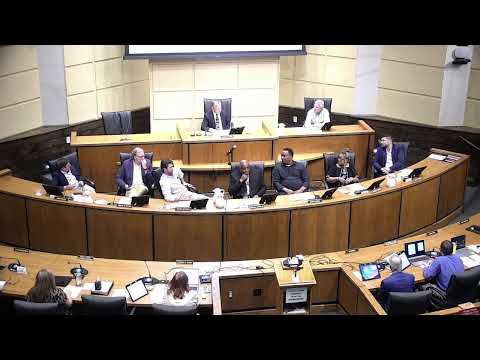
The board repeated its procedural reminder that five affirmative votes are required to approve an application. Chair William Guess announced a full quorum of seven regular voting members and two supernumeraries at the start of the meeting.
The meeting closed with a brief administrative discussion about board member attendance and supernumerary participation; staff noted practical challenges in pre-notifying supernumerary members when a quorum of voting members already plans to attend. The board adjourned after minutes and routine items were addressed.