Get Full Government Meeting Transcripts, Videos, & Alerts Forever!
Get email alerts on the Roads Infrastructure topic
No spam. Unsubscribe anytime.
York County outlines five‑year plan to improve local roads, aims to raise average pavement score from 57 to 70
Summary
County staff presented a strategic framework to expand paving, combine funding sources and increase in‑house capacity, prioritizing about 60 connector roads and a five‑year goal to produce 15 miles of improved pavement annually.
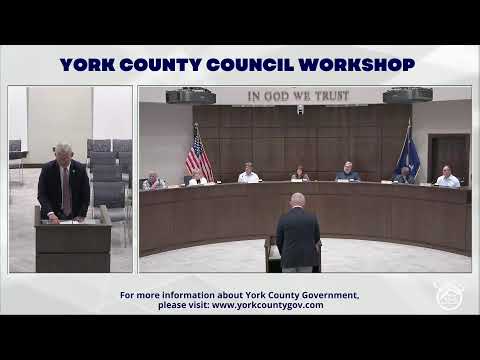
York County officials presented a strategic framework at the Sept. 9 county council workshop outlining how the county plans to increase road paving and preservation over the next five years, combining multiple funding sources and expanding Public Works’ in‑house capacity.
County Assistant Manager Tom Couch, who introduced the presentation, said the framework is built on four themes: “plan, fund, maintain, and deliver,” and emphasized the focus on local roads. Assistant County Engineer Patrick Hamilton described the primary funding streams — the Pennies for Progress sales‑tax program, state C funds collected from the gas tax, and a county capital maintenance account (Fund 14‑22) — and said staff will combine those sources when bidding projects to improve unit pricing.
Why it matters: staff told the council nearly a third of county roads are rated in poor condition and the county’s overall pavement condition slipped from an average score of 59 in 2022 to 57 earlier this year. Management set a target to raise the countywide average to about 70 within five years to reduce long‑term repair costs and slow the shift of “fair” roads into “poor.”
Funding and targets Patrick Hamilton said Pennies for Progress (the county’s 1% sales tax program) is active — the county’s Pennies 5 list is in design and SC DOT has bid about 15 miles so far. He told the council the county collects “around $7,500,000 a year through C funds,” but that for the current fiscal year most C funds are committed to state SIB projects (Exit 82, 85 and 90). Hamilton said the county is asking the State Infrastructure Bank for additional funding for Exit 82 that would require an additional local match.
On county roads specifically, Hamilton described a proposed county road paving program to use the capital maintenance fund (Fund 14‑22) plus targeted C funds for a combined push on county‑owned roads. He said staff identified roughly 60 county “connector” roads (higher‑volume county roads connecting state roads or other corridors) out of about 2,000 county roads and will prioritize those first with traffic counts and other metrics such as number of houses and businesses.
Scope, condition and costs Staff explained the county’s pavement rating categories (good: ~71–100, fair: ~45–70, poor: 0–44) and the relative costs of treatments: preservation for good roads, mill‑and‑fill or spot repairs for fair roads, and full reclamation for poor roads. Hamilton repeatedly described the dollar figures as ballpark estimates, saying preservation treatments are far cheaper per mile than reclamation. He also said Public Works can pave roughly two miles per year in house at about $300,000 per mile, while contractor unit costs are higher; staff are studying whether increasing in‑house capacity could produce cost savings without hitting diminishing returns.
Council questions and staff direction Council members pressed for detail on traffic counts, the list of 60 connector roads and data that shows how many homes are served by neighborhood roads. Hamilton said staff will collect traffic counts on connector roads first and will provide maps and lists to council. Council members also asked about coordination with SC DOT and municipalities; staff said they meet monthly with the DOT district office and have discussed ways to highlight priority locations before DOT’s bids are issued, but that contractors generally set the contractor schedule once a bid package is awarded.
Manager and staff goals County management described a “stair‑step” five‑year delivery plan that would aim for a recurring funding level and a mix of in‑house and contracted work to reach a target of roughly 15 miles a year at a sustainable plateau. A county official summarized the delivery objective: “we want to bring all of the roads that are poor in poor condition up to a fair or good condition, but we wanna raise the overall rating from 57 to 70.” The presentation also listed next steps: finalize the connector‑road list, collect traffic counts, refine cash‑flow projections for Pennies projects, analyze expanding Public Works’ paving capacity (equipment and personnel), and present a proposed funding plan during the budget cycle.
What’s not decided Staff emphasized funding remains the limiting factor and that some choices — for example, whether to stop accepting new subdivision roads for county maintenance — are slated for year‑two evaluation. No ordinance, tax change or binding commitment was made at the workshop; council members asked staff to return with detailed analyses and proposed budget adjustments.
Ending Staff said they will return to council with a prioritized list of roads, updated traffic counts and budget recommendations ahead of the next fiscal‑year budget process. In the meantime, the county will continue Pennies 5 project delivery and coordinate with DOT and municipalities on high‑priority locations.