Get Full Government Meeting Transcripts, Videos, & Alerts Forever!
Get email alerts on the General Government Operations And Appropriations topic
No spam. Unsubscribe anytime.
Guam lawmaker says governor bundled policy changes into budget; moves to adjourn special session
Summary
Senator Jesus Massey criticized the governor's special-session budget transmittal as including sweeping policy changes and procedural irregularities, urged rejection, and moved to adjourn; the presiding officer ruled the motion carried and the session adjourned.
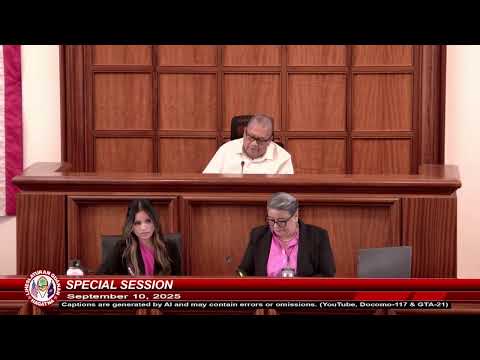
Senator Jesus Massey on the floor of a Guam Legislature special session sharply criticized the governor's budget transmittal as containing substantive policy changes hidden inside a Business Privilege Tax (BPT) measure and moved to adjourn the session.
The move followed a lengthy statement by Massey, who told colleagues that the governor’s proposal goes well beyond a tax-rate decision and, he said, “rewrites laws that were never vetted nor debated.” He identified provisions he said were embedded in the transmittal, including authorization for a new police headquarters, a sports field in Tiedzin, changes to how the Guam Department of Education is treated under the Central Accounting Act, higher procurement thresholds requiring attorney general review, and multi‑year extensions of health insurance contracts.
Massey argued the changes were presented without the strikethroughs and underlines required by the Legislature’s rules, a practice he said “hides changes from the public.” He said the governor’s submission was a “quasi clean version of a bill” that prevented the public from seeing what was added or removed and that the measure amounted to “a power grab.”
Why it matters: Massey framed the dispute as both a process and a policy problem. He said the package would shift control over roughly $270,000,000 in education funds if enacted as drafted, raise procurement approval thresholds from $500,000 to $5,000,000, allow extensions of health insurance contracts worth more than $100,000,000 a year for up to three years without hearings, and double‑appropriate $6,400,000 in federal matching grant funds, among other items he cited. Those numbers were presented by Massey as his summary of the transmittal; he characterized the package as unbalanced and insufficiently transparent.
Massey also referenced broader fiscal context, saying Guam had seen “7 years of record collections, 7 years of record breaking budgets, 2,000,000,000 in federal dollars,” and yet, he said, Guam Memorial Hospital (GMH) remained in poor condition. He urged colleagues to use newly available savings from a recent refinancing — which he described as about $32,000,000 — to restore capital projects that were removed from GMH’s budget in December 2024, and said he was “already working with colleagues to appropriate a majority of this money to Guam Memorial Hospital.”
On procedure, Massey pointed to the Legislature’s standing rules (he cited Section 6.0202(d)) that, he said, require strikethroughs and underlines so the public can see changes. He urged that substantive policy proposals be submitted as separate bills so the public and the Legislature could vet them.
After his remarks, Massey said, “For that reason, I urge you to reject this measure,” and moved to adjourn the special session on the bill. The presiding officer asked whether there were objections; when a member objected, the presiding officer called for those in favor to indicate by raising their hands and then said, “Motion carries. Session is adjourned.”
The session record shows no formal vote tally or roll-call names recorded in the transcript for the adjournment motion. Massey’s objections and his offer to reallocate the refinancing savings were presented as motions and statements on the floor; the transcript does not show any enacted changes to the transmittal or other formal legislative actions during the excerpts provided.
Massey’s remarks also named specific sections in Chapter 12 that he said would authorize projects or administrative changes without identified funding sources; he described those insertions as examples of policy being folded into a budget measure. He warned employees of Guam Memorial Hospital in attendance that the Legislature must prioritize services and fiscal discipline.
No other formal actions on the budget transmittal or related provisions are recorded in the provided transcript excerpt. The session adjourned following the successful motion to adjourn.
The Legislature previously passed a budget (Massey said the governor vetoed it); the special session was called to reconcile differences between the governor’s transmittal and that earlier legislation, according to discussion on the floor.