Get Full Government Meeting Transcripts, Videos, & Alerts Forever!
Get email alerts on the Gmh Funding Appropriation topic
No spam. Unsubscribe anytime.
Guam lawmakers consider $40 million special‑session appropriation for Guam Memorial Hospital; questions remain on funding source and procurement
Summary
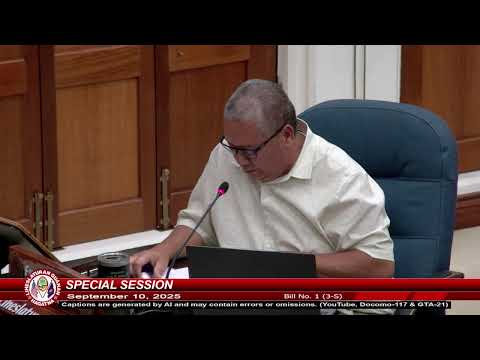
The Guam Legislature’s Committee of the Whole heard testimony Sept. 10 on bill 13‑S, a governor‑requested appropriation of $40 million from the general fund to the Department of Administration for Guam Memorial Hospital Authority operational costs and capital improvements.
The Guam Legislature’s Committee of the Whole spent the evening of Sept. 10 reviewing bill 13‑S, a governor‑requested measure to appropriate $40,000,000 from the general fund to the Department of Administration (DOA) to cover Guam Memorial Hospital Authority (GMH) operational costs and capital improvements.
The bill was placed on the special‑session agenda by motion of Vice Speaker Adah and carried without objection. Committee members questioned GMH leaders and fiscal officials about three immediate issues: the makeup of the $40 million request, how and when the money would be disbursed, and whether the administration can speed procurement for capital repairs without a formal emergency declaration.
GMH officials, led by CEO Lillian Perez Posadas, told senators the appropriation is intended first to address accounts payable and then to fund priority capital improvement projects (CIP) and supplies. Posadas and GMH finance staff said the authority’s accounts payable stands at about $26,000,000 and that the remaining roughly $14,000,000 in the governor’s request would be used for CIPs and supplies. GMH and hospital staff provided a near‑term CIP breakdown: about $5,000,000 for IT network infrastructure, $5,000,000 toward replacement or relocation of the main electrical distribution panel and associated sub‑panels, roughly $1,000,000 for HVAC components (part of mold mitigation work), and approximately $3,000,000 for medical and clinical supplies. GMH later corrected one figure presented earlier: the hospital’s initial estimate for the insurance claim related to the recent electrical fire was given as $18,000,000 (the smaller, immediate repair cost for the burned components was described in testimony as roughly $26,000).
Ed Byrne of DOA told the committee that DOA would administer the appropriation if it passes. Byrne said the bill’s language names the general fund as the source and that funds would be disbursed as revenues or fund balances become available: “These revenues aren't there entirely yet. … As they arise or are earned, yes they will be distributed to GMH,” Byrne said.
Steve Burns of the Office of Financial Management (OFB) and other fiscal staff described the funding source as an accounting mix rather than a single, immediately available pot of cash. Burns said the general‑fund balance includes accumulated results from prior fiscal years and projected excess revenue for FY 2025 (OFB’s collected‑revenue reports showed an estimated FY25 excess near $35,000,000 in discussion during the hearing). Burns and other fiscal witnesses told senators that the bill’s use of the term “general fund” intentionally allows disbursement from excess FY25 revenues, prior year fund balance, or unexpended revenues as they are realized.
Several senators pushed for far more granular detail. Senator Frank San Agustin (Senator Saint Augustine in the transcript) and others demanded a full vendor listing for the $26,000,000 accounts payable; GMH said it would provide the most recent accounts payable listing. Senators also asked for an itemized schedule showing invoice aging and whether debts include amounts owed to central‑government funds such as self‑insurance or utilities (Guam Power Authority appeared on the referenced vendor list). GMH said some payables are owed to government entities and would be automatically handled when DOA receives funds.
Committee members repeatedly raised procurement and timing concerns. Multiple senators and GMH staff agreed that while vendor payments could be made quickly once cash is available, larger CIP projects — replacement/relocation of the main electrical distribution, major roof and envelope repairs, IT network work and competitive procurements — cannot be completed by Sept. 30, 2025, without emergency procurement authority. Several lawmakers and witnesses recommended either an executive emergency declaration from the governor or an amendment specifying expedited procurement/reporting requirements to speed work. As one legislator summarized: without emergency authority the money helps pay debts and buy supplies, but it will not permit immediate, large capital contracts to be executed in the 20‑day window before the fiscal year end.
Witnesses and trustees also addressed sustainability. GMH’s administrators said paying vendors and restoring basic supplies will stabilize operations through the start of FY26 but will not solve underlying reimbursement and structural issues. GMH testified that hospital operations rely on a mix of patient revenue and government appropriations; the hospital’s presented operating budget for FY25 was discussed during the hearing as roughly $213,000,000. GMH officials and clinicians described routine shortages — IV tubing, breathing circuits, hospital beds and other stock items — and the clinical impact of running short on supplies.
The hearing also revisited prior budget debate. Senators noted a $35,000,000 amendment that had been included by the Legislature in the earlier FY26 budget package (bill 44‑38), which the administration treated as unavailable; witnesses pointed to prior communications from revenue offices explaining that some earlier apparent appropriation sources could not be relied on. Several senators argued that if the BPT rollback in the budget package had not been pursued, the $40,000,000 request may have been avoidable or funded through a different mechanism.
What the committee directed and next steps: legislators asked DOA and GMH for a timely, itemized vendor list, the invoice aging schedule and the hospital’s prioritized CIP scope and procurement readiness. DOA and OFB offered to provide periodic reports; legislators asked that reporting requirements and an audit trail be included if the appropriation is adopted. The Committee recessed at the end of the first round and scheduled a second round of questioning and an amendments session the following day.
The bill has been placed on the special‑session agenda and sent to the Committee of the Whole for further deliberation; no final vote on the appropriation was recorded during the session reported here.