Get Full Government Meeting Transcripts, Videos, & Alerts Forever!
Get email alerts on the Student Progression topic
No spam. Unsubscribe anytime.
MPS seeks state approval for ESAP/MSAP innovation waiver to accelerate over‑age students in grades 4–8
Summary
Chief curriculum staff presented a plan to submit an innovation waiver to the Alabama State Department of Education to run Elementary and Middle School Acceleration Programs (ESAP/MSAP) intended to allow students two years of grade‑level recovery within one school year for over‑age students in grades 4–8.
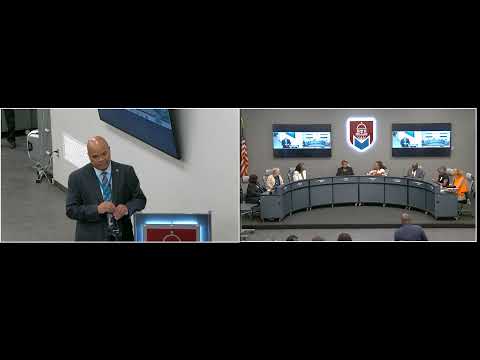
The Montgomery County Board of Education received a proposal Sept. 9 to request an innovation waiver from the Alabama State Department of Education to operate Elementary School Acceleration (ESAP) and Middle School Acceleration (MSAP) programs for students who are academically over‑age by two grade levels.
Doctor Shanice Williams, executive director for curriculum and instruction, said the waiver application would allow the district to provide a year‑round accelerated program enabling qualifying students to “recover at least 2 academic grade levels in 1 school year.” The district is seeking board approval to submit the waiver; the state typically requires about a 60‑day turnaround once an application is submitted.
Why it matters: district data show hundreds of over‑age students in early secondary grades; district leaders said an accelerated pathway could help students enter high school on‑time with their cohort rather than being retained or pushed into off‑site alternatives.
Program basics and eligibility stated by Williams: - Target grades and identification: the proposed ESAP/MSAP would focus on fourth and fifth grades at the elementary level and sixth and seventh grades at middle school; Williams gave counts of currently identified over‑age students: fourth grade 50, fifth grade 34, sixth grade 39 and seventh grade 54 (a total of 177 in those four grades). Williams said K–3 students are excluded because of the Alabama Literacy Act and that high school over‑age students would continue to be served through other adult‑learning or evening options. - Instructional model and schedule: students would participate in blended instruction, direct instruction and computer‑assisted instruction (examples given included PLP and other district digital programs), attend extended‑day and summer sessions and simultaneously work on the current and the next grade level. The district proposes families be contacted for an initial meeting and that principals, counselors and core teachers participate in planning. - Location and continuity: Williams said students would remain at their zoned school and that the district would create an “academic transition plan” and a PowerSchool indicator (coded ESAP or MSAP) so a student who transfers within MPS would carry the plan and code to the next school. - Inclusion: Williams said the proposal would include students with disabilities and English‑learners; the district said it had worked with special‑education leadership to confirm accommodations and procedures. - Timeline: with board approval to submit, Williams said the state’s review would take about 60 days; the district hoped to begin services as soon as the waiver is approved and, if approved, would start the next available 9‑week window so students could begin working through the program during the current year.
Questions from board members addressed several operational points: how eighth graders would be handled (district said eighth graders can be included and may be served at McIntyre or at their home middle school), and how student progress would be benchmarked (Williams said the program would require more frequent progress monitoring and two‑ to three‑week benchmark cycles to ensure mastery before advancing).
No formal board vote to submit the waiver was recorded on the meeting transcript during the work session; Williams asked the board to authorize submission and described next steps: state review, principal and counselor meetings, parent outreach and student identification. Williams said the ESAP/MSAP concept had been used in the district previously and leaders wanted to pilot and expand it with state approval.
Provenance: presentation and Q&A on the innovation waiver ran in the work session; Williams began her presentation and the discussion is recorded in the meeting transcript beginning with the ESAP/MSAP explanation and concluded with follow‑up questions about benchmarks and implementation.
Speakers and participants: Doctor Shanice Williams (executive director for curriculum and instruction), board members Dr. Brenda De Ramos Coleman (questions), Pamela Portis (questions), Doctor Byrd (superintendent comments).