Get Full Government Meeting Transcripts, Videos, & Alerts Forever!
Get email alerts on the Budget topic
No spam. Unsubscribe anytime.
Montgomery Public Schools proposes roughly $739 million operating budget for 2025–26, cites $35 million in reserves and declining enrollment
Summary
Montgomery County Board of Education members heard Montgomery Public Schools’ proposed fiscal 2026 operating budget Sept. 9; the district proposed roughly $739 million across all funds and highlighted $35 million in reserves, a required local foundation match near $36 million, and enrollment declines that reduced state‑funded staffing units.
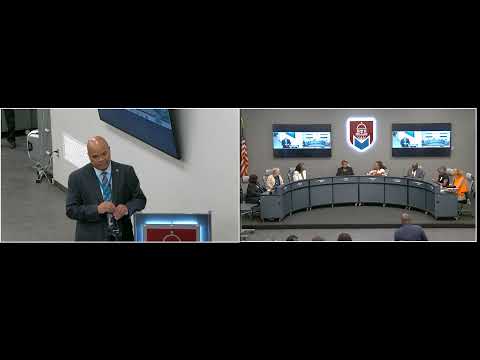
Montgomery County Board of Education members heard an overview of Montgomery Public Schools’ proposed fiscal year 2026 operating budget during a public hearing Sept. 9, 2025. Finance presenter Pamela Watkins told the board the district’s proposed total revenues across all funds are approximately $739 million and that general fund revenue — the board’s main focus — is about $295 million.
Watkins said the district has set reserves and other financial safeguards that helped win a recent credit-rating upgrade: “the district has set aside over $35,000,000 in reserves,” she said, and the district received “a 3 notch credit rating upgrade to an A-plus from a triple‑B plus.” The presentation noted that improved reserves, controlled spending and other measures were factors in the upgrade.
Why it matters: the budget determines school staffing, capital projects and how Montgomery Public Schools (MPS) will cover required local matches for state allocations. Watkins emphasized the district’s continuing reliance on state funding: about two‑thirds (≈67%) of general fund revenue is from the state and roughly 32% is local revenue, including ad valorem and sales tax receipts. That mix shapes how much local tax revenue must be reserved to meet state “foundation” program match requirements.
Key numbers and program highlights presented by Watkins: - Total revenues across all funds (including other fund sources): approximately $739,000,000; combined total expenditures across all funds were presented near $680,000,000. The board’s packet showed general fund revenue of roughly $295,000,000 and a proposed general‑fund expenditure budget near $294,641,009.21. - State sources: Watkins said the state share of the general fund is about $196,910,005.83. The district’s Foundation Program total cost was cited at roughly $193,000,000; the state foundation allocation planned to be sent was shown as $156,870,007.22. - Local match: Watkins said the district’s local match for the foundation program is approximately $36,000,001.87 and the capital purchase local match is about $1,000,003.35. She told the board those local dollars are drawn from local revenues such as the county ad valorem tax voters approved and other local sources. - Fund balance and reserves: Watkins said the district maintains a roughly three‑month (about 3.5 months) operating reserve and has set aside about $35 million in restricted reserves for capital renovation, technology, security and vehicle replacement. Watkins said projected ending general‑fund balance for FY2026 would be roughly $90 million. - Federal and special revenues: Special revenue (federal) funds were shown at about $54 million, including Title allocations and Child Nutrition programs. Watkins said Title I and some school improvement allocations changed this year and noted specific program decreases and increases in federal line items.
Enrollment and staffing: Watkins and the presentation noted a multi‑year enrollment decline since 2016 that reduces state funding. For FY2026 the district is funded for 25,226 students (a drop of about 125 from the prior year), and Watkins said that change translated into a reduction of 8.6 state‑funded “units” (for example: “we lost 4 teaching units, 2 principals, a half assistant principal, a half counselor, 1.5 librarians for a total loss of 8.6 units,” the presentation stated). Watkins warned continued enrollment decline would reduce state allocations in future years.
Capital projects and the bond market: Watkins said the district is preparing for possible bond issuance for capital projects, including the new Percy Julian High School, and that the district recently completed an RFP process to select underwriters for a bond issue (see “Votes at a glance” below). She noted the district may go to the bond market in the next several months and said improved reserves strengthened the district’s position.
Public input and hearings: Watkins opened the FY2026 hearing as the first of two public hearings; she said the second hearing was scheduled for Sept. 11 at 4 p.m. and encouraged public questions and comments.
Ending note: The budget presentation emphasized preserving reserves, stabilizing payroll and benefits costs, and funding capital projects amid rising construction costs. Watkins repeatedly asked the community to support the district’s local revenue streams, including ad valorem taxes, which she said are essential for meeting the state match and maintaining programs.
Votes at a glance (formal board actions taken during the Sept. 9 meeting): - Resolution naming underwriters for bond issuance (Percy Julian project): approved unanimously. The board approved naming Bank of America as senior manager with Siebert Williams & Schenck and The Frasier Lanier Company as co‑managers; the financial adviser said the planned issuance would be approximately $200,000,000 and that the board expects to reimburse about $25,000,000 of previously advanced funds. (Motion moved and seconded; outcome: approved; tally recorded as unanimous.) - Suspension of rules to add virtual‑school handbook amendment: approved unanimously. - Virtual‑school handbook amendment (virtual alternative program): approved unanimously. - Consent agenda and personnel reports (certified/classified/teams): approved unanimously.
Speakers: Pamela Watkins (Finance staff; presented the FY2026 proposed operating budget), Doctor Byrd (Superintendent), Erica Watkins Smith (Board president), Pamela Portis (Vice president). Quotations and numerical details in this article are taken from the public hearing presentation and the board meeting transcript.
Provenance: first budget remarks and distribution of the FY2026 packet began with Watkins’ presentation to the board; Watkins’ concluding summary of annual operating budget appears later in the same presentation and is the most recent budget‑related spoken segment in the public hearing.