Get Full Government Meeting Transcripts, Videos, & Alerts Forever!
Get email alerts on the City Finance topic
No spam. Unsubscribe anytime.
Harrisburg finance team reports midyear general fund shortfall and August cash drawdown; officials press for clarity on revenue replacement
Summary
City finance staff told Harrisburg City Council on Sept. 9 that through June 30 the general fund had collected $39.28 million (42% of its budget) while spending about $35.55 million (38%), and that an August reconciliation showed a $1.6 million projected general‑fund deficit and a $16.9 million cash balance.
City finance staff presented the 2025 midyear fiscal report to Harrisburg City Council on items including revenue performance, expenditures, fund balances and updates through August.
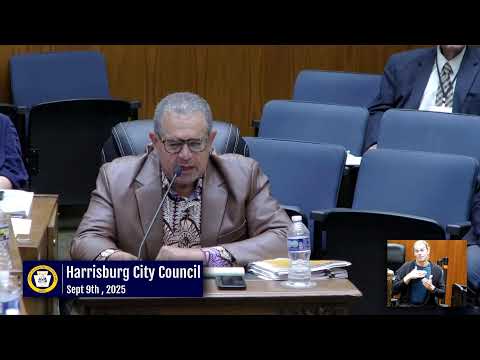
Timothy Burks, budget manager, summarized the midyear figures for the general fund: “Through June 30, our revenues sit at $39,281,263, representing 42% of our budget, while our expenses sit at $35,551,060.62, representing just 38% of the budget,” resulting in an ending cash fund balance of $22,199,454 on June 30, 2025. Staff told council most year‑over‑year variances were tied to the timing and accounting for federal ARPA/revenue‑replacement transfers recorded in the grants fund.
Burks and accounting manager Brian McCutcheon walked council through detail tables showing particularly strong early collections for real‑estate taxes (about 85% of expected receipts through June), real‑estate transfer taxes (about 113%), and hotel taxes (near 100%). Staff said debt service and certain capital expenditures are reported in separate funds and explained differences between tables in the packet.
Council asked for more detail about the Harrisburg Senators Fund and the FNB Field stadium upgrade. Burks said the Senators Fund’s midyear revenue was $379,738 (about 2% of the fund’s budget) with expenses of roughly $5.4 million (about 32% of budget). Staff explained the stadium upgrade is a multi‑year project that began in 2023 and included a roughly $12 million vision, funded partly from the general fund and expected RACP assistance; staff said there is not an immediate cash shortfall because prior appropriations and interfund transfers have provided beginning balances to cover the project’s spending.
After the packet presentation, staff offered an August reconciliation: the general fund through August showed approximately $48.2 million in revenue and $49.8 million in expenses, a projected deficit near $1.6 million; the city’s cash position at August was about $16.9 million, down from roughly $20 million. Staff attributed the August cash drawdown primarily to (1) an earlier‑than‑last‑year $1.95 million transfer to the Senators Fund for stadium work, (2) roughly $500,000 additional Broad Street Market expenditures versus prior year, and (3) about $750,000 of litigation settlements.
Councilman Jones pressed staff on long‑term impacts: “Once this ARPA money is gone, what will our budget look like?” he asked. Finance staff replied that much of what has been referenced as ARPA was handled as revenue replacement and that the city transferred significant amounts into the state grants fund to track and deploy those resources for housing, demolition and other initiatives; staff also noted quarterly federal reporting is ongoing. McCutcheon and Burks said forecast tables in the city’s five‑year plan submitted to the Intergovernmental Cooperation Authority (ICA) are being used as guidance for future budgeting and that interfund transfers taper in projection years.
Neighborhood Services and other special funds were also reviewed. Neighborhood Services showed revenue just over $14 million and expenses of about $14.8 million through August, with that fund bearing a large prior‑year settlement (Brenner Motors eminent‑domain settlement) of about $1.9 million.
Council members asked follow‑up questions about timing, the intersection of one‑time federal funds and recurring operations, and how long projects funded by grants or transfers (such as Broad Street Market work and stadium upgrades) will affect the general fund. Staff said some reimbursements — for example anticipated RACP proceeds for the stadium — would reduce net city costs when realized, but cautioned that reimbursements, grants and private fundraising timing can change projections.
Council requested continued updates and more granular budget detail during development of the 2026 budget and asked staff to clarify the cash‑flow implications of interfund transfers and staged capital projects so elected officials can communicate timing and tradeoffs to residents.