Get Full Government Meeting Transcripts, Videos, & Alerts Forever!
Get email alerts on the Emergency Medical Services topic
No spam. Unsubscribe anytime.
County briefed on AMR settlement: faster response times, persistent concerns about training, safety and quality
Summary
Multnomah County held a public briefing on American Medical Response’s implementation of temporary ambulance staffing changes, and county and AMR data show faster ambulance availability while paramedics and county medical staff warned training, clinical quality and safety still need urgent fixes.
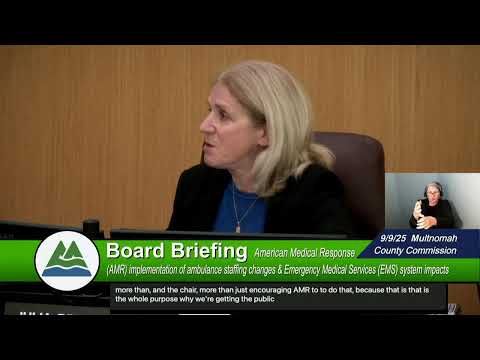
Multnomah County held a public briefing on American Medical Response’s (AMR) implementation of temporary ambulance staffing changes on the morning of the board briefing. County medical staff, AMR leadership and Teamsters Local 223 paramedics described progress in ambulance availability and response times under a mediated settlement agreement, but union members and county medical leaders warned the board that training, clinical quality and safety problems persist and require urgent attention.
The briefing matters because the settlement agreement changed how AMR staffs ambulances to improve response times, and those staffing changes affect clinical care, worker safety and public confidence in emergency medical services across Multnomah County.
County Health Officer Bruno (health officer, Multnomah County) opened the briefing and framed the settlement as a mediated, temporary set of staffing standards meant to restore contract performance. “This agreement…is an instrument designed to realign delivery of this critical public service within the county’s core objectives,” Bruno said. County medical staff described a monitoring framework that focuses both on response times and on quality-of-care metrics such as scene time, IV success and airway management.
Frontline paramedics and EMTs who testified at the dais said that while response times have improved, they face reduced training time, increased stress and what they described as punitive operational oversight. Michael Carlin, a paramedic and Teamsters Local 223 member, said field training officers often attempt to train multiple new hires while treating or transporting patients, making meaningful on-the-job training “nearly impossible.” “Please hold AMR and the policies that guide them accountable,” Carlin said.
Other union witnesses described specific operational and morale problems. Hillary Davis, a Teamsters Local 223 paramedic and preceptor, said “compliance must never come at the expense of safety, training, and the very mission of EMS to provide timely, competent, life‑saving care.” Timothy Mollman, a paramedic and shop steward, told commissioners that ambulance crews are experiencing violence, equipment failures and limited access to critical incident supports. “Private equity’s unquenchable thirst for profit continues to exploit workers,” Mollman said, adding that workers face growing barriers to workers’ compensation and payroll accuracy.
County medical leadership and AMR both showed data documenting improvements and continuing gaps. MCEMS Quality and Improvement Medical Director Matthew Neff summarized the tradeoffs the county has faced: “We traditionally use two paramedics per ambulance for the highest care standard. However, slow response times led to adopting a hybrid staffing model to deploy additional ambulances.” County slides show the target for life‑threatening urban responses is 90 percent compliance; recent monthly data have approached but not yet met that benchmark.
County staff cited increased stakeholder complaints and vehicle incidents as concerning trends. Through mid‑2025 the county reported 18 stakeholder complaints (nearly matching totals for entire prior years) and reported 44 AMR vehicle incidents from January through mid‑July 2025. MCEMS staff said those trends, combined with metric gaps on stroke alerts and trauma scene times, indicate declines in some measures of quality that require corrective action.
AMR regional director Rob McDonald and operations manager Andrew Cherry said they have increased daily ambulance deployment and staffing and invested in recruitment and training programs. Andrew Cherry said Multnomah now averages about 67 ambulances per day in July 2025, up from about 46 in July 2024, and that AMR has increased full‑time paramedic and EMT staffing in its internal counts. AMR described scholarship programs (stated average cost about $18,000 per scholarship) and international recruitment efforts, and said it has invested more than $3.2 million in system enhancements over the last year.
County and AMR presenters acknowledged differences in how staffing and part‑time attrition are counted. MCEMS presented a net loss of nine paramedics on monthly rosters during the settlement interval; AMR reported increases in full‑time paramedics and EMTs but also described attrition among part‑time staff after contractual changes. Commissioners pressed both sides for reconciled datasets and asked for more detailed publicly posted information.
During board questioning, commissioners emphasized retention, accountability and transparency. Commissioner Bridal Edwards asked for a public memo with the maximum non‑confidential detail the county can release; county staff confirmed a fuller public memo would be posted. Commissioners asked for specifics about fines that accrued under the contract (county staff said fines continued to accrue under the settlement but had been abated; staff offered to provide a line‑item breakdown to commissioners). Several commissioners said they would consider work‑session follow‑up to define more precise oversight or conditions tied to any use of abated fines for recruitment or retention.
The briefing closed with MCEMS recommending that the board continue to operate under the settlement agreement’s existing terms while increasing emphasis on training, credentialing, quality improvement and public reporting. Commissioners and county staff said the county will publish a fuller public memo and continue briefings; no board vote was taken at the briefing.
Provenance: MCEMS and AMR supplied each dataset and the county indicated it will publish monthly de‑identified compliance reports. The first transcript remarks introducing the briefing referenced AMR’s staffing changes and system impacts; the final county recommendation to continue the settlement with enhanced training and quality emphasis was stated near the conclusion of the public briefing.
Ending: County staff, AMR and union representatives said they will continue monthly public reporting and further analysis through the ambulance service plan (ASP) reassessment. Commissioners signaled interest in additional oversight or a work session to specify retention benchmarks and measurable quality goals tied to any funds returned or repurposed under the settlement agreement.