Get Full Government Meeting Transcripts, Videos, & Alerts Forever!
Get email alerts on the Workers Compensation topic
No spam. Unsubscribe anytime.
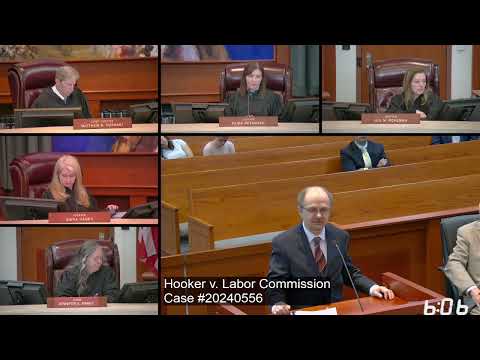
Utah Supreme Court weighs whether Labor Commission may dismiss workers' compensation claims for obstructive behavior
Summary
The Utah Supreme court heard argument on whether the Utah Labor Commission may dismiss workers' compensation claims as a sanction for "obstreperous" or obstructive conduct during discovery and defense medical examinations.
The Utah Supreme court heard argument on whether the Utah Labor Commission may dismiss workers'compensation claims as a sanction for "obstreperous" or obstructive conduct during discovery and defense medical examinations.
The issue was framed by petitioner's counsel as a question of statutory and constitutional limits on the commission's authority: counsel argued that the workers' compensation statute requires adjudication of the merits before dismissal with prejudice and that the statutory scheme and precedent make suspension of benefits the exclusive remedy when a claimant refuses or obstructs a medical examination.
Why it matters: The court's decision could change what administrative sanctions a state agency may impose in workers' compensation proceedings. If dismissal with prejudice is allowed as a discovery sanction in these cases, claimants could lose the substantive hearing on entitlement; if it is unlawful, the Labor Commission's ability to use procedural sanctions under Rule 37 may be constrained.
Argument overview
Stoney Olson, who identified himself as counsel for the petitioner, told the court the certified question presented was whether the Labor Commission "has the authority to dismiss cases as a sanction for obstreperous behavior." Olson argued no, offering three principal points: (1) the commission has no constitutional or statutory authority to dismiss a claim with prejudice as a sanction for obstructive behavior; (2) Utah's workers' compensation statute requires adjudication of the employee's entitlement before a dismissal with prejudice; and (3) the statutory provision addressing refusal to attend medical examinations (discussed at argument as "section 602") prescribes suspension of benefits during the refusal period, and other states' courts have treated similar suspension language as foreclosing dismissal as a sanction. Olson summarized the statutory backdrop as requiring either adjudication on the merits before dismissal with prejudice or application of the statute of repose (12 years) to bar claims.
Olson described the factual core of the certified case as a claimant with complex regional pain syndrome (CRPS) who sought to record an employer-ordered independent medical examination (IME) and later complained of airflow and temperature conditions at a defense IME. Olson told the court that, in the petitioner's view, the IME at issue ended when the examining physician declined to continue and that the record shows the claimant attempted to cooperate and wanted the examination completed.
Mark Sumption, appearing for the respondent (identified as Kroger), countered that the Labor Commission rule that incorporates civil discovery sanctions (Rule 37) applies to defense medical examinations and that dismissal can be an appropriate sanction in administrative proceedings where a party does not cooperate with discovery. Sumption emphasized distinctions between statutory provisions addressing commission-ordered medical panels and the discovery-based IME context, arguing the statute invoked by petitioner is not limited to discovery examinations and does not expressly preclude dismissal with prejudice in all circumstances.
Key factual and legal disputes raised
- Statutory text and scope: Counsel debated the proper reading of provisions the parties referenced at argument. Petitioner relied on language the argument identified as Utah Code section 34A-2-417 (as quoted at argument) and on a separate provision discussed in shorthand during argument as "section 602," which counsel described as mandating suspension of benefits during a refusal or obstruction of medical examination. Counsel for the respondent emphasized that the Labor Commission's rules expressly adopt discovery procedures (including Rule 37 sanctions) and that different statutory subsections govern different types of commission-ordered medical processes (medical panels, commission-ordered examinations, and discovery/defense IMEs).
- Remedy exclusivity: Olson argued the statute's specific suspension remedy for refusals forecloses more punitive sanctions such as dismissal with prejudice; Sumption argued the commission may use sanctioning authority adopted from civil discovery practice because Rule 35/Rule 37-style procedures apply to IMEs under the commission's rules.
- Underlying record and credibility: The case record includes a video of the IME at issue and earlier interactions involving exam scheduling and attempted recordings. The ALJ found the examination room temperature was appropriate (the ALJ noted a temperature above 70 degrees and no airflow near the petitioner), found the claimant not credible on certain points, and concluded there was obstructive behavior that supported sanctioning. Petitioner counsel disputed the ALJ's credibility conclusion and urged the court that the same video evidence is before the court and appellate deference principles may not foreclose reexamination of the factual record when the appellate tribunal has the identical tape evidence.
- Medical specificity and practical issues: Counsel and the justices discussed whether defense IME physicians typically review depositions and written responses beforehand, whether deposition answers can reasonably be used by an IME physician, and how a claimant with a condition such as CRPS can be safely and effectively examined. Petitioner counsel pointed to prior treating physicians who were able to examine the claimant without the same issues and argued that some IME physicians are not trained for CRPS and the record shows attempts to accommodate the claimant (for example, a nurse later turning off air-conditioning after the exam ended).
- Sanctions against counsel and appellate jurisdiction: The appeals board modified the ALJ's sanction order in the record by shifting at least part of the monetary sanction from the claimant to the claimant's attorney. Justices asked whether this court has jurisdiction to review sanctions imposed against an attorney who was not a party to the underlying administrative proceeding; counsel acknowledged the issue and referred to a 2012 case (cited at argument as Utah Down Syndrome Foundation) concerning appealability and sanctions against nonparties.
Questions from the court
Several justices pressed counsel on whether the disputed factual findings (temperature, perceived airflow, and credibility) are entitled to deference as ALJ findings, whether the statutory text specifically limits the commission's remedies to suspension, and whether the commission's rules properly incorporate civil discovery sanctions for IMEs. Justices also asked whether the court would be justified in deciding the statutory interpretation question on the record before it or whether supplemental briefing would assist if the court were inclined to resolve the dispute on the parsing of the relevant statutes and rules.
Disposition
At the close of argument, the court announced it would take the case under advisement. The justices asked whether supplemental briefing would be helpful if the court concluded a statutory/rule distinction (between commission-ordered medical panels and discovery-driven defense IMEs) was dispositive; petitioner counsel said he would anticipate supplemental briefing if the court considered that question central to its disposition.
Implications and next steps
The court's eventual ruling will determine whether the Labor Commission may rely on discovery-style sanctions, up to dismissal with prejudice, against claimants in defense IME contexts or whether the statutory scheme limits the commission to suspending benefits and otherwise requires adjudication on the merits before dismissal with prejudice. The decision will affect litigants in the state's workers' compensation system, labor agencies that adopt discovery procedures, and employers and insurers who rely on IMEs in defending claims.
Ending
The court has taken the issues under advisement and will issue an opinion after internal deliberations (and possibly after ordering supplemental briefing), resolving the certified question about the Labor Commission's authority to dismiss workers' compensation claims as a sanction for obstructive behavior.