Get Full Government Meeting Transcripts, Videos, & Alerts Forever!
Get email alerts on the Sentencing Amelioration Utah topic
No spam. Unsubscribe anytime.
Utah Supreme Court considers whether reduced penalties apply when law changes during appeal
Summary
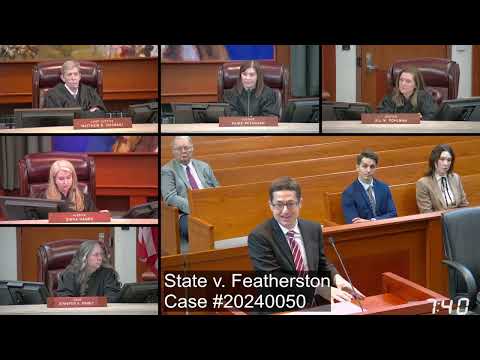
The Utah Supreme Court heard argument in State v. Featherston over whether defendants whose direct appeals are pending should get the benefit of a statutory sentencing reduction enacted while the appeal is unresolved.
The Utah Supreme Court heard argument in State v. Featherston over whether a defendant whose direct appeal is pending is entitled to a reduced sentence when the Legislature reduces the statutory penalty for the offense during the appeal.
Benjamin Miller, arguing for James Featherston, told the court the answer should be yes. Miller said the common-law amelioration doctrine and Utah precedents favor applying a more lenient statutory penalty that takes effect before a case becomes final. "If the sentence is illegal, it's illegal and we should correct it," Miller told the justices, arguing that furnishing the defendant the lower penalty is consistent with the purpose of sentencing and is a lighter remedy than ordering a new trial.
Mark Field, appearing for the State of Utah, said the question is controlled by the state's savings statute. "If a change is made after a defendant is sentenced that reduces the penalty, he's not entitled to it," Field told the court, citing the statutory provision and long-standing precedent that draws the finality line at sentencing in Utah. Field said the statute should be read to govern amendments or repeals that change penalties and that a narrow reading based solely on the word "repeal" would be unduly technical.
The factual background presented to the court was that Featherston was sentenced in March 2018, appealed, and during the pendency of the appeal the Legislature amended the aggravated-kidnapping statute so that unlawful detention no longer carried a first-degree felony penalty in the same form. Miller filed a Rule 22(e) motion seeking the benefit of the reduced punishment; the question before the court is whether that remedy is available when the change occurs after sentencing but before finality of the direct appeal.
Justices questioned both sides about the practical and doctrinal consequences of either approach. Some justices pressed Miller on how amelioration should apply to plea bargains, noting that plea agreements reflect a negotiated exchange reached under the law as it then existed. "People agreed to something knowing what they were all agreeing to," one justice said, asking whether the defendant could now obtain a benefit he did not negotiate. Miller responded that courts in other jurisdictions have applied amelioration equally in plea and trial contexts and cautioned against preserving harsher penalties "for punishment's sake." He also asked the court to distinguish earlier Utah cases, particularly State v. Miller, which cited the savings statute in refusing similar relief but, he said, did not analyze amelioration's common-law roots.
Field and several justices pressed hypothetical consequences if amelioration applied: whether resentencing would require a new sentencing hearing, whether concurrent and consecutive terms would need reexamination, and whether the State could seek to rescind a plea agreement if it lost the bargained sentencing benefit. Field suggested prosecutors could move to rescind plea agreements in appropriate cases and warned that allowing amelioration after sentencing could incentivize strategic delay or complicate district-court sentencing discretion.
Both sides also disputed the proper reading of Utah Code Section 68-3-5 (the state's "savings" statute) and the difference between repeal and amendment. Miller relied on decisions from other states and on common-law principles, while Field urged a pragmatic reading of the savings statute to preserve finality at sentencing. Counsel and justices discussed related authorities cited in briefing, including State v. Miller, State v. Guard, State v. Yates, Smith v. Cook, and other out-of-state decisions that adopt or analyze amelioration and retroactivity doctrines.
The court did not rule from the bench. After argument the justices took the case under advisement.