Get Full Government Meeting Transcripts, Videos, & Alerts Forever!
Get email alerts on the Double Jeopardy Mistrial Legal Necessity topic
No spam. Unsubscribe anytime.
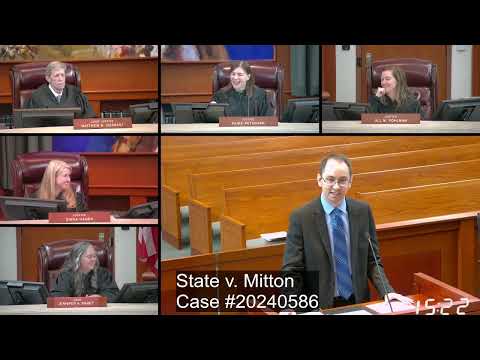
Utah Supreme Court hears arguments over whether opportunity-to-object rule made Court of Appealserror in mistrial double-jeopardy case
Summary
At oral argument the state urged the Utah Supreme Court to reverse a Court of Appeals decision that treated an opportunity-to-object as the dispositive factor in a legal-necessity mistrial review; defense counsel defended the Court of Appeals and stressed record gaps and practical constraints when a trial judge is disqualified mid-trial.
The Utah Supreme Court on oral argument was asked to overturn a Court of Appeals ruling that relied solely on whether parties had an opportunity to object when reviewing whether a midtrial disqualification and resulting mistrial was "legally necessary" for double-jeopardy purposes.
Connor Nelson, counsel for the State of Utah, told the court that "the Court of Appeals broke from this pattern and only considered whether there was an opportunity to object." He asked the justices to "reverse and remand for the Court of Appeals to conduct the court's holistic test." Nelson argued that Utah precedent requires a multifactor, holistic review and that treating a single factor as dispositive was error.
The question centers on how to apply State v. Harris and related Utah decisions such as Ambrose and Manaway when a trial judge is disqualified in the middle of trial and a presiding judge declares a mistrial. Under Utah precedent, the court explained in argument, a mistrial that allows retrial must meet two prongs: (1) the trial judge has carefully evaluated the circumstances and afforded the parties an opportunity to object and propose curative alternatives, and (2) the record must disclose the factual basis for the trial judge—s conclusion and why alternatives were unreasonable. Nelson told the court that "in over 40 years, no necessity case has turned solely on an opportunity to object," and that an absolutist requirement would contradict other legal-necessity principles.
Defense counsel Weymouth Stoddard, representing the appellee (the defendant), urged the high court that it could affirm the Court of Appeals on other grounds or provide clarifying direction but defended the importance of the opportunity-to-object requirement as a core part of the Harris test. Stoddard argued the requirement allows parties to develop the record the appeals court needs to evaluate whether retrial is permissible, and he noted practical consequences in the case record where the motion to disqualify was filed overnight and the presiding judge ruled the next morning.
Several justices asked practical and doctrinal questions. Justice Peterson and Judge Jennifer A. Mabey (Fourth District), sitting by designation to assist the court, focused on whether a defendant could withdraw a motion to disqualify after it was granted and on the logistical reality when no trial judge is available to hear objections. Justice Hagan and others pressed whether a bright-line opportunity-to-object rule would cause undue delay or impose de facto distinctions between cases that could and could not ever be legally necessary.
Counsel for the state and defense both acknowledged unusual facts in the record: the trial judge was disqualified midtrial; the presiding judge issued an order and the jury was dismissed; and the district court took an extended period (counsel referenced "almost 4 and a half months") before resolving some related motions. Defense counsel emphasized that, because the State later filed objections and pursued enhanced charges after retrial, the State and defendant suffered procedural consequences tied to how events unfolded.
Both sides urged the court to avoid a rigid rule that would treat opportunity to object as dispositive in every case. Nelson framed the issue as one of faithful appellate review, saying the Court of Appeals "didn't even consider whether a judge exercised discretion at all" and instead treated the opportunity-to-object factor in isolation. Stoddard emphasized that Harris and Ambrose as currently interpreted require the parties' participation to create a record for review, and he warned against affirming on a basis that would permit post hoc rationalizations lacking contemporaneous input from the parties.
No formal decision was announced at argument. The justices asked follow-up questions about scope of review and whether the Supreme Court should remand for the Court of Appeals to apply clarified standards. Counsel for the state recommended remand so the Court of Appeals could apply guidance; defense counsel said the Supreme Court could affirm on alternative grounds but preserved the argument that the Harris requirements are necessary to protect double-jeopardy rights.
The court took the matter under advisement.