Get Full Government Meeting Transcripts, Videos, & Alerts Forever!
Get email alerts on the Vicarious Liability topic
No spam. Unsubscribe anytime.
Justices probe whether snowmobile ride was within employee’s scope of employment
Summary
The court examined conflicting testimony over whether a Deer Valley employee who gave former coworkers a snowmobile ride on resort property was acting, at least in part, to benefit the employer and therefore within the scope of employment for vicarious-liability purposes.
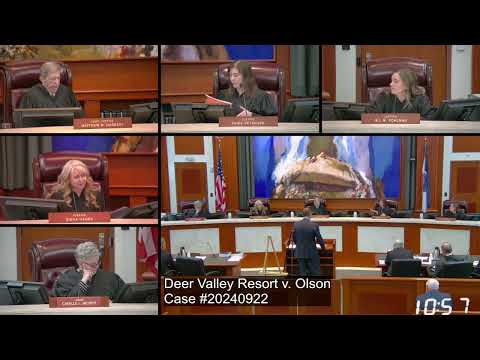
The Utah Supreme Court also considered whether Deer Valley can be held vicariously liable for injuries caused when a resort snowmobile left the trail with two former employees aboard. Plaintiffs argued the driver, Will Flansberg, was acting in a way that benefitted the resort at least in part; Deer Valley argued his conduct was personal, done while evading supervisors and contrary to policy.
Plaintiffs’ counsel Robert Sykes said deposition testimony and context support sending the respondeat-superior claim to a jury. He emphasized Flansberg’s testimony that the passengers were "good employees" and that Flansberg regularly transported people on the mountain — suggesting a jury could find the ride was partly motivated by employer interests. Sykes urged the court to view control, course of conduct, and context collectively.
Deer Valley counsel replied that Flansberg admitted he was "doing something against resort policy" and texted that he would wait until supervisors were not watching before giving the ride. "I knew I was doing something against resort policy and basically just trying to help some friends out," Flansberg’s testimony in the record reads, defense counsel told the court, and that admission pointed to a personal motivation removing the actions from the scope of employment.
The justices questioned whether mixed motives or isolated personal detours should be resolved by a factfinder and cited the court's prior cases requiring careful factbound analysis. Defense and plaintiffs disagreed about which prior decisions govern: counsel for plaintiffs relied on cases holding scope questions are typically for juries when reasonable minds may differ; defense counsel cited authorities that exclude acts clearly motivated by personal reasons or taken while evading supervision.
Why it matters: If the court finds a triable issue of fact about whether the ride was in part to benefit Deer Valley, the respondeat-superior claim survives to a jury; if the court finds Flansberg’s testimony shows purely personal motivation and deliberate evasion of control, the claim may fail as a matter of law.
The court recessed without announcing a decision after extended questioning of counsel.