Get Full Government Meeting Transcripts, Videos, & Alerts Forever!
Get email alerts on the Right To Hunt Utah topic
No spam. Unsubscribe anytime.
Utah Supreme Court hears challenge to HB 469 and scope of constitutional "right to hunt and fish"
Summary
The Utah Supreme Court heard arguments over whether 2023's House Bill 469, which repealed most statutory regulations governing cougar hunting, violates Article I, Section 30 of the Utah Constitution by undermining a voter-adopted preservation mandate and whether conservation groups have standing to sue.
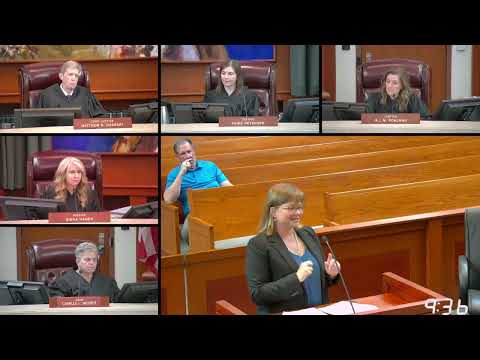
At oral argument before the Utah Supreme Court, counsel for the Mountain Lion Foundation and Western Wildlife Conservancy asked the court to reverse a district-court dismissal of their challenge to House Bill 469, arguing the 2020 constitutional amendment guaranteeing a ‘‘right to hunt and fish’’ includes a preservation mandate that bars statutes that do not promote wildlife conservation or preserve hunting for future generations.
Jessica Bloom, counsel for the appellants, told the court that the 2020 amendment must be read to protect not only an individual's right to hunt but also the availability of game and habitat needed "to forever preserve wildlife in the state ... for the public good." Bloom said HB 469 repealed nearly all statutory and regulatory controls over cougar hunting and resulted in "the unlimited and nearly unregulated year-round killing of cougars in the state of Utah from January 1 to December 31," an outcome she argued is inconsistent with the constitutional preservation and conservation provisions. Bloom said her clients alleged in the complaint that the statutory change and the Wildlife Resources Board's implementing actions likely would "result in the extirpation of mountain lions from the state or at least significantly diminish the availability of mountain lions in the state for hunters or for conservationists to observe or study."
The state, represented by Sarah Goldberg, countered that the conservation organizations lack standing because they "are interested in protecting cougars, not hunting them," and that the constitutional right protects hunters, not a freestanding public right to conserve particular species. Goldberg argued the amendment "does not mandate conservation or the protection of any specific species" and that the dispute raises nonjusticiable political questions about wildlife management. She also relied on the ballot pamphlet language and the amendment's subsection structure to argue the subsection containing the a–b–c factors applies to the right to use traditional methods of hunting and fishing rather than creating a broad species-conservation duty.
Justices pressed both sides on multiple points: whether the phrase "shall be forever preserved for the public good" modifies the individual right or requires preservation of species and habitat; whether subsection 2's three factors (promote wildlife conservation and management; provide reasonable regulation; preserve the future of hunting and fishing) operate conjunctively with subsection 1; and whether the plaintiffs, as conservation organizations rather than hunters, can satisfy associational or third-party standing requirements. One justice asked, "What noun is the object of the phrase 'shall be forever preserved for the public good'?" to clarify whether the amendment protects the right itself or the availability of species to exercise that right.
Bloom relied on out-of-state authority and the ballot pamphlet to argue that the preservation language was intended to ensure meaningful future hunting opportunities and that the district court erred by dismissing the case at the motion-to-dismiss stage before plaintiffs could take discovery and produce member affidavits. Bloom pointed to legislative changes (discussed in argument as "SB 203") that altered Utah standing law and said the organizations stand ready to identify members who would satisfy associational-standing requirements if the court requires them to do so.
Goldberg replied that even if the court were to accept a reading that the amendment incorporates conservation considerations, the proper plaintiffs to enforce a right tied to the availability of hunting would be actual or prospective hunters. Goldberg said, "Even if we assumed ... the right to hunt includes ... availability of hunting, I take it your argument is that it's still hunters or future hunters that would be the ones who could assert that right." She also argued the relief sought would entangle courts in scientific and policy questions about species management and quotas that are committed to the political branches and agency expertise.
Both sides and several justices discussed hypothetical scenarios to probe the scope of the right (for example, whether a law that expanded hunting to remove seasons and bag limits could be challenged under the amendment) and how courts should evaluate facial and as-applied challenges. Bloom described the plaintiffs' two-pronged claim: a facial challenge arguing HB 469 cannot, on its face, satisfy the subsection 2 standards, and an as-applied challenge arguing the Board's implementation violated those standards without scientific analysis. Goldberg emphasized standing and political-question limits and urged affirmance of the district court.
The court took the case under advisement and adjourned oral argument. The parties and several justices identified factual and procedural steps that would follow if the case were remanded—for example, discovery to develop evidentiary support about legislative intent and population impacts, summary-judgment briefing, and potential administrative-review components if agency decisions are implicated.