Get Full Government Meeting Transcripts, Videos, & Alerts Forever!
Get email alerts on the Child Welfare Termination topic
No spam. Unsubscribe anytime.
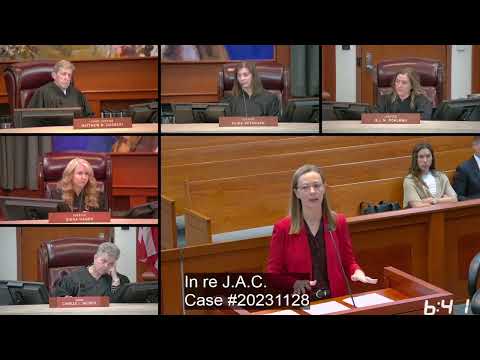
Utah high court hears dispute over due process, counsel and jurisdiction in child-termination appeal
Summary
At oral argument in the appeal of a parental-termination case, attorneys debated whether a mother’s lack of counsel and missed court notice while abroad amount to structural due-process error and whether the Supreme Court can reach orders from two prior termination proceedings.
The Utah Supreme Court on Wednesday heard arguments over whether a mother’s due-process rights were violated in juvenile-court proceedings that led to termination of her parental rights, and whether the high court has jurisdiction to review orders from two prior termination proceedings.
Alexander Marshall, counsel for the mother, told the court that “every one of mother’s due process rights were violated in this case,” saying the mother was excused from early hearings while she was abroad in Turkey, was not notified of the shelter hearing that led to removal of the children, and went unrepresented through critical stages until counsel was appointed in February 2021. Marshall asked the court to treat the errors as structural and to reverse the termination back to the point of disposition so the mother could be given an opportunity to reunify.
The argument focused on three overlapping questions: what adverse findings were entered while the mother was out of the country and unrepresented; whether those procedural defects created irreparable prejudice requiring a structural-error remedy; and whether this court has jurisdiction to review orders that originated in an earlier termination proceeding and a later remand and retrial.
Marshall described a sequence in which the mother was excused from a preliminary hearing, later learned of the children’s removal by phone, filed multiple affidavits seeking appointed counsel, and was not assigned a lawyer until about 18 months later. Counsel said the juvenile court treated the case as if the mother were on a nonreunification track even though a dispositional order had, on paper, listed reunification as the case goal. "That default adjudication of neglect," Marshall told the court, "forms a ground for termination and handed half of the termination argument to the state." He explained that the COVID-19 pandemic both restricted travel and shifted services online, making virtual participation possible if the court or child-welfare agency had provided notice and links.
The Assistant Attorney General, John Peterson, acknowledged the proceedings were "anomalous," but urged the court to view the underlying facts and the mother’s broader history before concluding the procedural defects required reversal. "These are children who, truthfully, at both removals in 2015 and 2019, were practically feral," Peterson said, characterizing expert and foster-parent testimony the state relied on to show longstanding neglect and the children's developmental delays. Peterson told the court that even if counsel had been assigned earlier, it's speculative to say the outcome would have been different.
Martha Pierce, guardian ad litem for the children, argued the Supreme Court’s jurisdiction is limited and that the only final order properly before the court is the most recent termination order. Pierce urged that if appellants wanted to contest earlier adjudication or disposition orders, they should have raised those issues at trial or by timely appeal or a timely Rule 60(b) motion. She warned the court against resolving disputed factual questions or creating new procedural remedies on appeal when the trial record has not been developed.
A central procedural dispute at argument was whether the Court of Appeals and the juvenile court's subsequent handling of a barely-misdirected or late notice of appeal and a later reentry of orders created a jurisdictional pathway for the high court to review the whole sequence. Counsel for the mother urged a Manning-style equitable remedy (referring to the criminal-law precedent allowing a late appeal in certain circumstances) and pointed to Appellate Rule 52(d) and Rule 60(b) motions that had been used to reinstate appeal rights. The guardian and the state disputed that approach, saying the proper appellate rules and finality principles limit the reach of this court.
Justices’ questioning probed whether the errors were preserved, whether counsel’s later objections and closing arguments were timely to preserve plain-error review, and what practical relief the Supreme Court could order if it found structural error. Marshall acknowledged the remedy would likely send the case back to juvenile court for further dispositional determinations, including whether to restore reunification services and to give the mother a fresh opportunity to comply with a reunification plan.
The parties also discussed practical details in the record: the children were removed in late 2019 (the transcript places a removal in October with the mother learning in November); the COVID-19 pandemic began in March 2020; counsel was reportedly appointed in February 2021; there was an earlier termination order (2021) later followed by a 2023 order after a remand; the children’s placement was at one point in Tennessee; and the mother had previously been involved in related proceedings around 2015 and 2019.
The court took the case under advisement after roughly an hour of argument and asked for no further briefing in the hearing. How the Supreme Court resolves the intertwined jurisdictional and due-process issues will determine whether the mother’s claims of structural error and extensive prejudice result in vacating the termination order, a limited remand for specific findings, or denial of relief based on finality and the trial record’s development.