Get Full Government Meeting Transcripts, Videos, & Alerts Forever!
Get email alerts on the Employment Releases topic
No spam. Unsubscribe anytime.
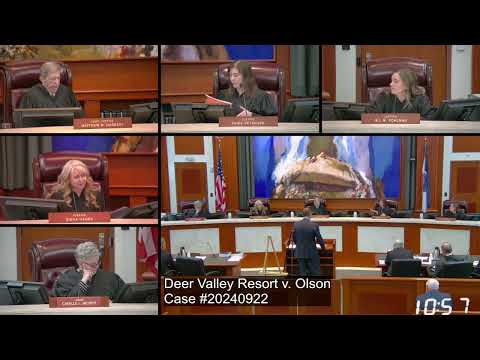
Utah Supreme Court hears dispute over Deer Valley employee release and scope of Pugmire
Summary
At oral argument, parties disputed whether a pre-injury release Deer Valley required employees to sign can be enforced after employment ends and whether the century-old Pugmire precedent still blocks employer–employee releases or has been superseded by the Workers' Compensation Act.
The Utah Supreme Court heard arguments over whether a pre-injury release used by Deer Valley Ski Resort can bar two former employees from suing after a March 17, 2020 accident. Counsel for Deer Valley said the release applies to injuries outside the course and scope of employment and should be enforced; counsel for the plaintiffs said the release is void under this court's Pugmire precedent and is unconscionable or otherwise unenforceable in any event.
The case turns on long-standing public-policy questions about releases between employers and employees, and the court questioned whether Pugmire v. Short Line Railroad — an older Utah decision barring employer–employee releases of employer negligence — should be read as limited to workplace injuries that modern workers' compensation law now governs.
Deer Valley attorney Adam Straumann told the court the resort’s season-pass and employee-privileges release covers non–work-related injuries and remains effective even after employment ends in many cases. "The release is effective as to this accident," Straumann said, arguing the plaintiffs had been terminated two days before the accident and were not acting in the course of employment at the time.
Plaintiffs’ counsel Mark Taylor and Robert Sykes urged the court to treat the release as an employer–employee contract made under unequal bargaining power and to apply Pugmire’s public-policy bar. "A master cannot, by contract in advance, absolve himself from liability which would exist if no contract were made," a justice read aloud from Pugmire during questioning, reflecting the line of inquiry the court pursued.
Counsel for Deer Valley and amici (including the National Ski Areas Association and Ski Utah) described the release as industry-standard and argued that the Legislature's workers' compensation scheme (cited during argument by reference to statutes in the 34A series) largely occupies the field of workplace-injury remedies. Plaintiffs countered that the particular Deer Valley release is broad, runs in perpetuity unless revoked in writing, and contains provisions they say are ambiguous, one-sided, and substantively unconscionable.
The court also debated remedies: whether severing any workers'-compensation–related waiver language would leave the rest of the release enforceable, a point Deer Valley urged based on the contract's severability clause and Utah precedent cited by defense counsel. Plaintiffs urged the court either to invalidate the release entirely or to send the contract-level challenges back to the trial court for findings on unconscionability, lack of clear notice, and the factual record about whether the pass privileges in fact survived the employees' termination on March 15, 2020.
Why it matters: The justices signaled concern about the practical consequences for the ski industry if Pugmire is read broadly or narrowed, and about unresolved factual questions about whether the release truly continued to provide consideration after the plaintiffs’ termination. The court also pressed whether Pugmire remains good law or is limited by the Workers' Compensation Act for workplace injuries.
The court paused the argument after extended questioning and moved next to related vicarious-liability issues. The justices did not announce a ruling at argument.