Get Full Government Meeting Transcripts, Videos, & Alerts Forever!
Get email alerts on the Infrastructure Facility Siting topic
No spam. Unsubscribe anytime.
Rapid City committee weighs rebuilding on Steele Avenue vs. new campus at Black Hills Industrial Park
Summary
The Rapid City Public Works Committee on Sept. 9 reviewed two site options for a new streets and maintenance campus and asked staff and legal and finance liaisons to develop funding and design steps. The committee voted to acknowledge the presentation.
The Rapid City Public Works Committee on Sept. 9 reviewed two site options for a new streets and maintenance campus and asked staff and legal and finance liaisons to develop funding and design steps. The committee voted to acknowledge the presentation.
City staff presented the comparison as a choice between rebuilding or substantially upgrading the current Steele Avenue site and acquiring and building on about 25 acres in the Black Hills Industrial Park. "To build what is needed for the community out, for about 5 or 10 years beyond our current situation, the approximate construction cost would be about $36.5 million," said Daniel, Public Works staff, who presented the analysis. He said the Steele Avenue option would allow reuse of two existing buildings, including a utility maintenance building constructed in 2015 that staff estimates would cost about $11 million to replace.
The staff analysis said the Steele Avenue site is centrally located and contains existing investments — including more than $22 million in site paving and fencing — but has constrained circulation and limited room for expansion. By contrast, the Black Hills Industrial Park site would provide more land and room to design circulation and future expansion but at a higher price. "When you start looking at the cost of the new facility there, the project cost would exceed $65,000,000," Daniel said; later in the presentation he cited an estimated project cost of $72,500,000 for the Black Hills Industrial Park option.
Staff outlined estimated financing scenarios. A 25-year bond for the $36.5 million Steele Avenue project would carry annual payments of about $2.3 million, while the roughly $72.5 million project would have annual payments just under $4.6 million, Daniel said. Staff identified two potential funding sources for bond repayment: the city's capital improvement program (CIP) fund or the Vision Fund. "Knowing that our CIP fund is already fairly constrained ... it probably doesn't make sense that we would tie up CIP funds. So then the other potential use would be the Vision Fund," Daniel said. He said staying at Steele Avenue would leave about $13.5 million available in the current Vision Fund cycle for other projects, and that the Vision Fund is expected to generate roughly $10.4 million to $12 million per year in future rounds, noting other Vision Fund commitments including Summit Arena bond repayment.
Staff also described potential tax-payer savings available by performing some work in-house if the city remained on Steele Avenue. "All of that together at the Steele Avenue site, we believe that we would be able to save the taxpayers about $3,000,000 if we were to stay at that location," Daniel said. He added that a phased approach to building a new campus — starting with part of the campus and keeping Steele Avenue in service during construction — was discussed but not costed; he said phasing typically increases total construction costs compared with building all facilities at once.
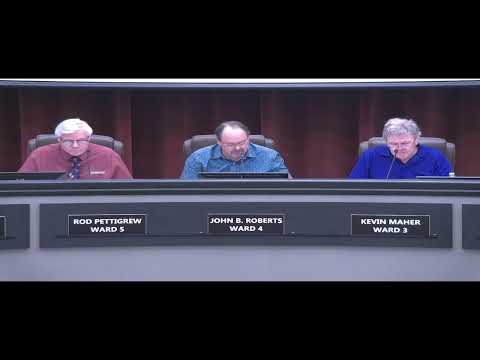
Committee members pressed on several topics. Kevin asked whether staff had considered a dual campus or phased approach; Daniel said a phased approach was possible but usually raises total cost due to inflation and loss of economies of scale. Committee member Rod said he supported the industrial-park option as long-term planning despite the higher upfront cost. Committee member Kelly asked for the assessed value of the Steele Avenue property; Daniel said there is an assessed value but he did not have the figure in the meeting and would provide it later.
The committee chair asked whether utility funds included in recent water rate increases could be used toward the project; Daniel said the $80 million referenced in prior rate actions had been intended for a lab and utility maintenance facilities and that staff would examine operational uses of those funds and possible economies of scale if functions were consolidated at a new campus. Daniel told the committee there were no explicit limitations on location for those utility funds and staff would explore options.
After roughly an hour of discussion, the committee moved and seconded a motion to "acknowledge" the presentation; the chair called for the vote and the motion passed. The presenter asked for direction to proceed toward hiring a designer and developing bonding and funding mechanisms if the committee wished to pursue the Black Hills Industrial Park or another new site.
The committee did not adopt a final site or specific financing plan at the meeting. Staff characterized the internal analysis as prepared quickly with participation from Public Works and Planning staff and requested further direction from the committee and from legal and finance staff to proceed with design and funding steps.
Next steps noted in the meeting record: staff to provide the assessed value of the Steele Avenue parcel, to continue detailed cost and phasing analysis, and to work with legal and finance on bonding options and potential use of Vision Fund and utility-related funds.