Poudre School District presents enrollment survey results, ‘Choose PSD’ marketing campaign and five‑year projections showing projected decline
Loading...
Summary
Poudre School District officials presented survey results, a new marketing campaign and a movement analysis with five‑year projections that the district said will guide staffing and budgeting.
Poudre School District officials presented the results of a districtwide enrollment survey, outlined a district marketing effort called Choose PSD and released a movement analysis and five‑year enrollment projections at the Sept. 9, 2025, Board of Education meeting. District leaders said the work is intended to guide staffing, budgeting and community outreach.
The enrollment survey ran Jan. 13–26, 2025. Dr. Duane Schmitz, the district’s chief institutional effectiveness officer, told the board the survey gathered 802 elementary, 424 middle and 378 high‑school family responses and that the district treats the results as perception data — a sample, not a census. “It occurred, last spring, early spring, so January 13 to January 26,” Schmitz said, describing the survey window.
District staff said three themes emerged across grade bands: elementary families prioritize proximity and capable programming, middle‑school families emphasize belonging, and high‑school families focus on future‑readiness (dual enrollment, career and technical opportunities and extracurriculars). The survey also flagged safety and behavior, mental health and supports for students with special needs as community priorities.
The district has used survey findings to shape the Choose PSD marketing campaign, launched in March 2025. Dr. Lauren Hooten, chief of staff, described the campaign as a mix of districtwide and campus‑specific outreach to current and prospective families, non‑English speakers and secondary audiences such as taxpayers and local businesses. “We are really striving to continue to reinforce that PSD is the top choice for pre k 12 education in Northern Colorado,” Hooten said.
Staff provided advertising metrics and outreach counts: the district’s Meta (Facebook/Instagram) buys reached roughly 700,000 audience members with nearly 800,000 impressions and about 23,000 clicks (a 2.9% click‑through rate), the Google Display Network delivered roughly 500,000 impressions (CTR about 0.1%), and district Spanish‑language ads showed measurable engagement. Physical outreach included two months of billboards (about 90,060 weekly impressions), a Valpak mailer to about 20,000 households, a kindergarten mailer to about 6,000 residential addresses, and a Choose PSD mailer to about 9,900 households with school‑age children. Staff also said they are placing QR‑coded banners and doing on‑the‑ground events such as Hero Fest and Treatsylvania.
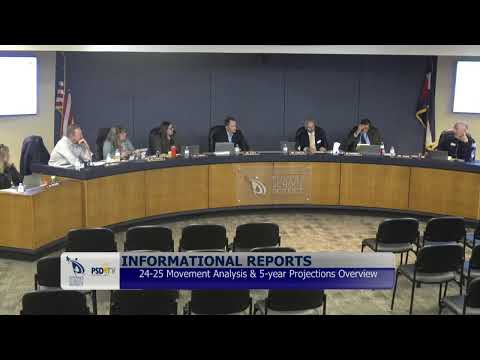
Separately, Chief Technology Officer Bud Hunt and the district data team presented a movement analysis and the five‑year projection the district will use for budgeting. Hunt said movement analysis (who chooses in and out of district and between district schools) is based on October count data and that the team distinguishes historical facts from modeled projections. “A 5 year projection is a lot like driving at night,” Hunt said, noting that accuracy decreases with time but that one‑year projections are stronger.
Key numbers shared by staff: the district’s October count baseline for 2024 was about 25,509 students; the projection used for budgeting estimates roughly 23,050 students by school year 2028–29 (a projected decline of several thousand students districtwide over five years). The movement analysis showed a long‑term net choice‑out trend (more families choosing non‑PSD public options or online providers than choosing into PSD from outside the boundaries in recent years), and the district recorded a net choice‑out of 739 students in the latest historical year.
Hunt outlined the projection methodology the team uses, including cohort‑survival modeling, birth‑rate and county demography inputs, housing growth data and historical choice trends. He said the team aims for conservative (slightly under) enrollment estimates to avoid overcommitting budgets. He also shared the team’s historical accuracy: excluding the COVID years, their projections have been within about 1% on average over the last decade.
Board members and staff discussed the survey’s sample size and representativeness: Schmitz and Hooten said the survey is one source of voice that should be triangulated with focus groups, advisory committees and other engagement work. Several board members asked staff to produce a concise, public “playbook” showing the data sources and modeling assumptions used to create projections and to surface where families are choosing programs and why.
District staff said next steps include continued community engagement, targeted focus groups (including groups the district may hear from less often), and regular updates to the board as the team refines projections and ties them to budgeting and facility planning.
Ending — Board follow‑up and transparency plans
Board members requested additional, publicly shareable materials showing the inputs and assumptions behind the projections (county demography, birth data, housing pipelines, October count definitions, and choice matrices by neighborhood and school). Staff agreed to provide those materials and to continue refining outreach and focus‑group strategies to better represent families who were less likely to complete the survey.