Get Full Government Meeting Transcripts, Videos, & Alerts Forever!
Get email alerts on the School Finance topic
No spam. Unsubscribe anytime.
Chambersburg Area SD officials say schools plan cost estimates rose; board to consider small bond issue as first financing step
Summary
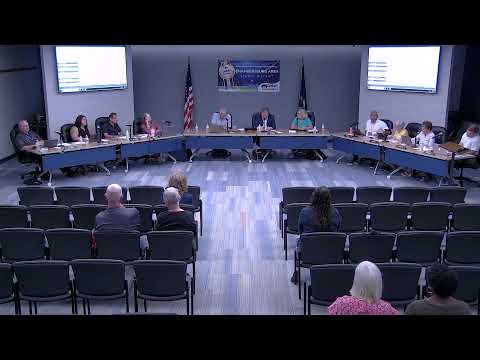
Board President Norcross told attendees that cost estimates for the district's "Schools of Distinction" initiative have risen from figures he previously cited, and district finance staff presented a multi-step funding scenario that would begin with a bank-qualified borrowing this year.
Board President Norcross told attendees that cost estimates for the district's "Schools of Distinction" initiative have risen from figures he previously cited, and district finance staff presented a multi-step funding scenario that would begin with a bank-qualified borrowing this year.
The most newsworthy point from the meeting: "that number has changed. That number right now ... we're at 270,000,000 as the low estimate, and 290 as a high estimate," Board President Norcross said. He acknowledged prior public statements that cited $240 million and said, "I apologize that my 240,000,000 comment ... was dead wrong." The board's financial adviser said the district should pursue a limited, bank-qualified bond this calendar year and return in October with the legal resolution needed to proceed.
The presentation laid out why the board and administration say they can pursue the projects but will need a combination of borrowing, dedicated transfers and possible use of reserves. Tammy Stauffer, presenting district financial indicators and the draft funding scenario, said the district's assessed-value growth and earned-income-tax (EIT) revenues have strengthened recently, and the district's assigned fund balance is larger than it was before 2020. She said the district's remaining borrowing capacity is about $274 million.
John Fry, the district's municipal finance adviser, told the board the recommended first-step financing would be sized to remain below $10 million in calendar-year tax-exempt obligations so it qualifies as "bank-qualified." Fry said the district could structure this initial borrowing at roughly $6.6 million net (after accounting for recent tax-exempt leases that count against the bank-qualified cap). He described the timetable: the board would adopt a parameters bond resolution at its Oct. 28 meeting, the underwriter (Raymond James) would be engaged in a negotiated sale in early November, pricing would be locked after that and the bonds would settle in December so project funds would be available.
Stauffer and Fry presented the draft multi-step plan in the context of three major projects the district has discussed: a new Green Village elementary, an intermediate (4'06) school, and a reconstructed middle school. Stauffer said the set of projects on the low end has draft estimates in the range shown to the board and that, under the current scenario, the district's funding plan would deliver about $231 million in project funds (including about $4.6 million of interest earnings on borrowed funds) and would still leave a financing gap of roughly $17 million compared with higher estimates.
Board members and staff discussed options to close that gap: additional borrowing, using capital reserves (Stauffer said the district has about $16.5 million in a cap reserve), committing additional annual transfers into debt service (Stauffer described a budgeting assumption of $7.5 million of extra debt service funding in the 2025 budget and suggested adding $2 million per year through 2029'30), and slowing project timing to allow debt capacity to grow. The presenters noted that a continuation of the governor's proposed state "adequacy" payments (an additional state aid proposal referenced by staff, not yet enacted) would materially improve the district's ability to fund the projects without additional tax increases.
Public comment addressed affordability and district expenditures. One audience member, identified in the record as Mrs. Jordan, urged the board to scrutinize district vendor and charter payments and said taxpayers would feel the impact of any increase. Several board members asked for more granular scenarios (examples shown for $217 million and $240 million borrowings) so they could compare tax impacts, timing and years of incremental tax increases.
Fry also noted market context: municipal long-term yields were roughly unchanged since April and the market has already priced in a likely federal funds rate cut; that context supports moving forward with a limited financing now to preserve flexibility and financing advantages tied to bank-qualified status.
The board did not adopt a bond resolution during this meeting. Fry and staff said the formal board vote to adopt a parameters bond resolution would be scheduled for the Oct. 28 meeting; if approved, the negotiated sale would follow and settlement would occur in December.
Ending: The board and staff said they will return with more detailed tax-impact scenarios and requested analyses of operating cost savings tied to the proposed grade reconfiguration. Staff will also provide Moody's/credit-rating materials and further refinement of the multi-step financing plan before the October vote.