Get Full Government Meeting Transcripts, Videos, & Alerts Forever!
Get email alerts on the Lmf Finances topic
No spam. Unsubscribe anytime.
Land for Maine’s Future staff report funds available but most are earmarked for projects
Summary
Land for Maine's Future staff told the board that while bank balances appear high, most funds are encumbered by earmarks and set‑asides; working farmland currently has no unencumbered dollars for new grants.
Land for Maine’s Future staff reported to the board on Aug. 28 that while the program’s bank balances total roughly $40 million plus accumulated interest, most of those funds are earmarked for existing projects and set‑asides, leaving limited cash available for new grants.
"Working farmland, we have no dollars available to spend at the moment," said Laura Graham, director of Land for Maine’s Future, noting that recent appraisal results and other adjustments make the C & R (conservation and recreation) number a bit "jumpy." Graham said the fund had received an infusion of $173,009.85 in interest but that earmarks and outstanding commitments reduce what is truly available to allocate.
Graham walked the board through two views of the accounts: a bank‑balance perspective that shows cash on hand, and a second, earmark‑adjusted view that shows net funds available after set‑asides and allocations. She told the board that about $12 million of the bank balance is already committed to projects underway and that the $13 million showing in the account does not equal $13 million free to spend.
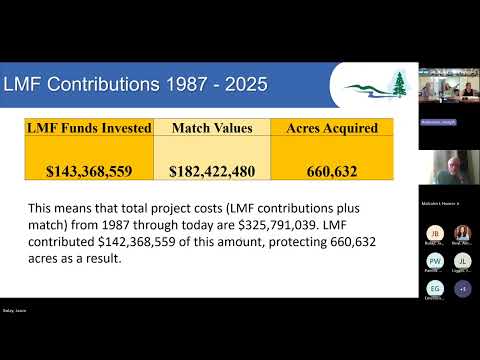
The director also reported program totals dating back to the program’s start: LMF’s direct contributions to projects total about $143.4 million to date, producing total project costs and matching funds of about $325.0 million, and protecting roughly 660,632 acres overall. Graham said the figures incorporate long time horizons and inflation adjustments, which complicate per‑acre comparisons.
Board discussion emphasized caution in how the program presents historical and inflation‑adjusted numbers publicly. One board member said the program’s totals and per‑acre calculations could be taken up in legislative testimony, while others said maps showing where conservation has occurred help explain why values and priorities vary across the state.
Graham and staff said they had added earned interest into the displayed totals and adjusted for memoranda of understanding (MOUs) that reserve funds for partner projects. She told the board that she had placed remaining interest into CNR (conservation and recreation) temporarily so members could see net values, but that the $361,981 so allocated had not been formally committed.
The presentation closed with staff describing the data sources used (biannual reports and internal reconciliations) and a reminder that some historical set‑asides are difficult to trace to the original records. Board members thanked staff for the visuals and asked for continued work to make the charts and tables more comprehensible for the public and for legislative use.
The board did not take formal action on the finance slides at this meeting; the discussion served as an update and context for upcoming project decisions.