Get Full Government Meeting Transcripts, Videos, & Alerts Forever!
Council directs staff to revise adaptive‑reuse ordinance, asks carve‑out for Central Business District inclusionary rule
Summary
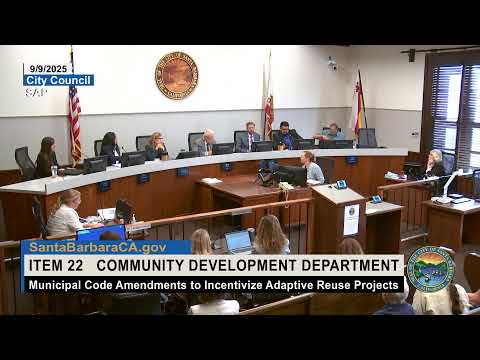
After hours of public comment and debate, the Santa Barbara City Council voted 5–2 to direct staff to return with a revised adaptive‑reuse ordinance that removes the citywide inclusionary requirement in the Central Business District and proposes a unit‑cap; staff will also use its recommended maximum average unit sizes for rental and ownership.
The Santa Barbara City Council on Sept. 9 directed staff to return with a revised adaptive‑reuse ordinance that would exempt the Central Business District (CBD) from the city’s 10% inclusionary housing requirement and provide a recommended cap on the size of projects that would qualify for the carve‑out.
The motion, made by Councilmember Freeman and seconded by Councilmember Jordan, passed 5–2. Councilmembers Santa Maria and Sneddon voted no.
The proposed ordinance, presented by Dana Folk, long‑range project planner in the Community Development Department, would allow conversion of existing nonresidential buildings to housing across inland areas of the city where multiunit residential use is allowed and would give qualifying projects four by‑right incentives: no maximum residential density, relaxed open‑yard rules, adjusted vehicle‑parking requirements and setback flexibility. Staff said conversions must fit within an existing building shell, generally limit new hotel uses, and meet minimum unit sizes and inclusionary obligations unless a geographic exemption applies.
Why it matters: the ordinance is the city’s primary tool to encourage housing inside existing downtown and corridor buildings — spaces that commercial markets currently underuse. Proponents said the incentives and streamlined review can catalyze housing production and downtown revitalization; opponents warned that removing inclusionary requirements risks producing…
Already have an account? Log in
Subscribe to keep reading
Unlock the rest of this article — and every article on Citizen Portal.
- Unlimited articles
- AI-powered breakdowns of topics, speakers, decisions, and budgets
- Instant alerts when your location has a new meeting
- Follow topics and more locations
- 1,000 AI Insights / month, plus AI Chat