Get Full Government Meeting Transcripts, Videos, & Alerts Forever!
Get email alerts on the Adaptive Reuse topic
No spam. Unsubscribe anytime.
Council directs staff to revise adaptive‑reuse ordinance, asks carve‑out for Central Business District inclusionary rule
Summary
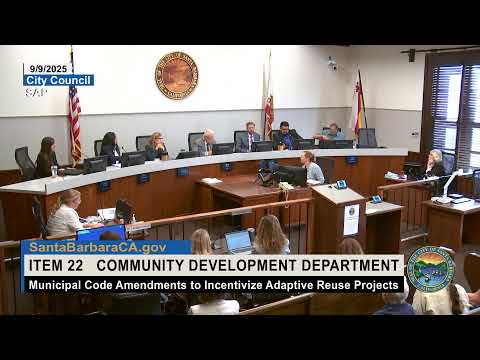
After hours of public comment and debate, the Santa Barbara City Council voted 5–2 to direct staff to return with a revised adaptive‑reuse ordinance that removes the citywide inclusionary requirement in the Central Business District and proposes a unit‑cap; staff will also use its recommended maximum average unit sizes for rental and ownership.
The Santa Barbara City Council on Sept. 9 directed staff to return with a revised adaptive‑reuse ordinance that would exempt the Central Business District (CBD) from the city’s 10% inclusionary housing requirement and provide a recommended cap on the size of projects that would qualify for the carve‑out.
The motion, made by Councilmember Freeman and seconded by Councilmember Jordan, passed 5–2. Councilmembers Santa Maria and Sneddon voted no.
The proposed ordinance, presented by Dana Folk, long‑range project planner in the Community Development Department, would allow conversion of existing nonresidential buildings to housing across inland areas of the city where multiunit residential use is allowed and would give qualifying projects four by‑right incentives: no maximum residential density, relaxed open‑yard rules, adjusted vehicle‑parking requirements and setback flexibility. Staff said conversions must fit within an existing building shell, generally limit new hotel uses, and meet minimum unit sizes and inclusionary obligations unless a geographic exemption applies.
Why it matters: the ordinance is the city’s primary tool to encourage housing inside existing downtown and corridor buildings — spaces that commercial markets currently underuse. Proponents said the incentives and streamlined review can catalyze housing production and downtown revitalization; opponents warned that removing inclusionary requirements risks producing market‑rate units without affordable workforce housing.
Staff presentation and legal review
Dana Folk told council the ordinance implements Program 1 of the 2023–2031 Housing Element and is intended to speed conversions of older commercial or office buildings into housing. Folk said staff completed environmental review and determined the ordinance is exempt from further review under the CEQA Guidelines’ general rule (CEQA Guidelines §15061(b)(3)). The proposed municipal code change would add a new Section 30.1850.045 to Title 30 to govern adaptive reuse projects.
Folk described the principal incentives: elimination of a site maximum density in favor of an allowable maximum average unit size, modified open‑yard and parking rules, and a possible path to building‑permit review rather than discretionary land‑use hearings for projects that do not change exteriors. She said the Planning Commission recommended smaller average unit sizes than staff proposed; staff’s recommendation is a 1,200‑square‑foot maximum average for rental projects and 2,000 square feet for ownership projects.
Public comment and council debate
More than a dozen members of the public spoke during the item. Developers and downtown business advocates said the inclusionary obligation would deter conversions in financially thin downtown projects. Ben Romo (developer) told the council the downtown market is “the most complex, place to build,” and argued that “the financial margins are very, very thin on these projects.” Cody Sargent, representing the Coastal Housing Coalition, warned that “10% of zero units is still zero” if the requirement discourages conversions.
Housing advocates and community groups urged retaining the 10% moderate‑income requirement or at least a meaningful in‑lieu fee. Lisa Carlos, a Housing Authority commissioner, said: "What doesn't make sense is eliminating our very modest inclusionary housing requirement. We're only asking for 10% affordability at the moderate income level." Anna Arcey of CAUSE and other speakers likewise urged keeping affordability requirements and ensuring any in‑lieu fee is large enough to fund housing.
Council members framed the issue as a balance between housing production and downtown economic revitalization. Councilmember Jordan said the downtown conversion program functions as an economic development tool as much as a housing initiative and urged flexibility to get projects moving. Councilmember Sneddon and Councilmember Santa Maria expressed concern about losing the inclusionary requirement and the long‑term implications for workforce housing.
Council action and next steps
Councilmember Freeman moved — and Councilmember Jordan seconded — a motion directing staff to return with an ordinance for introduction that (a) removes the CBD from the adaptive‑reuse inclusionary requirement, (b) includes a recommended project‑size cap for that exemption, (c) adopts staff’s recommended maximum average unit sizes (1,200 sq ft rental; 2,000 sq ft ownership) rather than the Planning Commission’s smaller sizes, and (d) asks staff to analyze ownership (for‑sale) inclusionary implications in its return package. The motion passed 5–2; Santa Maria and Sneddon dissented.
Staff told council the revised ordinance would be returned for introduction (a single reading) and, if introduced, later scheduled for adoption. Folk said the city’s inclusionary study (examining in‑lieu fee levels and feasibility) remains pending and will be part of follow‑up discussions.
Opposition and legal questions
Speakers and several council members flagged potential tradeoffs: developers argued that hotels can still be achieved via other processes without inclusionary obligations, reducing the incentive to choose housing unless the downtown rules are competitive; several council members worried that carving out the CBD now could be difficult to restore later. Staff cautioned there is some legal uncertainty about adding inclusionary requirements later, and directed the council that staff would provide analysis and potential ordinance language when they return.
The council directed staff to draft the revised ordinance for introduction and to include a recommended unit‑cap and the staff‑recommended average unit sizes. The item will return to council for introduction and, subsequently, adoption if the council votes to advance it.