Crowley faces multi‑million dollar wastewater upgrades after DEQ compliance order
Loading...
Summary
City engineers told the Crowley City Council’s utility committee that a new LPDES discharge permit and an amended DEQ compliance order require corrective action across the city’s wastewater collection and treatment systems, with preliminary cost estimates near $17.8 million and phased work tied to grants and user‑fee decisions.
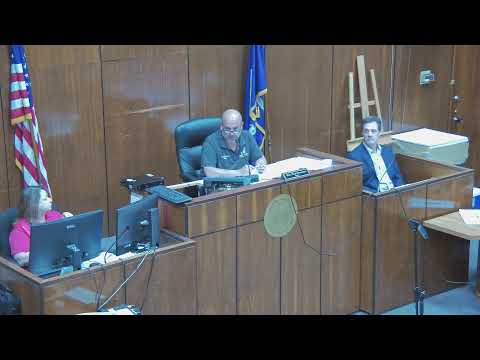
City Engineer Tim Mader told the Crowley City Council’s utility committee on Sept. 9 that the state Department of Environmental Quality has issued a draft LPDES discharge permit and an amended compliance order that require a multi‑phase corrective plan of action for the city’s wastewater collection and treatment systems.
Mader said the draft permit is under public review and the city expects a new five‑year discharge permit by October. “We’re expecting by the October that the city would have its new discharge permit,” Mader said.
The nut of the problem, Mader said, is more stringent discharge limits — especially for ammonia nitrogen — that the city’s 20‑to‑25‑year‑old treatment components were not designed to meet. “Ammonia nitrogen used to be in our permit at the level of…5 parts per million. That’s been reduced to 0.8 parts per million,” Mader said, adding the plant cannot reliably meet the older limit and must be upgraded to meet the new one.
Mader described a five‑phase corrective plan the city submitted and which DEQ has incorporated into an amended compliance order (compliance order number referenced in committee materials as WEC2400685). That amended order requires quarterly progress reports documenting plan, timing, cost and funding efforts. “They want corrective action that will guarantee to them that we have a plan…a timetable…we know what it’s gonna cost, and we know where the funding’s gonna come from,” Mader said.
Work already budgeted or underway includes a Phase 1 renovation to cover the existing duckweed (Limna) pond with a modular insulated cover. Mader said the cost for that phase is about $1.8 million, funded by roughly $1 million in ARPA funds and $800,000 of city funds, and that fabrication of the insulated cover is already under contract and expected by year‑end.
Planned later phases target the East Marsh excavation and upgrades to the ammonia‑nitrogen reactor. Mader gave project estimates and funding paths discussed with staff: a $2.28 million estimated project to upgrade or duplicate the ammonia reactor (an application was submitted to the Louisiana Community Development Block Grant program, 2627 cycle, with a required local match estimated around $850,000); a larger insulated cover for the East Marsh estimated at roughly $3.5 million (funding source TBD); and options to build or expand detention basins or pump‑station capacity to prevent sewer system overflows (SSOs) tied to heavy rainfall.
Mader warned that the city’s total needs add up to nearly $17.8 million if the city must proceed through all phases. He said DEQ has given the city three to five years to achieve compliance and is not immediately fining the city while it responds and reports progress, but the amended order requires active quarterly reporting and progress on funding and construction plans. “We have nearly $18,000,000 of needs. We don’t have funds right now for more than about a third of that,” Mader said.
The compliance order addresses two related problems, Mader said: treatment plant performance and collection‑system overflows in heavy rain. He described measures the city has begun to reduce inflow and infiltration, notably a smoke‑testing program to identify public‑side defects that the city will repair and private‑side defects that will require code enforcement and owner cooperation. “Smoke testing has revealed public side leaks. Tim Crater’s operation is going to fix the public side leaks. Code enforcement has to deal with the private side,” Mader said. He said past grant efforts to fix private‑side defects were only partially accepted by homeowners and that the city may need enforcement options — including capping service — if owners refuse to remedy inflow sources.
City Wastewater Superintendent Tim Crater briefed the committee on plant equipment needs and recent outages. Crater said two pumps ordered to replace burned motor housings are expected in six to ten weeks and that the aeration motor at the plant burned and is being replaced. He described ongoing repairs at several pump stations and street patches tied to recent repairs.
Committee members pressed funding and programmatic questions. Multiple grant applications are in process or under review, Mader said, including applications to the Delta Regional Authority (DRA/LATICORE) and LCDBG. He warned that federal funding cycles and environmental review mean that even awarded grants could take a year or more to clear pre‑construction steps.
Mader and Crater both urged council members to prepare for rate study work and constituent questions about user fees; Mader said the city has an “annual user fee study” in front of the council and that the likely need for capital will shape any rate recommendations. “When you are besieged with phone calls about what we may decide about user fees, you need to be versed in this new permit and versed in this compliance order,” Mader said.
What’s next: staff said smoke testing and public‑side repairs are underway and the city will continue applying for grants while planning phased construction. Mader asked committee members to read the links to DEQ materials included in his written report and to expect quarterly reporting obligations to DEQ as part of the amended compliance order.
Ending: The committee did not take a vote on specific construction authorizations at this meeting; Mader framed the presentation as an update on mandatory regulatory obligations, funding efforts and the scale of capital work ahead. He repeatedly emphasized that while DEQ is enforcing more stringent limits, the state has allowed several years for compliance and the city’s next months will focus on funding and design work.