Get Full Government Meeting Transcripts, Videos, & Alerts Forever!
Get email alerts on the Comprehensive Plan topic
No spam. Unsubscribe anytime.
Pitkin County planning commissioners review draft comprehensive plan, focus on natural environment and water policies
Summary
At a Sept. 9 work session, the Pitkin County Planning and Zoning Commission reviewed the draft comprehensive plan’s natural environment chapter and related sections, emphasizing water policy, agricultural supports, monitoring and implementation steps before code amendments and final county approval.
Pitkin County Planning and Zoning Commission members held a work session Sept. 9 to review the draft comprehensive plan, concentrating on the natural environment chapter and related implementation priorities. Planning staff presented the draft, described next steps and solicited commissioner feedback on water, agriculture, scenic quality, public lands, recreation and environmental hazards.
Planning staff framed the meeting as a policy review rather than a code-writing session and urged commissioners to identify policies that should be prioritized for implementation. As one staff presenter said, the draft seeks to “make sure that the policies we develop are grounded in the BOCC's vision to implement bold climate action while balancing our economy, preserving our rural and wild lands, and supporting an equitable and affordable community.”
Why it matters: Commissioners and staff said the comprehensive plan will provide the policy foundation for future land-use and code amendments. The commission’s endorsement and subsequent approval by the Board of County Commissioners will guide specific code changes, permitting standards and county programs. Staff told the commission they expect the planning commission to consider adoption of the plan late in 2025 and then forward it to the Board of County Commissioners for approval.
Key discussion points
Water quality and supply: Commissioners and staff spent substantial time on the draft’s water policies. Staff noted the county prepared a separate water-conditions appendix based on a survey of metro districts and that a water-land-use integration approach had been reviewed by the Northwest Colorado Council of Governments’ water-quality-and-quantity committee and by the City of Aspen water department. Staff said the draft emphasizes keeping water in rivers, conservation and efficiency, avoiding wasteful outdoor uses and supporting existing wastewater systems.
Commissioners asked for clarity on several operational items raised by the draft: where and when new wastewater treatment facilities would be allowed, the circumstances under which temporary water trucking would be permitted, and how the county’s policies intersect with downstream water-right obligations. Staff said temporary water trucking would be limited to life-safety or emergency situations (for example, filling fire-suppression tanks) and that the draft includes a policy that “new wastewater treatment facilities will not be developed in Pitkin County if existing facilities at legal and physical capacity can be expanded or consolidated to provide additional wastewater treatment service.” Staff also said legal review and coordination with regional water partners informed the chapter.
Natural resources and biodiversity: Commissioners generally supported the chapter’s conservation emphasis and asked for more specificity in implementation and monitoring. Staff said much of the natural-resources text consolidates existing county and caucus master-plan language and noted added specificity on items such as migration and movement corridors and noxious-weed control. Several commissioners pressed for stronger monitoring and enforcement language, saying rules without follow-through are ineffective.
Agriculture and working lands: The draft includes policies to support agricultural production (defined in the materials as production of food and other goods from plants and animals, including grazing, haying and crop production). Commissioners and staff discussed barriers for local producers — examples cited included the regulatory fit for hoop houses, farm-support structures and housing for farm workers. Staff said the plan would identify land-use and program changes to better support working farms and ranches.
Scenic quality, renewables and dark skies: Commissioners reviewed policies intended to protect visual and night-sky resources. Staff emphasized siting and minimizing disturbance as preferred approaches for solar and other renewable infrastructure rather than relying solely on screening. Commissioners recommended balancing scenic protection with reasonable siting to avoid unintended obstacles to renewable projects where appropriate.
Public lands, recreation and ski-area growth: The draft reiterates long-standing county support for public lands and open-space partnerships. On recreation and tourism, commissioners discussed managing recreational impacts and whether policies should explicitly prohibit new ski-area terrain versus limiting new base-area development or ancillary resort expansion. Staff said they would return to the commission with clearer language differentiating skiable-terrain expansion from base-area and service-area development.
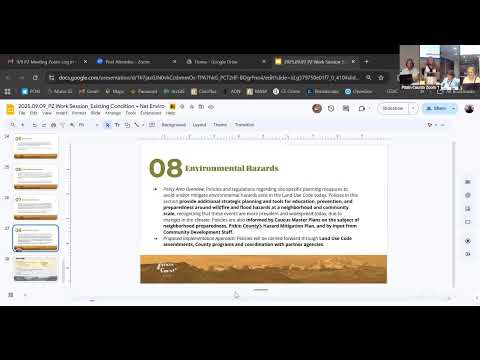
Environmental hazards and resilience: The draft calls for using best-available hazard mapping and integrating adaptation and resilience at community and neighborhood scales, not only on individual sites. Commissioners discussed potential programs to help existing neighborhoods undertake hazard mitigation and the need to align the plan with the county wildfire plan and other regional efforts.
Implementation and next steps: Staff described implementation as a multi-pronged effort including land-use and energy code amendments, targeted county programs, coordination with partner agencies and updates to other county plans. Staff said the county will return with a more detailed implementation matrix this fall and asked commissioners to flag policies that should be implemented within a two-year priority window. Staff also outlined upcoming outreach: caucus meetings, a community mapping charrette in early October and continued digital engagement; staff reported roughly 60 survey responses to date.
What commissioners asked staff to do: Commissioners requested clearer language on municipal coordination (in particular, how City of Aspen input is recorded and reflected in the draft), stronger monitoring and enforcement language for natural-resource protections, clarification of wastewater and temporary water delivery policies, and more explicit differentiation between ski-area terrain expansion and base-area development in recreation policies.
No formal decisions were taken at the meeting; the session functioned as an informal work session to collect commissioner feedback. Staff scheduled the next work session to address the built environment chapter on Sept. 30 and indicated they expect to return to the commission in late 2025 for adoption and then forward the plan to the Board of County Commissioners.
Ending: Staff invited written comments and said they would circulate revised language and an implementation matrix in coming weeks. The commission closed the work session after confirming future meeting dates.