Get Full Government Meeting Transcripts, Videos, & Alerts Forever!
Get email alerts on the Planning topic
No spam. Unsubscribe anytime.
Eagan planning commissioners and council discuss religious-zoning changes, data‑centers and 2050 plan preview
Summary
At a joint workshop the advisory planning commission and city council reviewed the APC work plan, proposed zoning changes to reduce burdens on smaller religious facilities, rising concerns about data centers/crypto mining, and early options for the 2050 comprehensive plan to meet a Met Council housing allocation.
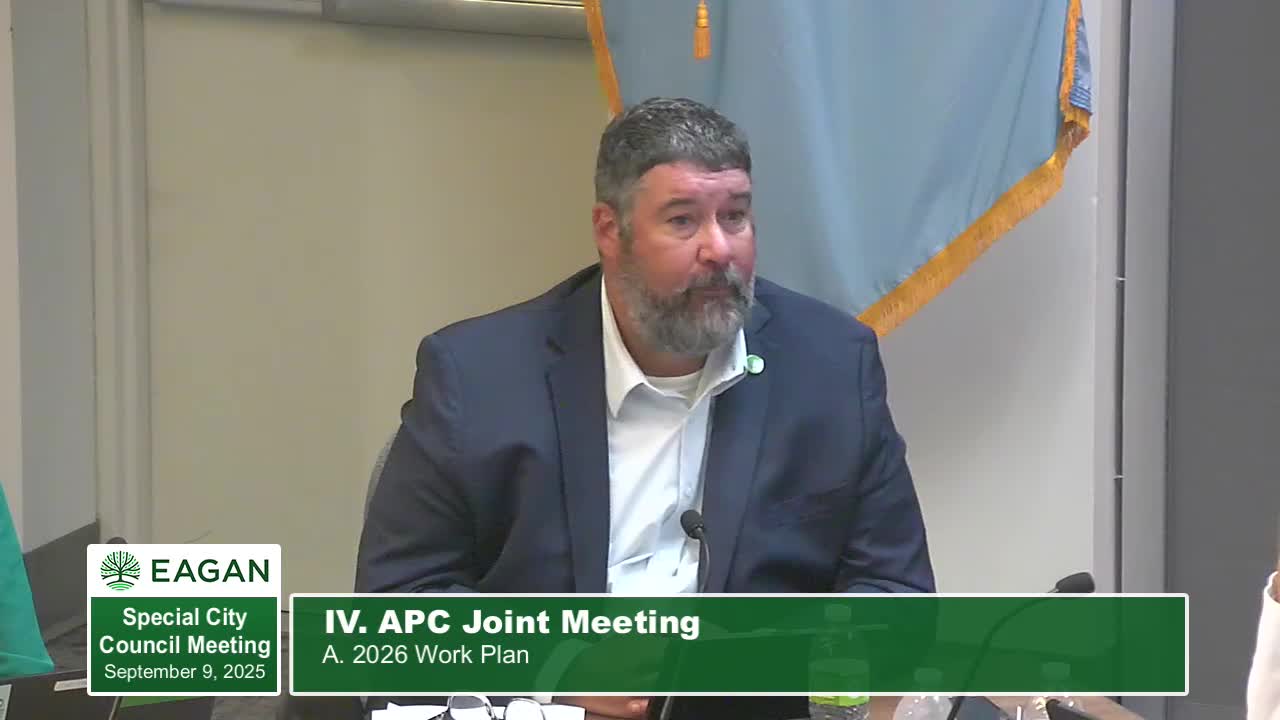
The Eagan City Council and the city's Advisory Planning Commission (APC) met Sept. 9 for a joint workshop to review the APC 2025 work plan and to discuss three planning issues: proposed zoning flexibility for religious facilities, emerging questions about data centers and crypto mining, and the city’s approach to the Metropolitan Council’s Imagine 2050 planning framework.
Religious facilities: proposed flexibility and limits
Mike Schultz, director of planning, summarized an APC recommendation to broaden where smaller religious facilities are allowed while keeping review for larger congregations. Under the staff/APC proposal, places of worship would remain permitted by right in public facility zones; smaller congregations (measured by building occupancy, not simply number of services) would be permitted by right in additional business zones if they occupied less than 40% of a building and had an occupancy under 100. Uses exceeding either threshold would require a conditional‑use permit and public hearing.
Schultz said the change aims to reduce burdens set off by the federal Religious Land Use and Institutionalized Persons Act (RLUIPA) and avoid the situation of small groups being forced into lengthy rezoning. The planning director said a CUP standard for larger uses would let the city address parking, traffic and other site impacts on a case‑by‑case basis.
Planning commissioners and council members sought clarifications: occupancy should reference building official occupancy limits rather than seat counts (to include faith groups that use prayer areas), and the 40% cap might be adjusted (some cities use 20% or 50% caps). Council members also emphasized that a CUP remains available for cases where parking or other impacts make a particular site unsuitable.
Data centers and crypto-mining issues
Commissioners reviewed recent inquiries about data centers and small‑scale cryptocurrency mining operations. Staff said Eagan currently contains multiple data centers and treats most as a form of warehousing for land‑use classification; however, crypto mining can differ in energy use, heat and continuous operation patterns and may raise noise and utility‑capacity concerns. Commissioners asked staff to examine setbacks, utility system impacts and noise standards and to track regional regulatory developments.
2050 comprehensive‑plan preview and options
Planning staff previewed the early approach to the 2050 comprehensive plan, noting the Metropolitan Council’s Imagine 2050 framework and a draft system statement expected in September. The Met Council’s forecast allocates a need of roughly 4,700 housing units to Eagan by 2050; staff said existing approvals and special-area plans already account for about 3,000 of those, leaving an additional roughly 1,700 units to be planned for between 2040 and 2050.
Staff described a menu of strategies to accommodate that allocation without large outward expansion: (1) reclassify some contiguous low‑density parcels near major collectors to allow modestly higher density; (2) identify underperforming office properties and other Class C commercial sites with redevelopment potential for housing; and (3) expand land‑use categories and density ranges (for example adding intermediate density categories to enable “missing middle” housing forms). Staff emphasized these are planning allocations to show feasibility, not guarantees of redevelopment.
Next steps
The council and APC agreed to refine the religious‑use language and to task staff with drafting ordinance amendments for further APC review. Staff will also research data‑center and crypto‑mining standards with utilities and regional partners. On the 2050 plan, staff plans a consultant RFP, two phases of public engagement (informational kickoff and later concept‑plan feedback) and a multi‑year schedule aimed at meeting Met Council deadlines in 2028; council members asked staff to design the public engagement program to build community buy‑in for any proposed transitions.
Ending
The APC members thanked staff for the review and commissioners and council members agreed to continue working on ordinance text and the comp‑plan timeline; several council members reiterated support for a phased, community‑oriented approach to the 2050 plan rather than one‑size‑fits‑all mandates.