Get Full Government Meeting Transcripts, Videos, & Alerts Forever!
Get email alerts on the Hazard Mitigation topic
No spam. Unsubscribe anytime.
Sandy reviews county hazard mitigation plan; adoption required for FEMA reimbursement
Summary
Battalion Chief David Larson presented the Salt Lake County 2025 multi-jurisdictional hazard mitigation plan and Sandy City annex, outlining 19 assessed hazards, ranking methodology and next steps for local adoption required by FEMA and the Utah Division of Emergency Management.
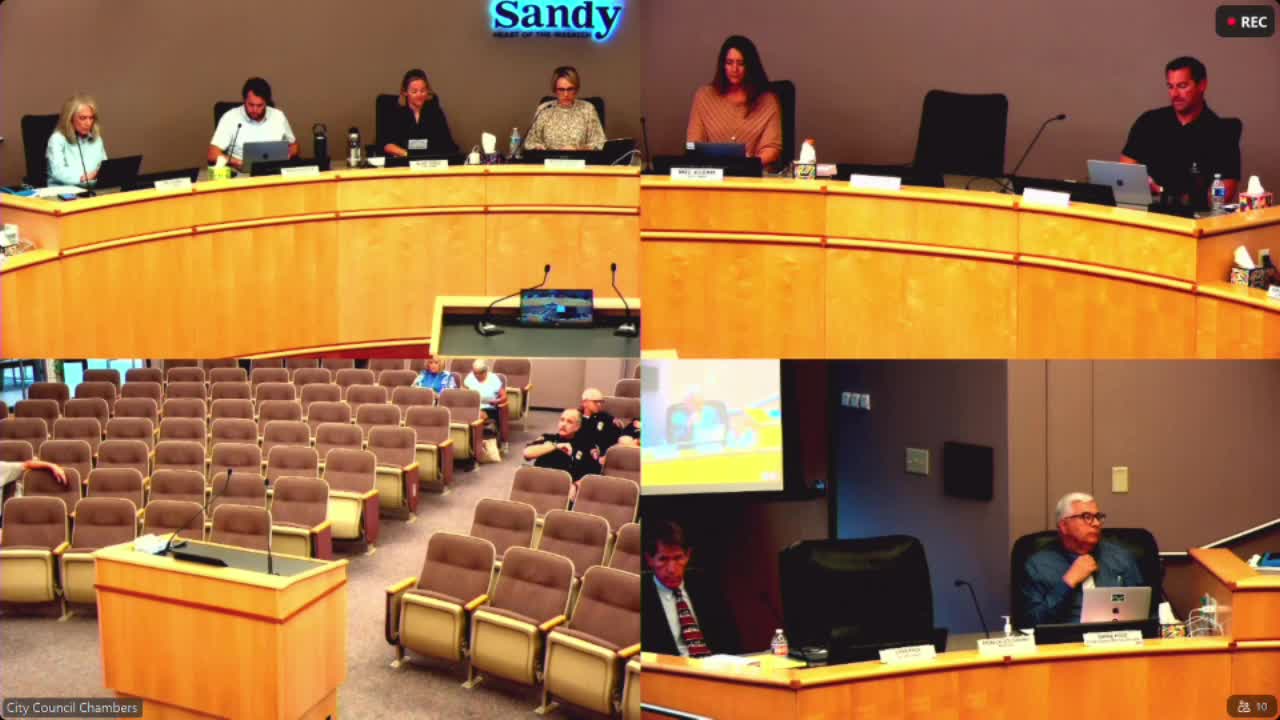
Sandy City officials heard a presentation Tuesday on the Salt Lake County 2025 Multi-Jurisdictional Hazard Mitigation Plan and the Sandy City annex that counties and cities must adopt to remain eligible for certain FEMA disaster reimbursements.
The Salt Lake County Emergency Management planning team produced a two-volume plan — a countywide volume and a Sandy City annex — that identifies and assesses 19 natural and human-caused hazards, according to Battalion Chief David Larson, Sandy’s emergency manager. “Every five years FEMA and the state requires that every jurisdiction has a multi jurisdictional hazard mitigation plan,” Larson said. He added that the county led the multi-jurisdictional effort to provide continuity and cooperative planning across municipalities.
The plan documents a countywide risk-and-vulnerability assessment that used historical data, risk modeling and local input. Larson told council members the assessment ranks hazards by both probable frequency and expected economic impact. “The biggest issues obviously that we're concerned with is first and foremost the wildland urban interface with our East Bench and with Dimpledale,” he said; he also listed flooding and earthquakes among major concerns. Larson said earthquake ranked highest in overall monetary risk to infrastructure, while wildfire scored higher on a combination of risk and probability.
Larson emphasized the adoption requirement tied to federal reimbursement: “If we have the disaster and the mayor has to declare an emergency, ... the only way that we can get any reimbursement monies from FEMA is if we've adopted this plan.” The final step for state and FEMA approval requires jurisdictions to submit evidence of adoption via a council resolution; Sandy staff said they will return with a draft resolution for adoption next week.
The annex also includes a National Flood Insurance Program overview for Sandy. Councilmember Cindy Sharkey read numbers from the annex during the meeting: nine recorded losses and 45 active NFIP policies in the dataset used for the plan. Larson said the plan and local outreach are intended in part to increase resident awareness of flood risk and insurance availability. Staff reminded the council that FEMA and state map updates occur periodically and that local projects (for example, stormwater or channel improvements) can trigger individual map revisions outside the larger countywide updates.
Council members asked about who compiled the Sandy annex; Larson said Sandy staff led the work with support from Salt Lake County on county-owned infrastructure elements such as canyon dams. He told members the local annex draws on information from city departments and emergency management meetings over the past year.
Next steps: Larson said county and state reviewers requested minor changes not affecting Sandy’s annex. Sandy staff will circulate a draft resolution and return to the council for formal adoption so the city’s annex can be submitted to the Utah Division of Emergency Management and FEMA for final approval.