Get Full Government Meeting Transcripts, Videos, & Alerts Forever!
Get email alerts on the Parks Recreation Cip topic
No spam. Unsubscribe anytime.
Waukesha proposes restrooms, concessions and community room at Mindiola Park; committee hears revenue plan
Summary
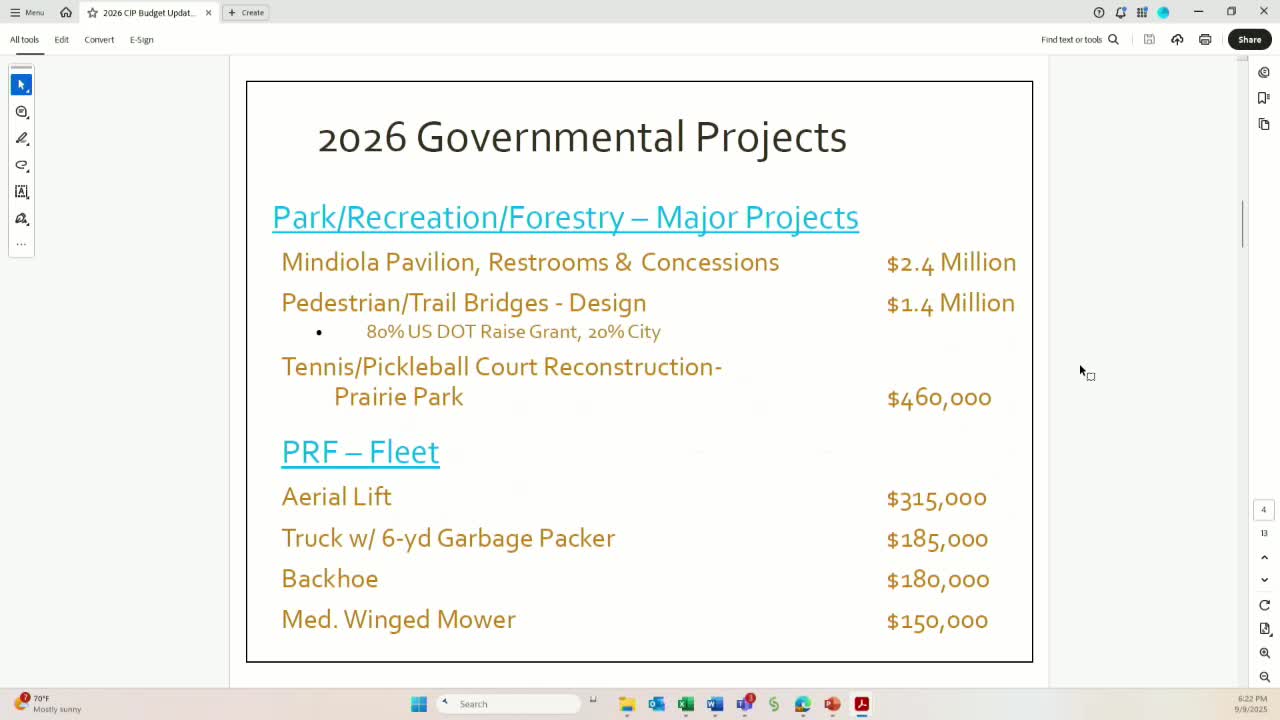
Parks officials presented a $2.35 million concept to add restrooms, concessions and an 80-person rentable community room at Mindiola Park; staff said the facility is designed to be largely self-supporting, funded with a mix of park impact fees, GO borrowing and private donations.
City parks and recreation staff detailed plans Sept. 9 to build a restroom and concession building with rentable community space at Mindiola Park, telling the Finance Committee the facility would address restroom needs, create concession revenue and provide year‑round rentable space.
Parks staff described three primary objectives: permanent restrooms to replace portable toilets, concessions to capture on-site sales during events, and an 80-person community room that could be rented year-round. Ron (Parks, Recreation & Forestry staff) said the park includes two lighted synthetic turf fields and other grass fields and supports high weekend use; staff said the most frequent customer request has been for restrooms.
Key numbers and funding: staff presented a project estimate of $2,352,575. Proposed funding is roughly 42% from park impact fees, about 10% from private donations/sponsorships and about 47.7% from general obligation (G.O.) borrowing. Parks projected complex revenue of roughly $220,000 in 2025 (programming $136,000; rental revenue $84,000) and estimated the proposed building would generate net revenue of about $61,000 in its first year of operation. Staff said portable toilets currently cost $8,000–$10,000 annually at Mindiola; replacing them with permanent restrooms removes that recurring rental expense.
Site and operational notes: presenters cautioned the site is a capped landfill, which imposes utility and construction considerations; staff said city engineers will work to locate the best feasible spot and address utility connections. Staff also described a partnership with Bridge Church that has provided parking support for some events.
Committee reaction and process: members asked about operating costs, timing, and whether the facility would be self‑supporting immediately. Parks staff said the operating budget shown was conservative and that the building was projected to be self‑supporting in year one based on multiple revenue streams (concessions, alcohol sales, programming and rentals). Alderman Lemke noted the use of impact fees and said she supports prioritizing Mindiola ahead of another park project; other alderpersons stressed the need to maintain existing facilities and welcomed the plan’s fund-balance approach to operating sustainability.
Where it goes next: the parks presentation was part of the broader 2026–2030 Capital Improvement Plan (CIP) review. Committee members thanked staff for the detailed presentation; no final construction approval was taken Sept. 9 pending the council/CIP process and any necessary design steps.
Ending: If approved in later steps, staff said additional public information and detailed design would follow, and the parks department aims to make the facility self‑supporting over its operational life while using borrowed funds for construction costs.