Get Full Government Meeting Transcripts, Videos, & Alerts Forever!
Get email alerts on the Animal Services Budget topic
No spam. Unsubscribe anytime.
Indianapolis Animal Care Services unveils 2026 budget and timetable for new shelter
Summary
The Indianapolis City-County Council Community Affairs Committee heard a presentation Sept. 9 from Indianapolis Animal Care Services leadership on the agency's first budget as an independent entity, the features and move timeline for a new 60,300-square-foot shelter, and budget shifts tied to increased internal chargebacks and operating changes.
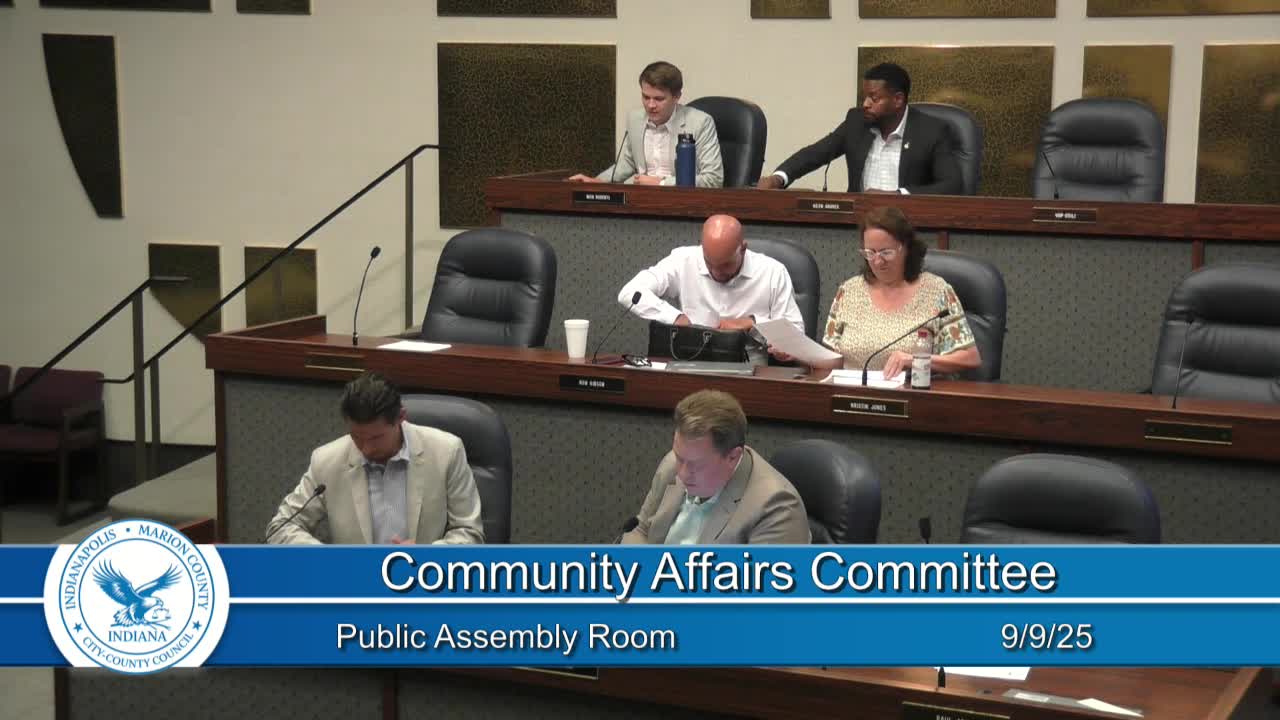
INDIANAPOLIS — Indianapolis Animal Care Services Director Amanda Dehoney Hinkle and CFO James Finlayson presented the agency's proposed 2026 budget to the Indianapolis City-County Council Community Affairs Committee on Sept. 9 and outlined the timeline and features for a new shelter slated for completion March 31, 2026, with a likely public move-in by May.
The presentation, the agency's first budget submitted since becoming an independent entity, said the overall operating budget is effectively down about 1.5 percent from the prior year largely because of increased internal chargebacks tied to the new facility. James Finlayson told the committee the agency “followed OFM's direction and identified the target amount for reserves” and that the character 1 operating budget increased by $49,810 to support a 2.6 percent cost-of-living adjustment for most staff and a 3 percent increase for AFSCME-represented employees.
IACS emphasized performance gains in recent years: a live-release rate averaging 91 percent in 2024 (up from 84 percent the prior year); more than 2,000 high-risk animals transferred to rescue partners in 2024; a 10 percent increase in adoptions; reduced workplace injuries; a reduced vacancy rate from 38 percent in August 2024 to 19 percent in July 2025; and a volunteer program whose hours equaled the output of about 15 full-time employees.
The new facility, described in the presentation and supported by drone footage shown to the committee, is 60,300 square feet and includes 234 dog kennels (182 indoor-outdoor), 10 indoor public visitation rooms, five puppy kennels, 12 outdoor dog run kennels, a 3,200-square-foot meet-and-greet dog park, 3,700 square feet of veterinary space, 80 cat cages with multiple indoor and outdoor cat play areas, two acres of pasture for livestock, a two-acre public dog park, a walking path of approximately 2,400 feet around a pond and 74 parking spaces. The director said “this will be a big time of transition and learning for us at IACS” as operations move into the modern facility.
Committee members questioned several budget items. Councilor Michael Paul Hart asked about the building rent and financing; IACS staff said rent is paid to the building authority and that the bonds for the project are a building-authority project (specific bond documentation was not provided during the meeting). Hart also pressed staff about an apparent increase in OCC chargebacks into character 5; Finlayson said he would follow up with OCC and return with more detail.
Finlayson described other line-item shifts: a $100,000 reduction in character 2 (general office and some medical supplies) tied to operational changes and pursuing different vendor contracts; a $131,000 increase in character 3 largely due to chargebacks for rent and related costs of the new building; a decrease in character 4 related to reduced vehicle purchases because much of the fleet has been recently replaced; and a marginal character 5 change tied to OCC charges.
The agency also said it is ending an external kennel-cleaning contract as space and staffing improvements allow cleaning to be handled in-house. Staff warned, however, that some contracts — especially veterinary services — may need reevaluation because of a national veterinarian shortage.
Councilors and IACS staff discussed adoption fees set by ordinance at $60 and the agency's continued practice of largely waiving that fee to keep shelter capacity available. Councilor Michael Paul Hart estimated collecting the full, ordinance-set fee could bring in “roughly” $200,000 annually, though Finlayson said the exact amount would fluctuate with intake and adoptions. Hart asked whether revenue from adoption fees could be directed to IACS rather than deposited into the general fund; staff said they would raise the question with OCC to examine pathways and legal mechanisms.
In public comment, volunteer and mayoral appointee Chris Roberson praised the new director and board progress but cautioned the council that “we have not solved the animal crisis in Marion County,” noting persistent overpopulation and concerns about any decreases in funding.
No formal motions or votes were recorded on the budget during the committee meeting. Committee members requested follow-up information on OCC chargebacks and next steps for evaluating whether adoption-fee revenue could be earmarked for IACS operations. The committee adjourned after the presentation and public comment.