Get Full Government Meeting Transcripts, Videos, & Alerts Forever!
Get email alerts on the Water Distribution Safety topic
No spam. Unsubscribe anytime.
SFPUC adopts revised cross‑connection control plan; hazard assessments to cover all services over 25 years
Summary
The SFPUC approved a revised cross‑connection control plan that expands hazard assessments to all 182,000 service connections on a 25‑year schedule and requires upgrades to many fire and temporary service connections.
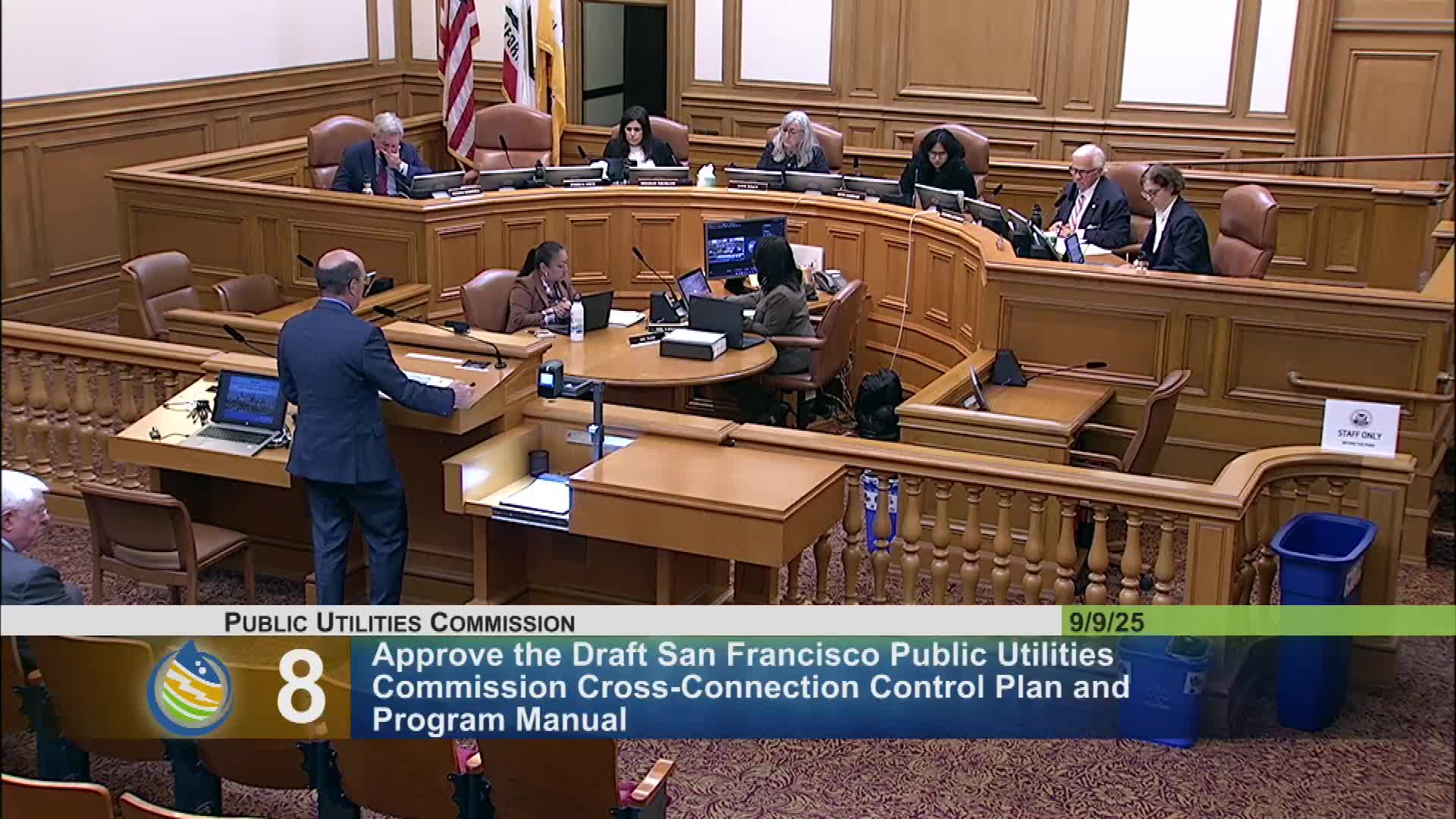
The San Francisco Public Utilities Commission on Thursday approved a revised Cross Connection Control Plan and manual to comply with the State Water Resources Control Board’s cross‑connection control policy handbook. The plan, presented by Water Quality Division Director Andrew Grasso, sets a schedule and work plan to identify and mitigate cross‑connection risks across the city’s water system.
Why it matters: cross connections are physical links that could allow non‑potable water to enter the potable distribution system. State policy now requires utilities to perform hazard assessments for service connections beyond the historical subset of commercial and high‑risk accounts; SFPUC must identify hazards for all 182,000 services in its system and bring the program into compliance.
Key provisions and timeline
- Scope expansion and schedule: SFPUC currently manages roughly 35,000 backflow prevention assemblies covering about 18,000 services. The new plan requires hazard assessments for all 182,000 services; staff negotiated with the State Water Board to perform assessments over a 25‑year timeframe.
- Fire services upgrades: Approximately 4,200 fire service connections currently use single swing checks that do not meet the new policy’s required backflow prevention standards (RP assemblies). SFPUC said it will replace these swing checks and work with customers, the Fire Department and the Department of Building Inspection (DBI) to coordinate upgrades and permitting. Staff estimated individual customer installation costs for required devices may range from $10,000 to $100,000 depending on site complexity.
- Hydrant and temporary connections: Roughly 300 hydrant connections used for temporary services will need RP devices; SFPUC expects to procure and phase deployment of these devices.
- Pilot and staffing: SFPUC intends to run a pilot program (proposed ~100 fire service replacements and ~1,000 hazard assessments) to estimate costs, staffing and permitting needs before full roll‑out. New staffing and contractor resources will be required; enforcement procedures for noncooperative property owners will be developed.
- Implementation and cost concerns: Staff said the largest near‑term costs will be program startup (staffing, outreach, device procurement) and capital work to replace swing checks. The plan assumes long‑term replacement over a 20‑year to 25‑year period; staff said they negotiated a 20‑year timeline for some fire service changes with the state but retained a 25‑year horizon for hazard assessments in the revised manual.
Commission questions and public input
Commissioners pressed staff on residential impacts (the policy requires assessments for single‑family homes as well as commercial buildings) and on how SFPUC will detect and prioritize actual backflow events. Staff said reverse‑flow events are rare but detectable with current advanced metering infrastructure (AMI) in some large anomalies; AMI noise and battery life limit continuous, minute‑level detection.
Staff emphasized outreach and coordination with the Fire Department, DBI and communications staff and said the agency will prioritize upgrades that align with customer remodeling projects and contractors’ schedules to reduce duplicative work.
Vote and next steps
Commissioners approved the plan. President Stacy, Commissioner Jamdar, Commissioner Levarone and Commissioner Thurlow voted aye; Vice President Arce was absent. Staff will submit the plan to the State Water Resources Control Board and return with detailed pilot results, cost estimates and a proposed enforcement approach.
Speakers recorded in the presentation included Andrew Grasso (Water Quality Division Director) and Steve Ritchie (Assistant General Manager for Water), with follow‑up comments and questions by commissioners.