Get Full Government Meeting Transcripts, Videos, & Alerts Forever!
Get email alerts on the Drinking Water Quality topic
No spam. Unsubscribe anytime.
SFPUC approves 2025 Public Health Goal report; staff flags bromate, hexavalent chromium and lead concerns
Summary
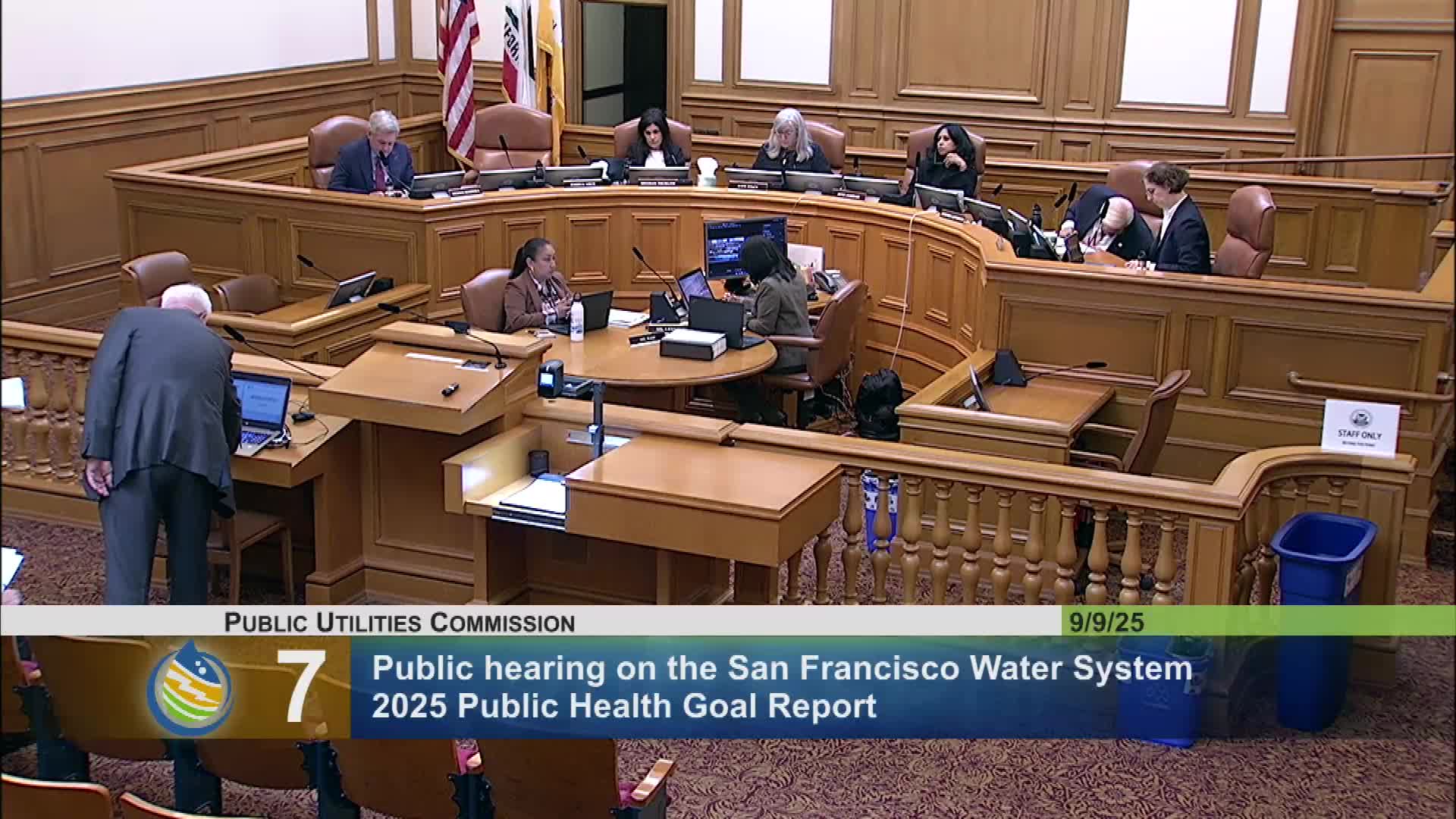
The San Francisco Public Utilities Commission on Thursday approved its 2025 San Francisco Water System Public Health Goal report and directed staff to notify the State Water Resources Control Board that a public hearing was held.
The San Francisco Public Utilities Commission on Thursday voted to approve the San Francisco Water System 2025 Public Health Goal (PHG) report and directed the general manager or the general manager’s designee to submit a letter to the State Water Resources Control Board documenting that a public hearing was held.
The report compares recent monitoring data to California public-health goals or federal maximum contaminant level goals where state goals do not exist and identifies three contaminants that exceed public-health goals: bromate, hexavalent chromium and lead. Commissioners approved the report by voice vote; President Stacy, Commissioner Jamdar, Commissioner Levarone and Commissioner Thurlow voted aye; Vice President Arce was recorded absent.
Why it matters: public-health goals are non‑enforceable benchmarks intended to identify potential health risks and treatment options. Commission staff said the three contaminants of concern appear at concentrations far below regulatory limits (maximum contaminant levels) but above the PHGs, which are typically much lower.
Key findings and staff response
- Bromate: Detected at the Harry Tracy Water Treatment Plant where ozone is used. Staff said bromide in source water reacts with ozone to form bromate, a probable human carcinogen. The report recommends ongoing watershed protection, monthly monitoring of bromide, and optimization of ozone dosing to minimize bromate formation.
- Hexavalent chromium: Detected at low levels that exceed the PHG. Staff said likely sources include groundwater, soils and treatment‑chemical impurities. The State Water Resources Control Board has identified best available treatment (BAT) only for the MCL, not for the much lower PHG. SFPUC said it blends groundwater with high‑quality surface water to reduce levels and maintains a chemical quality control program to limit contaminants introduced by treatment chemicals.
- Lead: The PHG for lead is 0.2 ppb. Staff noted that most lead detected in customers’ tap samples originates from plumbing and fixtures on the customer side rather than SFPUC distribution mains. SFPUC reported it previously removed roughly 7,000 known lead service lines in the 1980s and 1990s and has been replacing galvanized “required replacement” service lines identified in subsequent surveys.
Lead program numbers provided by staff
- SFPUC said it identified about 1,578 galvanized service lines in earlier surveys that required replacement and launched a 10‑year replacement program starting June 2020.
- As of the June reporting cutoff, SFPUC reported replacing approximately 90% of the meters that needed lead‑free versions and expects to complete the utility‑side lead user service line replacements by mid‑2026. Staff said they now estimate roughly 700 galvanized required‑replacement lines will remain after additional survey work.
- The utility said unknown service lines (initially 407) are being resolved through further investigation; any unresolved unknown is treated as a required replacement under the lead and copper rule.
Staff noted that installing full‑scale treatment to achieve PHG concentrations would be expensive and, given current detection methods, may not be demonstrably effective at the PHG level. For lead, SFPUC emphasized its long‑running corrosion control program, component replacements (meters, curb stops) and public outreach, including school and childcare testing, as primary controls.
Public and commissioner input
Multiple public commenters urged the commission to hold workshops on the Tuolumne River voluntary agreement, the commission’s “design drought” assumptions and demand projections — subjects connected to broader water planning but separate from the PHG item. Commissioners asked staff for added transparency and earlier public posting of draft PHG reports; staff agreed to publish drafts on SFPUC’s website when the report is dispatched to the commission to increase public access.
What happens next
By approving the report, commissioners authorized staff to submit a certification letter to the State Water Resources Control Board documenting that the hearing occurred. Staff said the PHG report will remain a living document and that the utility will continue monthly monitoring and targeted programs (lead service line replacement, ozone optimization, blending) described in the presentation.
Speakers quoted or referenced at the hearing came from SFPUC staff and commission members and were limited to the names and roles recorded in the meeting transcript.