Get Full Government Meeting Transcripts, Videos, & Alerts Forever!
Get email alerts on the Government Operations topic
No spam. Unsubscribe anytime.
DeKalb committee adopts timeline to implement Malden and Jenkins operational assessment
Summary
The DeKalb County Finance, Audit & Budget Committee approved a phased timeline to implement recommendations from a Malden and Jenkins operational assessment covering the county’s finance, Office of Management and Budget and purchasing functions and agreed to use Momentum Firm for change management and monitoring.
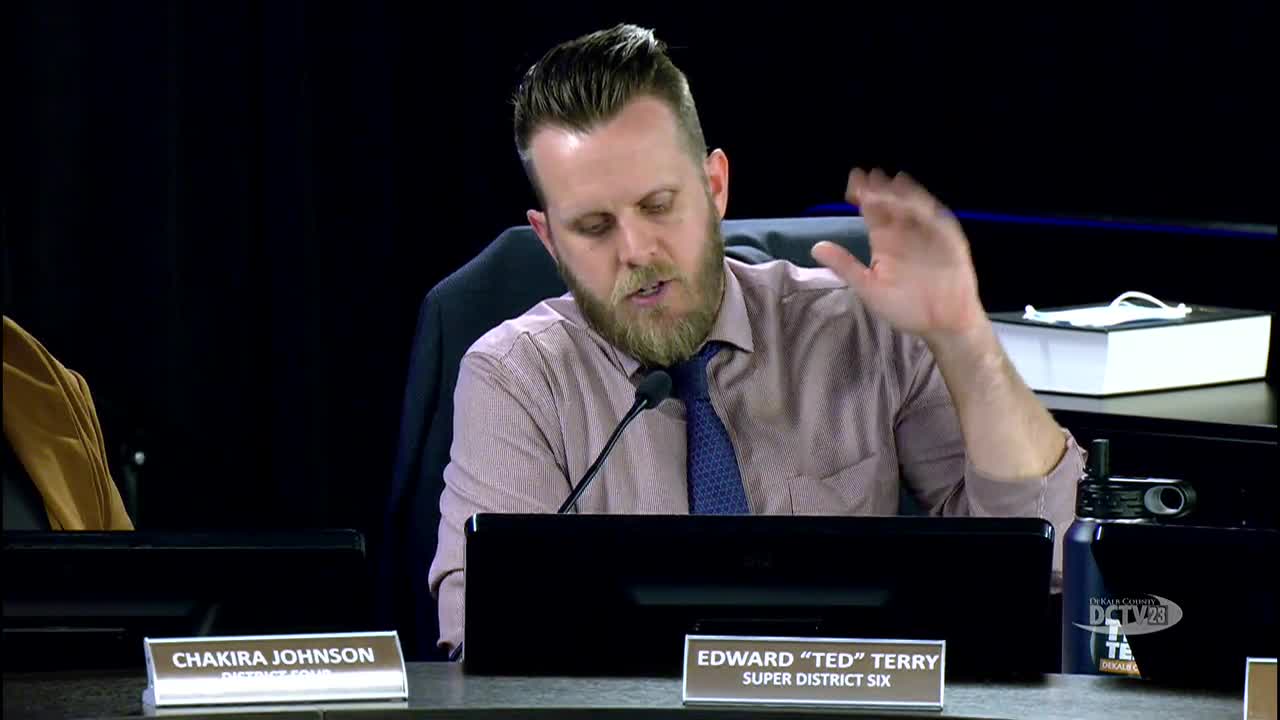
The DeKalb County Finance, Audit & Budget Committee, chaired by Commissioner Ted Terry, approved a phased timeline at a committee meeting to begin implementing recommendations from a Malden and Jenkins operational assessment of the county’s finance department, Office of Management and Budget and purchasing office, Commissioner Ted Terry said.
The decision responds to a roughly 300-page assessment that Terry said contains 266 findings. Committee members and County administration outlined a five-phase timeline that begins with departmental briefings and is intended to produce initial action plans by early November, with quarterly monitoring through 2026 and broader implementation continuing into 2026 and beyond.
Committee chair Commissioner Ted Terry framed the work as a focused, multi-committee effort to translate the assessment into concrete changes. “It is a, like, I don't know. It's, like, 300 pages, Zach. I read every single page. Twice. Twice,” Terry said, emphasizing the scale of the report. The committee agreed to use Momentum Firm as an external vendor to assist with change management and to help departments produce action plans and monitoring tools.
Chief Executive Officer (CEO) Williams said committee-level engagement is necessary to make the assessment a “living document” and that departments have already begun work with outside experts. “The good thing, when you look at purchasing, for example, they have brought in the National Institute of Government Procurement to assist,” CEO Williams said, noting that finance, the budget office and purchasing have all begun planning responses to the assessment.
Under the adopted approach, Phase 1 was the committee’s timeline review. Phase 2 calls for departmental hearings at the next available FAB meeting in which the finance department, Office of Management and Budget and purchasing would present findings and initial responses. Phase 3 would use Momentum Firm to help departments synthesize findings and draft action plans. Phase 4 (if needed) would provide additional reporting and refinement; Phase 5 would include joint sessions between the committee and department heads and establishment of a monitoring structure into 2026.
Commissioner Shakira Johnson asked when departments would receive the timeline and be made aware of expectations; Johnson said, “when will the departments get it and be made aware of some of the expectations that we'll have come forward.” CEO Williams and staff said departments were receiving documents at the meeting and that staff would follow up before the next committee session so departments can prepare presentations.
Committee members discussed monitoring cadence and tools. Commissioner Michelle Long Spears asked whether monitoring would be done by the FAB committee, the Office of Independent Internal Audit, Momentum Firm or another body and whether a dashboard would be built to track progress. Committee members and staff said Momentum Firm’s contract will include work on monitoring and dashboards and that quarterly check-ins, either at committee or full-board level, are the expected cadence for 2026.
Several committee chairs said they plan to adapt the FAB timeline and template for their own committees. Commissioner Robert Patrick said he intends to replicate the schedule for Public Works. Staff will distribute the timeline and templates to committee chairs and central staff for refinement.
Votes at a glance: two procedural motions were recorded during the session — approval of prior meeting minutes (agenda items 13-14 and 13-15) and a motion to adjourn. Both motions passed; only generic voice votes were recorded in the transcript (ayes and the chair’s affirmative vote), with no roll-call tallies provided.
Next steps: staff will share the schedule and template with committee chairs and departments, the committee expects departmental briefings at its next meeting or at a special-called session if needed, and Momentum Firm will be asked to prepare templates and monitoring tools as part of its scope. The committee set a goal to produce draft action plans by early November and maintain quarterly progress reports in 2026.