Get Full Government Meeting Transcripts, Videos, & Alerts Forever!
Get email alerts on the School Bond topic
No spam. Unsubscribe anytime.
VICTORIA ISD bond committee favors large modernization package; ranks STEM middle school move top
Summary
At a Oct. 25 Victoria ISD bond workshop, district administrators presented facility needs and committee members ranked options that favor modernizing the 56-classroom STEM middle school and moving Smith STEM Academy there; the committee’s advisory tallies indicate a large bond request in the $165–$200 million range.
Victoria ISD Superintendent Sheila (last name not specified) told the bond committee on Oct. 25 that administrators recommend a multi-campus modernization plan and that “the time is now” to take advantage of public momentum and rising construction costs.
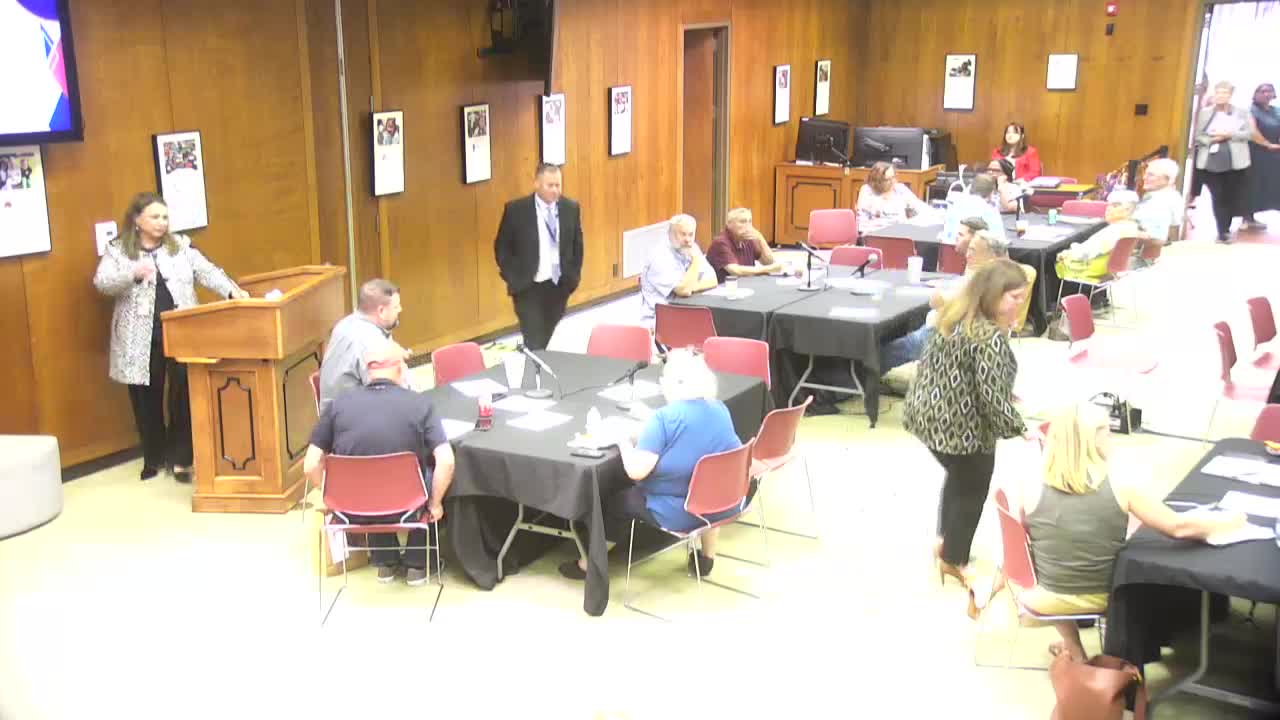
The workshop reviewed 10 years of enrollment data, facility assessments and estimated renovation costs, and asked members to privately rank a set of bond options. Committee tabulation announced near the session’s close showed a clear advisory preference for modernizing the 56-classroom STEM middle school and moving Smith STEM Academy students to that facility: 26 committee members circled the STEM 56-classroom option versus 2 who chose modernizing Smith in place. For the option affecting Dudley and Hopkins elementaries, 18 preferred a new Stroman elementary with Hopkins and Dudley wings, 5 chose Dudley modernization, and 3 chose Hopkins modernization.
The administration’s presentation summarized enrollment trends (about 2,000 fewer students districtwide than a decade ago and roughly 180 fewer students than at this time last year), attendance-zone and feeder-pattern analyses, and annual insurance and utility costs for underused campuses. Administration estimates included: Torres elementary expansion and asset improvements, $25,250,000; Vickers modernization, $20,000,000; STEM Bridal School (complete modernization), $30,000,000; Patty Welder modernization, $20,000,000; and a new Stroman elementary (with Hopkins and Dudley wings) estimated at about $50,000,000. Superintendent Sheila cautioned these are preliminary projections pending architect-driven cost estimates.
Administrators highlighted cost drivers and operational trade-offs that helped frame the options. They reported that running the underutilized VSA/Stroman campus has averaged roughly $420,000 a year in insurance and utilities; with parts of the campus low‑enrolled or vacant in recent years, that has resulted in multi‑year carrying costs (three years at current vacancy levels was cited as roughly $1.2 million). The presentation also noted that full demolition and rebuild is materially more expensive than renovation and that athletic, fine-arts and technology projects may need separate bond or funding vehicles.
Committee members asked planning and cost questions during the presentation, including whether demolition and hazardous-material abatement (for example asbestos) were budgeted; administrators said demolition/remediation costs were not included in the preliminary estimates and would need to be added and refined with architects. Committee discussion also covered transportation and traffic impacts of rezoning and right-sizing campuses, playground and cafeteria capacity if schools are consolidated, and security provisions tied to any new construction (administration proposed a $1,000,000 allocation for cameras and perimeter fencing as part of project security upgrades).
District staff described how the proposals would change the elementary count from 14 to an 11-school configuration under the administration’s right‑sizing recommendation: Torres and O’Connor combined, either Dudley or Hopkins consolidated (or both as wings in a new Stroman), Smith moved to the 56-classroom facility and Shields Elementary removed from the set of active campuses and rezoned. Staff emphasized that these are recommendations for the bond action committee and that any final package would require board resolution; the board must adopt a bond resolution in February for a May bond election, or the district could choose a November election date.
Committee members and administrators repeatedly framed the question of timing and scale. Staff estimated a full package including a new elementary and the modernization work discussed would put the bond in the neighborhood of $165 million to $200 million; administrators cautioned that waiting would likely raise costs further. As Superintendent Sheila put it during the meeting, “The time is now,” adding that the district has momentum from recent improvements and community conversations but that a successful referendum would require sustained outreach and oversight.
The tabulation announced at the meeting was advisory to the administration and school board. No formal board motion or public bond authorization occurred at the workshop; the committee’s rankings will be provided to district staff for further cost refinement, architect consultation and eventual recommendation to the board of trustees.
The district proposed next steps include engaging architects for detailed cost estimates, preparing a board workshop to present committee recommendations, and scheduling an oversight committee cadence similar to prior bond efforts. Administrators said they expect to reconvene the bond group in November to review refined estimates and messaging and to discuss voter engagement strategies.