
Brownsburg police chief reports budget increase request, staffing strains and event after-action
Get AI-powered insights, summaries, and transcripts
Sign Up Free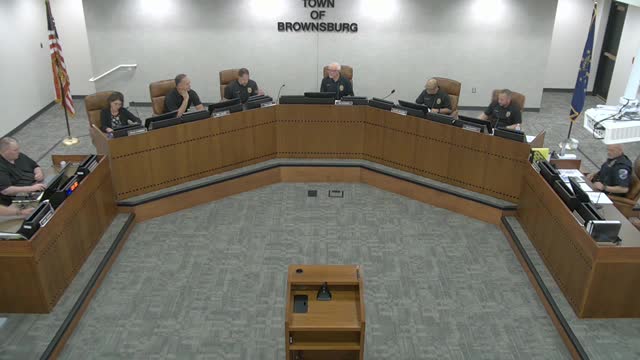
Summary
Chief Joseph Grimes told the Brownsburg Police Commission the department has requested a roughly $1.281 million budget increase for 2026, outlined staffing and field-training numbers, and reviewed public-safety operations during the U.S. Nationals, which drew an estimated 30,000–35,000 people and included one on-site death.
Chief Joseph Grimes, chief of the Brownsburg Police Department, told the Brownsburg Police Commission on Sept. 9 that the department has submitted a 2026 budget request that would raise the police appropriation by about $1,281,000 and that the department is managing reduced patrol staffing while training several new officers.
The request matters because it would fund recurring costs the department identified — including an extra payroll period, higher retirement and insurance expenses, additional electricity costs and legal-fee allocations — while the department continues to provide regular patrol and event coverage.
Grimes said about $300,000 of the requested increase is attributable to a 27th pay period in 2026 rather than a permanent salary change: “there's nearly 300,000 of that that is contributed to that.” He also told the commission the department was asked to budget an additional $40,000 for electricity, increasing that line from $60,000 this year to $100,000 next year, and that pension/retirement (the public safety retirement costs) and insurance pressures also pushed the overall request higher.
On staffing and training, Grimes said one officer, Callahan Baxter, was sworn in Aug. 25 and has begun the experienced-officer field training program. Three non‑experienced officers graduated from the Indiana Law Enforcement Academy on Aug. 22 and have entered field training; the full FTO program is more than 600 hours. He said Morgan Ettenberger, hired as a certified officer from Indiana University–Bloomington Police Department, is near completion of phase 2 of training. Lateral hire Officer Kenneth McElune completed the experienced-officer field phase and has been assigned to an AM shift for solo patrol.
Grimes also provided a head-count snapshot and described turnover pressures: after a resignation later in the meeting the department would sit at 61 sworn officers against an allocation of 62. He said five officers were in field training, leaving about 57 officers available for solo patrol until trainees complete the program, and that four officers were out on leave or light duty during August. He told commissioners he was not seeking more authorized positions for the coming year.
The chief reviewed operational results for recent deployments and special events. The Brownsburg Police Department supported the NHRA U.S. Nationals, which Grimes estimated “we were in excess of 30,000 participants or persons in attendance, with 1 even being over 35,000.” He said the event required expanded staffing for traffic and public-safety oversight. Investigations included overnight thefts of e-bikes from vendor pits, several on‑site vehicle collisions and one medical fatality: “we did have personnel that provided life saving measures, but our thoughts and prayers go out to the family.” Grimes said there were no event-related arrests requiring processing and credited officers and administrative staff for command-center support.
On proactive policing and K‑9 activity, Grimes highlighted examples where traffic stops led to discovery of narcotics, firearms and persons with outstanding felony warrants; he named Officers Majeski, Molina, Foote, Plichta, Argueta and Klontz for recent enforcement. He said K‑9 teams recorded 24 deployments during the reporting month that led to 25 arrests. Grimes noted the department is down one K‑9 handler because that handler is on light duty and emphasized the training and upkeep demands of maintaining a K‑9 program.
Grimes briefly described budget procedure: his final budget submission was sent to the town manager’s office and fiscal planner and, he said, originally scheduled to go before town council the following Thursday but postponed to a later meeting to allow updated revenue projections.
The commission also heard from staff about policy review and records-keeping improvements, and the chief said some policies are being tracked for review dates to document periodic review even when no substantive changes are required. He told commissioners the last update to his job-description policy was 2020 and recommended adding a review date to policy documents to improve the manual’s maintenance record.
The commission did not take a budget action at the Sept. 9 meeting; the chief said he will continue coordinating with the town manager’s office and council as the budget moves forward.