Get Full Government Meeting Transcripts, Videos, & Alerts Forever!
Get email alerts on the Unified Development Code topic
No spam. Unsubscribe anytime.
McKinney commission approves UDC amendments to implement recent state housing and zoning bills; forwards to council
Summary
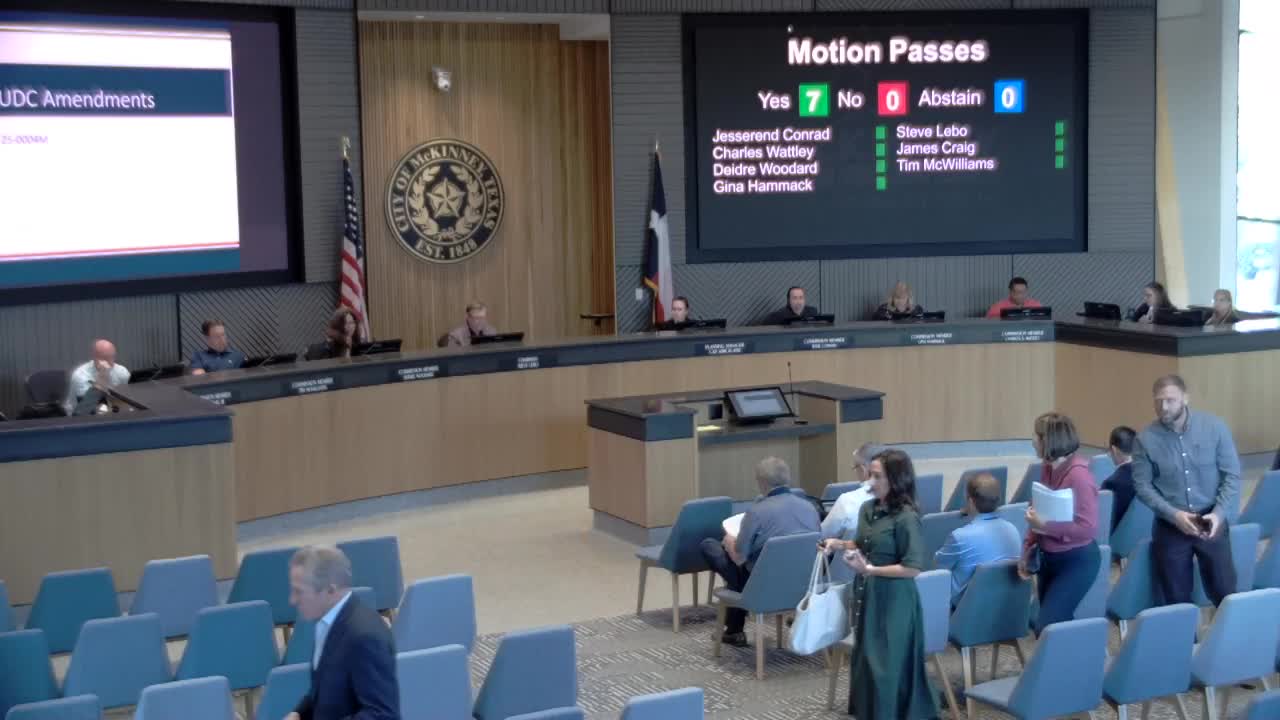
The Planning and Zoning Commission voted 7‑0 to approve amendments to the Unified Development Code aligning local rules with recent state laws affecting multifamily, mixed‑use, and small‑lot single‑family development; the item will go to City Council on Sept. 16 for final action.
The City of McKinney Planning and Zoning Commission approved amendments to the Unified Development Code (UDC) on Sept. 9 to implement state law changes affecting multifamily, mixed‑use and small‑lot single‑family development. The commission voted 7‑0 to forward the UDC amendments (agenda item 250004M) to City Council for final action on Sept. 16, 2025.
Hailey (Hailey) Angel, planning manager for the City of McKinney, summarized the package and its relationship to recent state bills. Angel said the amendments respond to three state bills cited in the staff report—Senate Bill 840 (multifamily/mixed‑use provisions), Senate Bill 15 (small‑lot single‑family provisions) and House Bill 24 (zoning protest petition changes)—and also include minor wording updates reflecting other recent legislation affecting home‑based businesses and dwelling unit occupancy. Angel said staff approached the changes by preserving regulation of building form where state law limits regulation of density and height.
Key changes described by staff include: - Allowing multifamily and mixed‑use residential development in zoning districts where office, commercial, retail or warehouse uses are permitted, in conformance with state law, while using building‑form standards (for example, "multifamily cottage" vs. "multifamily traditional") to maintain compatibility. - Renaming MF‑30 to MF‑36 to reflect the required minimum of 36 dwelling units per acre where multifamily is allowed and reducing the residential adjacency setback for that district to 25 feet (the maximum the city may require under state law for that case). - Limiting city parking requirements for covered categories to one parking space per dwelling unit (state law maximum), with a local proposal that 75% of parking in multifamily/mixed‑use in nonresidential districts be covered or enclosed where feasible. - Requiring a minimum first‑floor height of 14 feet for mixed‑use buildings to preserve the option for future conversion to commercial uses, and adding facade and architectural standards and prohibiting balconies facing single‑family residential where applicable. - Creating an R‑3 zoning district option and permitting small‑lot single‑family detached as a use with conditions to implement SB‑15; noting that for developments over 5 acres the city may not require lot widths greater than 30 feet and that lots under 50 feet wide will require alley (rear) access. - Updating the zoning protest petition calculation to reflect state law: the threshold that could once be triggered by 20% of the land area within 200 feet has been adjusted to a 60% land‑area calculation under the new state standard; even if that threshold is met the required council vote would be a simple majority rather than a supermajority.
Angel also noted staff recommendations to consolidate and clarify some legacy districts (including removal of a seldom‑used flex residential district) and small wording edits to TR‑1.8 and other sections for clarity. Commissioners asked clarifying questions about specific setback and height interactions, applicability to industrial zoning (I‑1/I‑2) and the tree/landscape calculations; Angel and staff answered that state law exempts certain heavy industrial definitions and that staff had applied the state definitions when drafting the use chart.
Commissioner (unnamed) moved to close the public hearing and approve the UDC amendments with the small posted changes; Commissioner Charles seconded. The commission recorded a 7‑0 vote to forward the amendments to City Council for final action at its Sept. 16, 2025 meeting.