Get Full Government Meeting Transcripts, Videos, & Alerts Forever!
Get email alerts on the Housing Noah topic
No spam. Unsubscribe anytime.
Austin council work session explores fund to preserve naturally occurring affordable housing
Summary
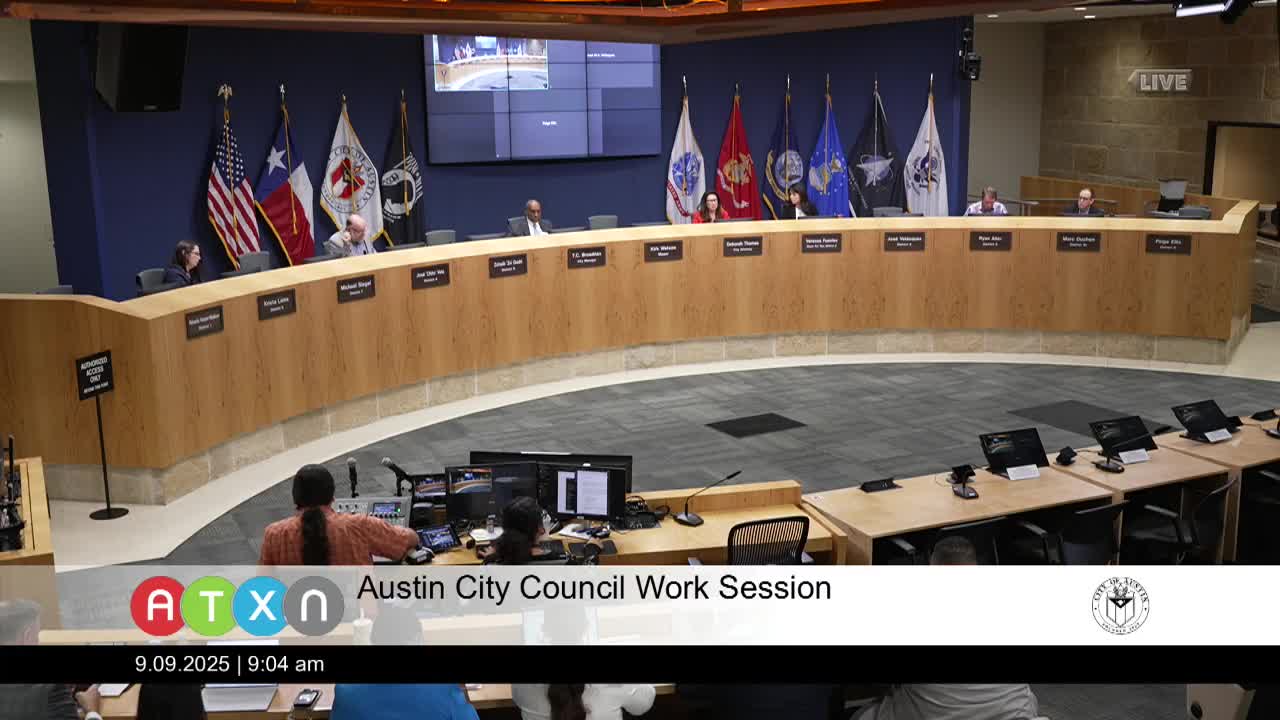
Mayor Pro Tem Vanessa Fuentes and council members discussed an approach to preserve naturally occurring affordable housing, or NOAH, during a work session at Austin City Hall.
Mayor Pro Tem Vanessa Fuentes and council members discussed an approach to preserve naturally occurring affordable housing, or NOAH, during a work session at Austin City Hall.
Assistant City Manager Dr. Eric Anthony Johnson briefed the council on NOAH's size and the preservation fund model under consideration, saying the approach used in other cities pairs a small public seed with private, philanthropic and banking capital. “The trifecta would be grant‑based sources for NOAH capital improvements, a low‑cost fund for acquisition/new construction and a services component,” Dr. Johnson said.
Why it matters: staff warned that many aging multifamily properties commonly identified as NOAH are attractive to investors because acquisition plus modest renovation can produce substantial rent growth. Dr. Johnson cited CoStar data staff used for the briefing showing an estimated local NOAH inventory and a market forecast that, if realized, could lead to substantial loss of units by 2030. He described a preservation strategy that targets properties that are repairable rather than those considered functionally obsolete.
Staff overview and proposed structure
Dr. Johnson told the council that locally NOAH includes older multifamily buildings and that CoStar’s taxonomy — used by many cities and investors — groups properties by condition. He said Austin’s NOAH stock is concentrated in thousands of units across several hundred buildings and that market forces create incentives for acquisition and rent increases.
He described a three‑part fund model tested elsewhere: 1) a grant source to pay for capital and deferred maintenance so owners can keep units habitable without raising rents; 2) a low‑cost loan/acquisition vehicle to preserve or acquire at‑risk properties; and 3) a services component tied to resident needs and property stewardship. “It’s not necessarily buying down the rent,” he said. “It’s saying to an owner…we could provide a grant to do the capital improvements in exchange for a covenant on the property to guarantee affordability for a certain percentage of affordability over a period of time.”
Leverage and precedent
Dr. Johnson and council members discussed how a city contribution can serve as a loan‑loss reserve or seed that attracts banks and philanthropy. He cited Dallas’ experience, where a relatively small public commitment helped draw private capital into a larger preservation fund, and mentioned funds or initiatives in San Francisco, Charlotte, Detroit, Cleveland and Washington, D.C. as comparators.
Council questions and concerns
Council members asked for more detail on several practical points: how properties would be selected; the difference between properties that need full redevelopment versus those that can be preserved; how to weigh ownership/land‑banking against covenant agreements; whether the fund would offer below‑market loans and what returns investors would accept; and how utilities, weatherization and underground infrastructure factor into rehabilitation costs.
Councilmember Ellis raised utilities and weatherization costs as important drivers of deferred maintenance; Dr. Johnson agreed that older complexes can have single, shared mains or aging systems that are costly to repair and that those risks affect which properties are feasible candidates for preservation. Several council members asked staff to map clusters of NOAH and to analyze pipeline risks tied to transit‑oriented development or other redevelopment pressures.
Data and clarifying figures
Staff cited CoStar figures during the briefing: an aggregate NOAH inventory, a per‑building average unit size figure, and a forecast that described potential demolition and redevelopment pressure that staff characterized as material through 2030. Dr. Johnson also discussed examples of fund sizes in other cities and said that the city’s initial contribution is usually intended as a signal to leverage outside capital.
Next steps and timeline
Council did not take formal action during the work session. Members pressed staff for criteria to target properties, for a pipeline analysis, and for recommendations on fund structure, covenant length and resident protections. Dr. Johnson said other cities have moved quickly once partners and capital were available — Dallas organized the initial structure in months in his account — but that timelines vary with market conditions and capital commitments.
No formal vote or ordinance was introduced; councilmembers indicated interest in moving the item to the regular council meeting schedule for further consideration and in receiving staff proposals that would define selection criteria, affordability levels and program guardrails.