Get Full Government Meeting Transcripts, Videos, & Alerts Forever!
Get email alerts on the Solid Waste topic
No spam. Unsubscribe anytime.
Solid Waste presents route technology, transfer-station repairs and CDL training in budget briefing
Summary
Josephine Valencia, director of Solid Waste, briefed the council on operations and the FY2026 funding picture, describing route navigation technology, transfer-station repair set-asides, a CDL training pipeline and steps to address illegal dumping and encampment cleanups.
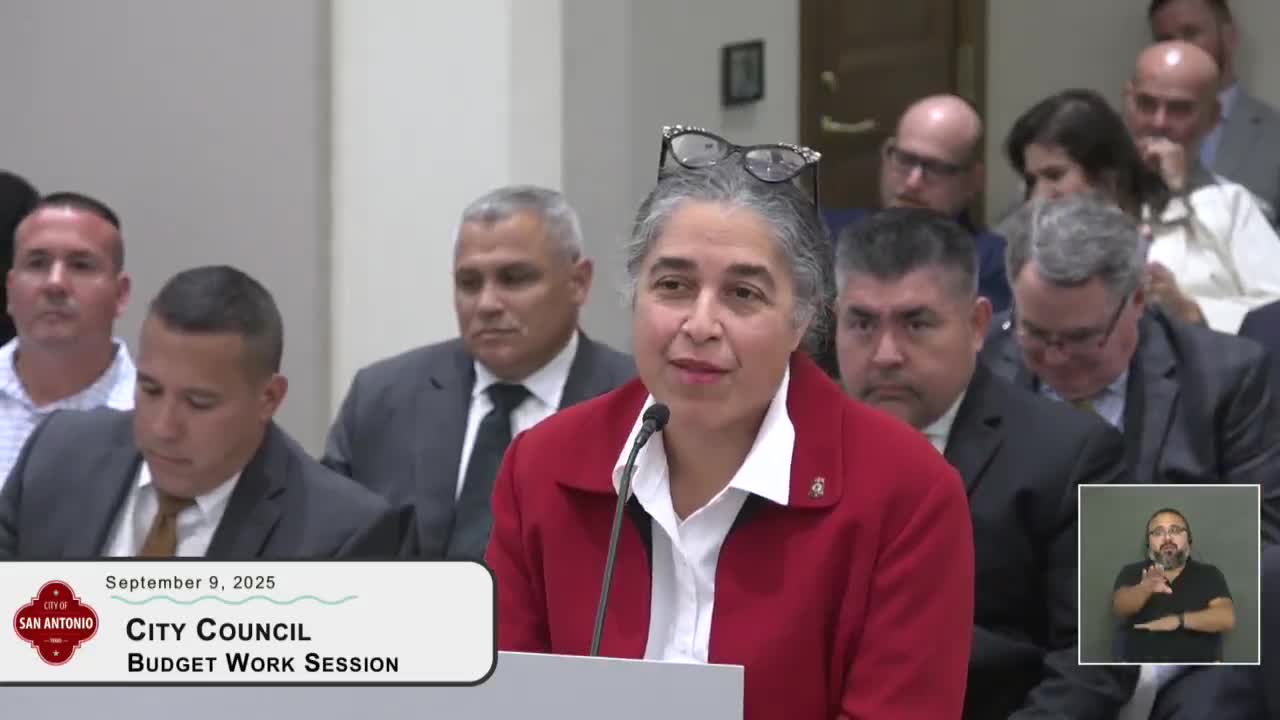
Josephine Valencia, director of the San Antonio Solid Waste Management Department, outlined the department—s operations and proposed budget during the Sept. 9 council budget session, describing route navigation technology, transfer-station repair funds, collection volume estimates and workforce-development efforts.
The department said it performs roughly 60 million curbside collections a year and is implementing a tablet-based route navigation and verification system that ties collection points to customer records and on-board cameras. Valencia said the system makes it easier to reconcile missed pickups, verify collections with video and assign exceptions for later follow-up.
Why it matters: Solid Waste operations are funded largely through user fees for collection services; reliability and route efficiency affect residents citywide. Councilmembers raised questions about illegal dumping, costs for cleanup of encampments and the number of vacant collection positions.
Key points from the presentation and council questions
- Route technology and verification: Valencia described a navigation system that displays route points on a tablet and records a change in status when a driver stops at a customer location; the system is integrated with cameras so the department can verify whether a pickup occurred. She said the system can also flag exceptions for reconciliation with billing records.
- Volume and facilities: Valencia told council the department expects to collect roughly 80,000 tons of material on curbside routes in the coming year and reiterated that the city does not own any landfills but operates transfer stations to consolidate loads for transport to private landfills. The department reserved $2.5 million for potential repairs at a transfer facility and noted other facility-repair investments.
- Workforce and training pipeline: The department highlighted an in-house commercial driver—s license (CDL) training program used to recruit and certify drivers. Valencia said the city—s CDL training has produced about 140 CDL-certified individuals since the program began, and more than 100 of those obtained jobs with the department.
- Performance metrics and vacancies: Councilmembers asked about on-time collection rates and vacancies. Valencia and staff said the department—s customer satisfaction rate is about 97% and that the household collection goal was 87% on-time; they identified about 61 vacant positions in collection. The department said the new route technology should improve efficiency for newer drivers.
- Illegal dumping and encampments: Councilmembers pressed the department on outreach and cleanup costs related to illegal dumping and encampments. Valencia said the department conducts community outreach and partners with police and other departments on enforcement; she offered to provide cost figures for illegal-dumping cleanups on request.
What the presentation did not include
No formal council votes were taken on Solid Waste operations during the session. Councilmembers requested additional information, including cleanup cost estimates and an update on vacancy numbers and on-time collection metrics by district.
Valencia and Solid Waste staff said they would follow up with the requested data and that some improvements tied to the navigation system and CDL pipeline are expected to be in use by the winter months.