Get Full Government Meeting Transcripts, Videos, & Alerts Forever!
Get email alerts on the Coastal Management Midnight Pass topic
No spam. Unsubscribe anytime.
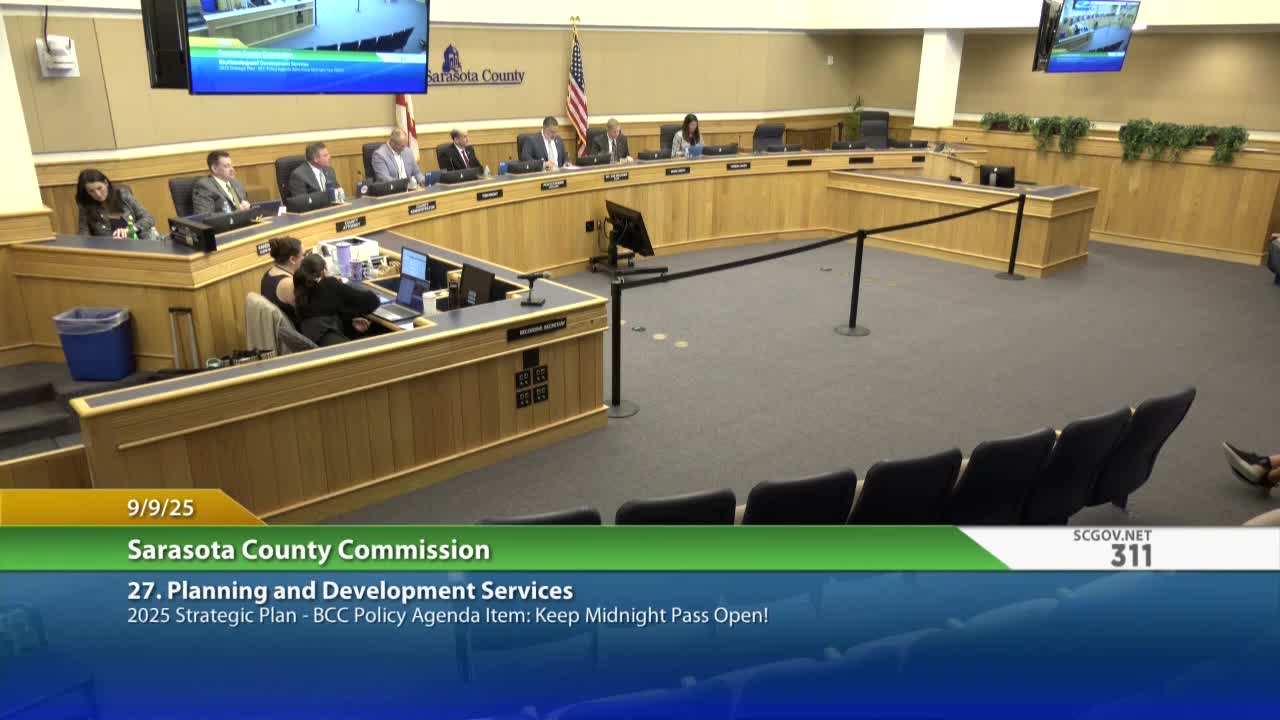
Sarasota officials outline monitoring, emergency triggers to keep Midnight Pass open
Summary
County engineers and consultants told commissioners that the storm‑created Midnight Pass has remained open for nearly a year, is showing signs of stabilizing, and will be monitored weekly; staff described emergency triggers and said long‑term inlet management would require years of permitting.
Sarasota County officials said Wednesday that the storm‑created Midnight Pass has remained open since October and that monitoring and modeling so far show a generally favorable trend, but they outlined specific triggers that would prompt emergency action if the inlet begins to close.
The county’s hydrodynamics consultant, Dr. Mike Jenkins of ATM Geosyntec, told the Sarasota Board of County Commissioners that the inlet “has remained open post Milton and is exhibiting behavior consistent with an evolving, unstabilized coastal inlet.” Jenkins said weekly surveys and recent current measurements show the inlet’s cross‑section and tidal flows have generally increased since a January low and that peak flows measured in August reached roughly 120 cubic meters per second.
County staff and consultants said the monitoring program is focused on whether the inlet will remain open, and on providing data to regional models and to state regulators. Commissioners and staff described three formal “triggers” that could prompt an emergency response if the pass begins to close: the inlet throat shrinking toward roughly 500 square feet, a rapid northward migration of the deepest channel centerline, or an abrupt storm‑driven closure.
The board’s staff said the county has been collecting cross‑section profiles since late October and is doing repeated current and tidal‑prism measurements at multiple locations. Jenkins summarized work to update regional hydrodynamic models to reflect the new inlet and showed an animation the county said indicates increased water exchange across the bay system since the pass opened.
Why it matters: Midnight Pass has been a long‑running local priority because an open inlet changes tidal exchange, navigation and local water quality. County staff said the state is engaged and that the county has already sought cost‑share funding for ongoing monitoring and management.
What officials plan next: Staff recommended continuing weekly profile surveys, repeating current measurements, updating models, sharing data with academic and nongovernmental partners, and keeping open lines with the Florida Department of Environmental Protection. Jenkins and staff advised that a formal inlet management plan under Florida rules would be a multiyear permitting effort and only be triggered if the county pursued corrective construction such as jetties or permitted dredging. In the shorter term, the county described the option to pursue a narrowly limited emergency action under a board emergency order — done in consultation with DEP — if the inlet showed signs of imminent closure.
Commissioners asked staff to expand planning for related community needs, including signage, safety outreach and seagrass protection as the inlet and adjacent shallow areas evolve. Commissioners and staff also agreed to pursue public engagement (town hall/forum) so residents can hear technical findings and ask questions.
Quotes and context: Dr. Mike Jenkins, the county’s engineering consultant, summarized the monitoring: “The minimum cross section we observed was in January of 629 square feet. Our maximum cross section we just saw in July was 1,543 [square feet].” County staff added that measured peak flows in August were roughly 120 cubic meters per second — an order of magnitude higher than winter peaks — and that these flows help explain why the inlet has so far remained open.
Limitation and next steps: Jenkins and staff cautioned there are no guarantees — inlets evolve over years and the county is only about 10 months into this new condition — and that long‑term corrective measures would require formal permits and environmental review. For now, county staff said it will continue monitoring, coordinate with DEP and partner organizations, and return to the board if emergency conditions trigger corrective action.