Get Full Government Meeting Transcripts, Videos, & Alerts Forever!
Get email alerts on the Historic Preservation Signage topic
No spam. Unsubscribe anytime.
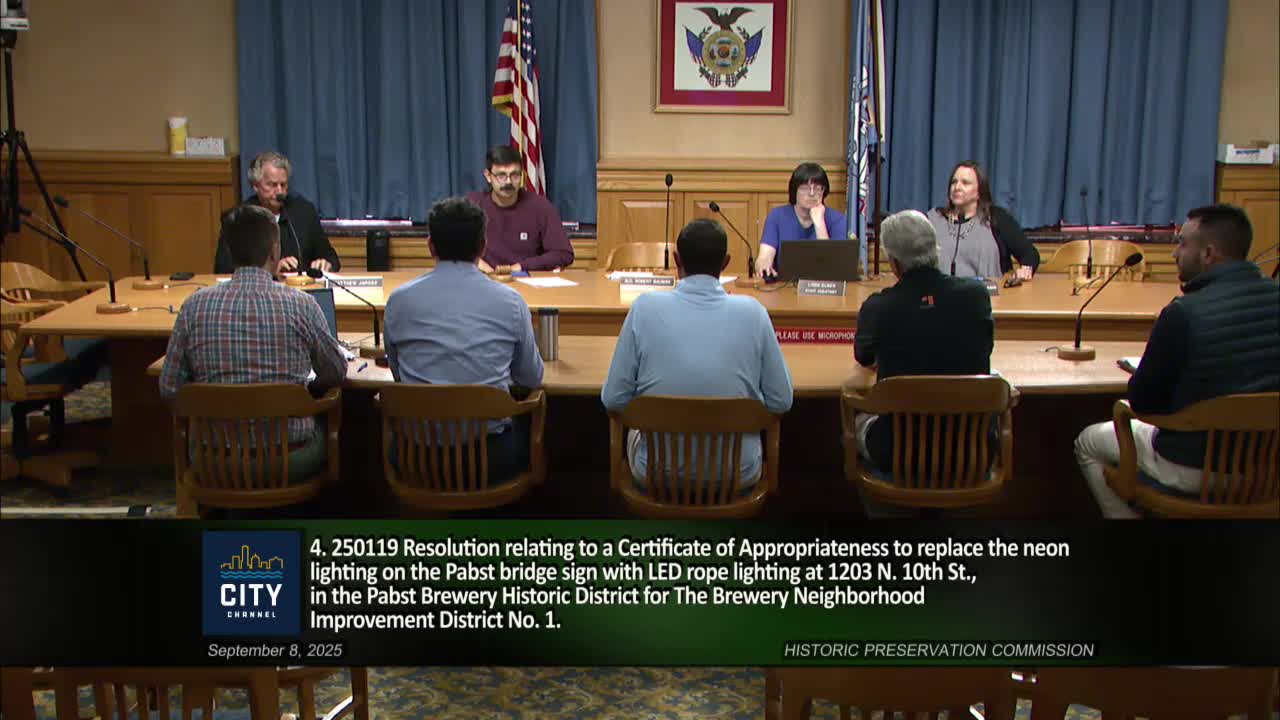
Historic Pabst Bridal sign to keep neon look but switch to LED over accessibility objections
Summary
Milwaukee Historic Preservation Commission approved replacing the Pabst Bridal neon lighting with LED rope lighting, adding a condition requiring a color formula and noting the sign's inaccessibility as the basis for the decision despite staff and preservationist objections to removing historic neon.
The Milwaukee Historic Preservation Commission voted to allow the Pabst Bridal sign on North Tenth Street to be re-lit with LED rope lighting, with a condition that the LED color formula match the sign’s historic red as closely as possible and noting the sign’s limited accessibility as a unique circumstance.
The sign’s applicant, represented by Michael Kelly, chairman of the Pabst Brewery Neighborhood Improvement District (NID), asked the commission to permit Aurora Flex LED rope lighting to replace the sign’s historic neon and said the switch was aimed at keeping the sign lit more reliably. "This is the only option we found to make sure that the sign is lit 24/7, 365," Kelly said.
Staff recommended denying the LED replacement and retaining the neon. Historic Preservation staff argued the Pabst sign "rises to the level of being an iconic sign" in the city and quoted National Park Service guidance that historic materials should be retained and, where possible, replaced with like materials. Staff added that the sign’s neon lighting can be serviced and repaired and that prior failures were largely due to moisture intrusion in transformer and connection areas.
Jeremy Ebersole, formerly of the Milwaukee Preservation Alliance and a national expert on neon preservation, gave testimony opposing LED conversion. Ebersole argued neon and LED differ materially in appearance and longevity and warned that LED is a "cheap, throwaway substitute" compared with neon. "Photos don't really do justice to the true difference in the materiality and quality of light," he said.
Commission discussion addressed preservation precedent, visibility of differences at the sign’s high elevation, and the practical difficulties of servicing the Pabst sign. Commissioners who visited a full-scale mock-up said the LED was close in color and profile and noted that the sign is unusually inaccessible: it is mounted over a public roadway, requires street closures and crane work for major repairs, and experiences frequent outages and costly repairs when neon tubing fails.
One commissioner who supported the LED replacement said the mock-up made the LED "pretty close" to the neon when viewed in place; another commissioner urged caution about precedent but noted the limited number of comparable large neon signs in the city.
The motion to approve the LED substitution included explicit language that the approval was based on the sign's substantial inaccessibility for routine repair and that the COA should specify the LED color formula to match the historic red. The motion passed with one commissioner recorded in opposition.
The commission did not direct removal of the original neon in any specific phased timeline; the applicants described replacing neon tubes in the field as part of the installation process.
The commission’s action permits the proposed LED installation subject to (1) a color/formula requirement to maintain the approved red appearance and (2) the statement in the motion that this approval reflects this sign’s particular inaccessibility for routine maintenance and is not intended as a blanket precedent for other signs.
The decision follows extensive public comment and technical testimony about neon preservation and the practical maintenance burdens the NID described. The applicant said the LED conversion costs are roughly $20,000 and that LED components likely will need replacement on a multi‑year cycle.
The commission did not adopt staff’s recommendation to retain neon; the vote carried with one opposed.
The commission moved on to other agenda items following the vote.