Get Full Government Meeting Transcripts, Videos, & Alerts Forever!
Get email alerts on the Economic Development Area topic
No spam. Unsubscribe anytime.
Grant County panel agrees to pursue two economic-development areas to target industrial parcels
Summary
The Grant County Regional Commission reviewed maps and agreed by consensus to advance two proposed economic development areas — around the Fairmount interchange and a west-side rail-spur/industrial cluster — and asked staff and its advisers to produce detailed, parcel-level proposals for the next meeting.
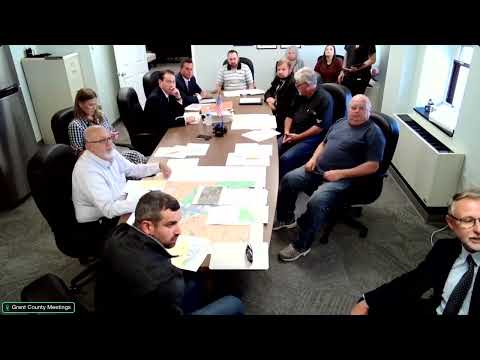
The Grant County Regional Commission on Sept. 2 reviewed maps showing unincorporated industrial parcels and reached a consensus to advance two candidate economic development areas (EDAs) for later formal action.
Commission staff presented maps that highlighted several unincorporated industrial parcels east and west of Marion, parcels near the State Road 26/I-69 interchange, and a cluster served by a railroad spur. Staff and the commission discussed using an EDA and one or more allocation (TIF) areas to capture increment for infrastructure and site-preparation work.
Why it matters: creating an EDA establishes where tax-increment revenues can be spent; the base valuation date used for an allocation area determines whether future assessed-value growth will generate increment to support debt or projects. Commissioners emphasized early designation so the base can be fixed before major development increases assessed values.
Staff framed the recommended first step as establishing a consolidated economic development area and then carving smaller, project-specific allocation areas as needed. The commission said it preferred to begin with a consolidated boundary and then refine it into smaller allocation areas tied to project needs, rather than creating individual, isolated districts at the outset.
Greg Bassano, a financial adviser with Baker Tilly who joined the meeting, explained the mechanics and timing. He told the commission to “think of it as the economic development area is that area where the money can be spent,” and outlined how allocation-area bases are set. Bassano said that if an allocation area’s process is completed in 2025, the base would be set to the assessed value on Jan. 1, 2025 (taxes payable 2026), and any development that occurs after that date will not increase the base for capturing increment.
Commissioners and staff discussed trade-offs of broad versus narrow EDAs. Several members cautioned against designating the entire county, noting that a county-wide allocation area would capture a larger share of future assessed-value growth (and thus reduce future general-fund revenue available to schools and other taxing units). Staff noted the statutory and financial consequences that drive those trade-offs and said that the group must balance flexibility for recruiting projects against potential tax-rate impacts for other taxing districts.
On locations, commissioners expressed support for two priority areas to be advanced for detailed mapping and next steps: (1) the Fairmount interchange (the highway interchange with three to four parcels identified, where staff said six of seven property owners have indicated they would entertain discussions with a prospective developer), and (2) a west-side area tied to a rail spur and existing industrial-zoned parcels. The commission also discussed extending an EDA along key corridors (for example along State Road 18 east from Marion) where parcels are currently a “sawtooth” mix of incorporated and unincorporated property and where utilities and right-of-way connections would matter for future projects.
Direction to staff and advisors: commissioners asked staff to prepare parcel-level options and a timeline for the next meeting. Staff said the process requires approvals by this body, the county council, the county commissioners and a public hearing; they also noted creation of an economic development committee and other statutory steps. Bassano and county staff said there is a roughly 25-year expiration commonly used for allocation areas tied to debt issuance; the 25-year capture period starts from the first issuance of debt for that allocation area.
Concerns and process clarifications: multiple members urged restraint in drawing overly broad boundaries and requested continued coordination with municipal officials (the commission discussed the need for “courtesy” engagement with city leaders so counties and cities do not end up in direct competition). Members also asked staff to confirm utility availability for candidate parcels before drafting final maps.
Next steps and timeline: staff committed to return with parcel-specific proposals and draft maps at the next regular meeting; commissioners discussed trying to complete initial steps so base dates could capture 2025 assessed values where possible, and mentioned an October timeframe for initial ordinance drafting and public-notice steps.
Votes at a glance
• Motion to approve meeting minutes from Aug. 4, 2025 — mover recorded as Aaron; second not specified; outcome: approved by voice vote; exact tally not specified.
Provenance
Topic intro: “Alright. Perfect. We'll move on to number 4, maps of some areas in Elkport, Grand County. Yeah. So I have, provided you all with some different, options.” (transcript block starting at 241.86).
Topic finish: “I mean, I guess it's a general consensus side. I don't think they necessarily need for a vote too, but I will undertake this work to advance the 2 locations that show up. Great stuff. I'll work with Chris and, Greg and you'll work on what may plan next meeting for. Okay.” (transcript block starting at 2547.24).