Get Full Government Meeting Transcripts, Videos, & Alerts Forever!
Get email alerts on the Mental Health Facility topic
No spam. Unsubscribe anytime.
County official says merged departments will oversee mental health facility; board discusses forensic backlog and need for supportive housing
Summary
Kathy Burgos announced that Community Action Human Services and Juvenile Services have merged and that the merged department will oversee the planned mental health facility; board members discussed the state's forensic backlog, potential use of the facility for step‑down placements and the need for more supportive housing.
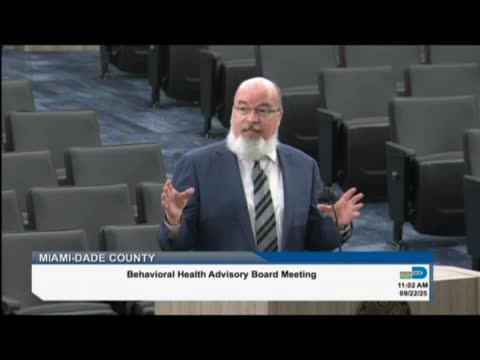
Kathy Burgos told the Behavioral Health Advisory Board that Miami‑Dade County has merged Community Action Human Services and Juvenile Services and that the merged department will oversee the planned county mental health facility.
Burgos, who said she will oversee the merged department, told the board the county can begin services once the budget item passes and licensing is completed. She said the building itself requires additional build‑out—specifically a kitchen and work on the seventh floor—but that meals can be delivered while kitchen work is completed. Burgos estimated the program could be set up and begin offering crisis, short‑term and longer‑term services within about six months if licensing and procurement proceed without delay.
Several members brought up the statewide backlog of people found incompetent to proceed and asked whether Miami‑Dade could prioritize placements from local jails and state hospitals. The public defender noted the high waiting lists and urged prioritizing the roughly 50 individuals in Miami‑Dade County who are awaiting forensic placement. Burgos and other officials said county officials and the board will pursue coordination with state authorities and managing entities to identify pilot options.
Board members discussed the distinction between residential level classifications and available community placements. A county official said state dollars intended to fund an intermediate residential (level 1) placement for forensic diversion are currently being used for level 2 placements at a nearby center; opening a level 1 unit at the Miami Center or related campus was discussed as one local option. Several members emphasized that even when inpatient or forensic beds are available, community step‑down placements and supportive housing are necessary to create throughput and avoid bottlenecks.
Members urged county staff to pursue state pilot programs, explore partnerships with existing regional providers and track whether any state funds could be drawn down for beds that support forensic diversion and transition to community care.