Get Full Government Meeting Transcripts, Videos, & Alerts Forever!
Get email alerts on the Community Resources Nami topic
No spam. Unsubscribe anytime.
NAMI Miami‑Dade outlines helpline, peer support and outreach programs to board
Summary
Susan Holtzman, president and CEO of NAMI Miami‑Dade County, described the affiliate’s education, support and advocacy programs, helpline operations and partnerships with first responders and county services.
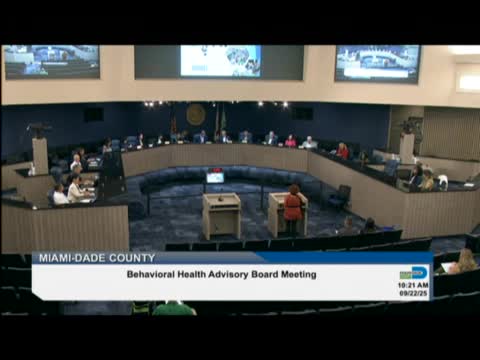
Susan Holtzman, president and CEO of NAMI Miami‑Dade County and a board member, briefed the Behavioral Health Advisory Board on NAMI’s local services and outcomes on Sept. 22.
Holtzman said NAMI Miami‑Dade is one of the largest local affiliates in the country and serves Miami‑Dade and Monroe counties. She described the organization’s three pillars—education, support and advocacy—and listed signature programs including Ending the Silence (school outreach), Family‑to‑Family education, QPR suicide prevention training, peer support groups and a helpline.
The helpline number given at the meeting was (305) 665‑2540. Holtzman said the helpline is staffed by trained peers who answer calls Monday through Friday and will speak with callers as long as needed; the service can provide warm handoffs from 988 and from mobile response teams. She said NAMI also provides peer mentoring and help for families, in English, Spanish and Creole, and operates a signature walk that draws community participation.
Holtzman cited statistics to describe scope and program outcomes: “One in five U.S. adults experience mental illness each year,” she said. She added that “50 percent of all lifetime mental illness begins by age 14 and 75 percent by age 24,” underscoring the affiliate’s focus on youth outreach.
On program outcomes, Holtzman reported that 72 percent of youth in the Ending the Silence program improved protective factors; QPR participants improved protective factors by roughly 79.8 percent; and support‑group participants reported increased connection (87 percent) and improved well‑being (83 percent). NAMI is running local studies to quantify program impacts in Miami‑Dade, she said.
Holtzman asked board members to consider referrals and partnerships; members asked about linkage to 988 and call volume. Holtzman said NAMI is not the 988 call center but that the affiliate coordinates with 988 and other partners and will provide warm handoffs when calls exceed NAMI’s scope.