Get Full Government Meeting Transcripts, Videos, & Alerts Forever!
Get email alerts on the Financial Empowerment topic
No spam. Unsubscribe anytime.
City staff to explore Financial Empowerment Center model; CFE Fund academy and grants described
Summary
Office of Equity and Inclusion and Economic Development staff reported to committee on Financial Empowerment Center models, program delivery options, grant timing and next steps for possible city participation in the CFE Fund Financial Empowerment Academy.
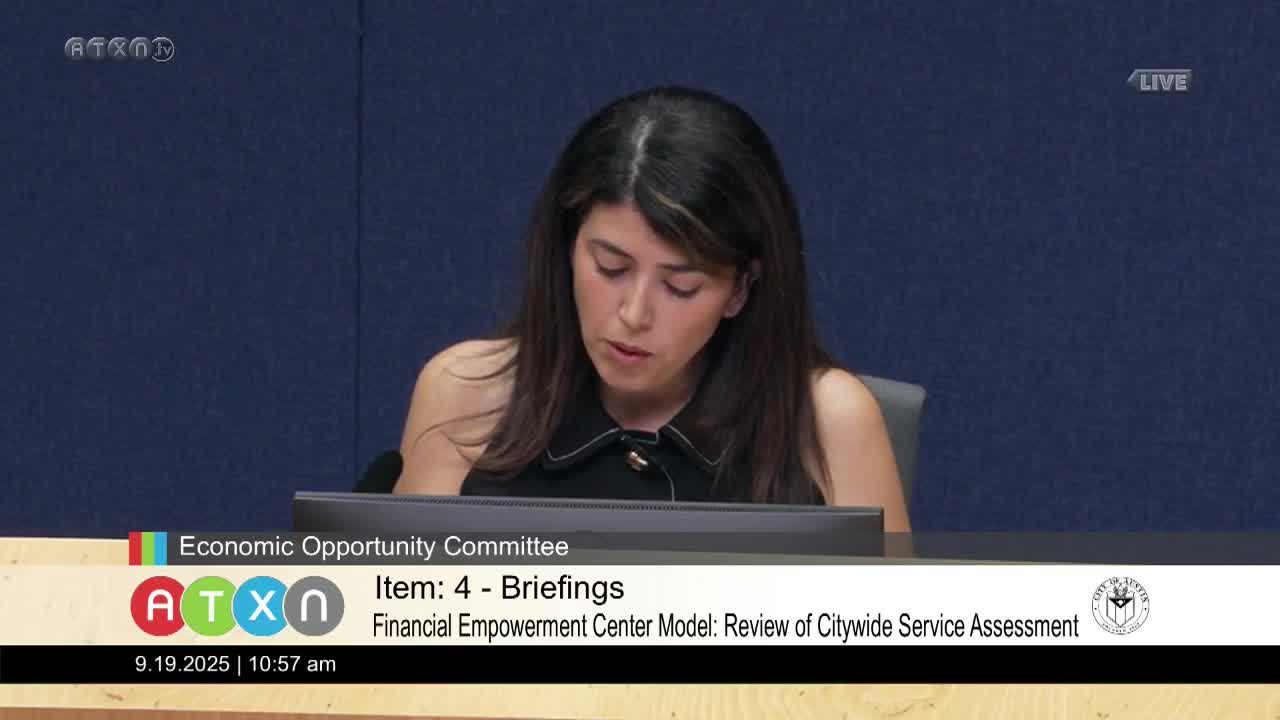
Dr. Lindsey Wilson, director of the Office of Equity and Inclusion, briefed the Economic Opportunity Committee on Sept. 19 about Financial Empowerment Center (FEC) models and how Austin might pursue the Cities for Financial Empowerment (CFE Fund) program.
Wilson explained that FECs provide free, professional one‑on‑one financial counseling focused on banking access, credit improvement, debt management and savings. She said roughly three dozen local governments operate FEC models nationally and the CFE Fund supports city participation through training and technical assistance.
Wilson described two primary delivery options: an in‑house model, in which a city hires counselors and manages service delivery, and a contractor model, in which a city contracts nonprofit partners already providing financial counseling. In‑house models provide tighter oversight but higher operating costs; contractor models reduce initial investment but can present sustainability and quality‑control challenges, Wilson said.
She reviewed examples from peer cities (Dallas, Houston, Shreveport) and described how local programs vary: Houston and Dallas use contractor models at multiple sites, while some other cities use in‑house delivery. Wilson told the committee there are no current Austin city programs that meet the formal FEC standards for structured one‑on‑one financial coaching.
The CFE Fund’s Financial Empowerment Academy is a two‑phase, roughly 15‑month program: an initial feasibility and planning phase (including registration and training) and a second technical assistance phase. The Academy includes a $20,000 planning grant and, upon completion of the two phases, eligibility to apply for a $150,000 matching implementation fund. The transcript notes a 2025 enrollment window and an October 2025 academy start for jurisdictions moving forward.
Wilson said cities considering participation must demonstrate capacity (cities typically have more than 50,000 residents), choose a delivery model, register on the CFE Fund platform and complete counselor training and certification. Councilmembers asked about timing and costs; Wilson said the Academy is a 15‑month commitment, organizations would need to plan for ongoing operational funding, and staff would return with more specific resource needs if Austin pursues the program.
No formal council action was requested at the briefing; committee members expressed support for further exploration and for submitting an application to the next Academy cycle. Wilson noted the need to evaluate whether to stand up in‑house capacity or to partner with local nonprofits and asked staff to return with feasibility and cost estimates.