Get Full Government Meeting Transcripts, Videos, & Alerts Forever!
Get email alerts on the Board Governance topic
No spam. Unsubscribe anytime.
Behavioral Health Advisory Board adopts bylaws, names vice chair and forms four committees
Summary
The Miami‑Dade Behavioral Health Advisory Board adopted bylaws based on the county ordinance, confirmed a vice chair and created four working subcommittees to focus the board's work on prevention, stigma, social media outreach and supportive housing.
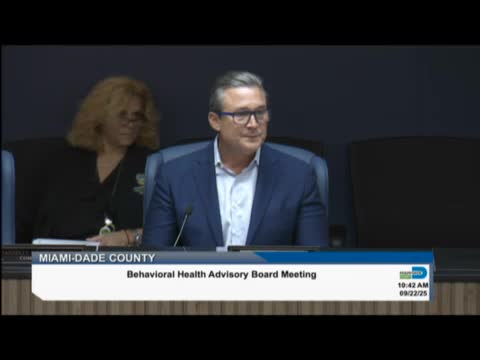
The Behavioral Health Advisory Board adopted its bylaws, confirmed a vice chair and established four subcommittees at its meeting on Monday, Sept. 22.
The board voted to adopt bylaws prepared by county staff that the presentation said were “based on the ordinance” that created the advisory board. The bylaws were amended at the meeting to replace the term “suffering” with “recovering” in membership language; the amendment was approved by voice vote and the bylaws were adopted as amended.
The board also nominated and confirmed Claudio Perez as vice chair by acclamation. Members approved the July 29 minutes by voice vote earlier in the meeting.
Board members discussed the ordinance-specified duties that the bylaws reflect, including advising the board on behavioral health issues, developing a community needs assessment and monitoring county-funded behavioral health programs. Amanda (staff member) read sections of Article 10 of the ordinance aloud during the discussion, noting duties such as identifying high service utilizers, developing a comprehensive list of behavioral health providers and advising on a data‑sharing collaborative.
Senator Renee Garcia (chair) opened discussion about next steps now that the board is organized. Members moved to create four subcommittees to do the detailed work outside full board meetings: (1) prevention and first‑responder/veteran outreach (including suicide prevention), (2) stigma reduction and public engagement, (3) social media and communications strategy, and (4) supportive housing. Amanda said staff will circulate committee options and sign‑up information to members.
Senator Garcia emphasized using the subcommittees to produce actionable recommendations the full board can bring to the County Commission. Several members asked that committee work be Dade‑County specific and coordinated with existing provider networks and university needs assessments.
Board members agreed the committees should be small (three to five members) to permit focused work and regular reporting back to the full board.