Get Full Government Meeting Transcripts, Videos, & Alerts Forever!
Get email alerts on the Workforce Development topic
No spam. Unsubscribe anytime.
Austin Infrastructure Academy launches navigators, scholarships after $5 million city investment
Summary
City-funded Austin Infrastructure Academy has hired career navigators, awarded training scholarships and reported early placement results as Workforce Solutions and partners align training with construction and infrastructure project demand.
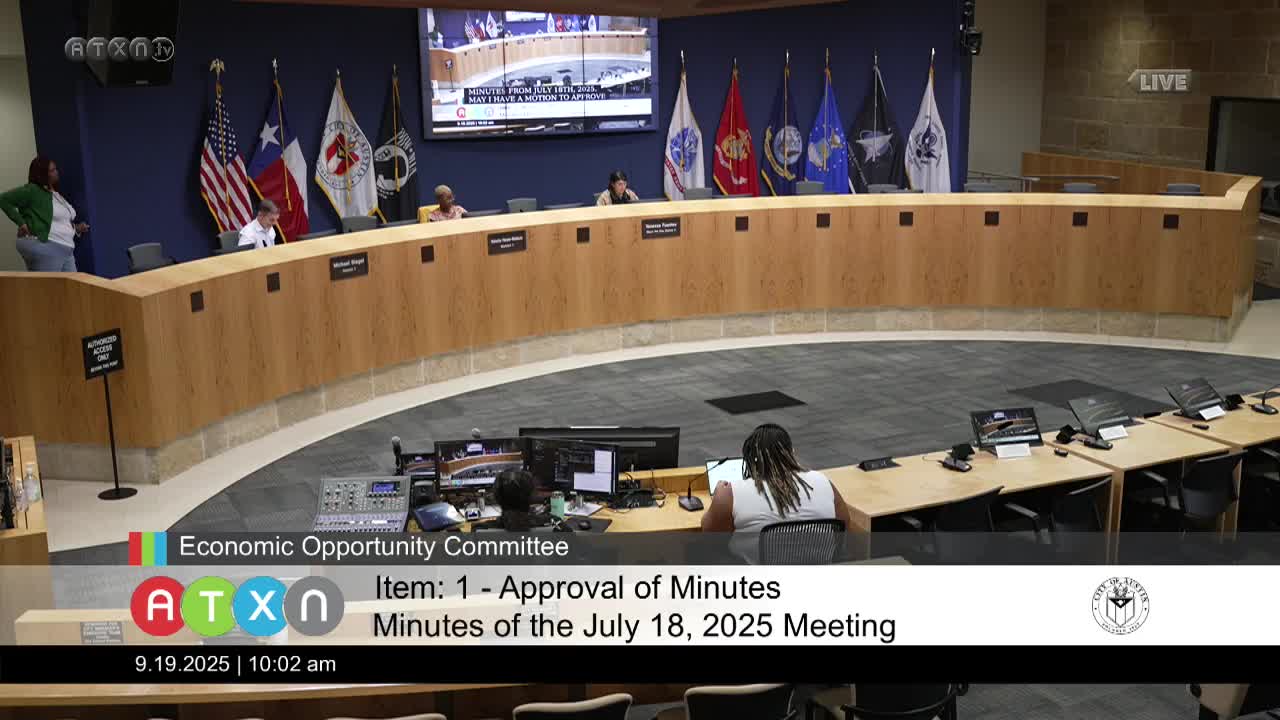
Mayor Pro Tem Vanessa Fuentes convened the Economic Opportunity Committee on Sept. 19 to receive an update on the Austin Infrastructure Academy, a city-backed workforce initiative designed to connect local residents to training and jobs in construction, transportation and skilled trades.
The interim CEO of Workforce Solutions, Yael Lawson, told the committee the Infrastructure Academy serves as a networked “ecosystem of partners” — including Austin Community College (ACC), unions, training providers and community organizations — rather than a single physical facility. “We help employers find the workers that they need, connect local people to local jobs, support people in building long term careers, and we remove barriers such as the training costs, child care, transportation,” Lawson said.
The program launched in March 2025 after a planning phase that included a study funded by CapMetro and ATP. Lawson said the city council approved $5,000,000 to put the initiative into action and that ACC has offered space on a new campus being built by the airport. Private and philanthropic support cited during the presentation included grants or funding from Texas Mutual and Google to support planning and hiring.
Lawson described new roles called career navigators that Workforce Solutions has hired to provide hands-on guidance. “They don’t have a caseload. They’re just talking to people and sharing the opportunities that are available to them,” she said. Navigator services include placement assistance, referrals for childcare and transportation support, and help with on-the-job needs such as tools.
Committee members pressed for details about how the Academy will reach groups underrepresented in the trades. Lawson highlighted outreach to women, justice-involved individuals and people experiencing homelessness, and noted the Academy is tracking referrals and navigator contacts to measure use of supports such as childcare and transportation. “Women represent just 14% of the workforce in these skilled trades,” Lawson said, framing the gender gap the Academy plans to address.
Program partners and training examples cited included ACC, Local 286 (plumbers and pipefitters) and the MC3 pre-apprenticeship curriculum. Lawson said ACC and unions built an MC3-like course and the Infrastructure Academy funded most of the first cohort. The presentation also described partnerships with Del Valle High School (spelled in the transcript as “Dale Valley”), an HVAC course run by the Other Ones Foundation for people experiencing homelessness, and employer collaborations intended to align curriculum with demand from large city and regional projects such as Project Connect, the airport expansion and I-35 work.
Staff gave a short tally of early outputs: 306 attendees at the launch/career fair (28 employers and 11 training providers), a June career fair with 209 attendees (21 employers and five providers), about 100 people who have met with career navigators, 47 scholarships awarded for training, and 28 job seekers who obtained full-time employment, nine of whom entered jobs after “earn and learn” training.
Councilmembers and staff discussed funding, coordination and next steps. Councilmember Greg Casar’s seat was not present on the dais; Councilmembers Siegel and Harper Madison asked detailed questions about childcare, transportation supports, outreach to women and justice-involved residents, and tracking of graduates into city hiring pipelines such as Austin Water and Austin Energy. Anthony Segura, interim director of the Economic Development Department, and Anne Eaton, assistant director, were among city staff participating in the discussion.
Lawson and staff said next steps include formalizing governance through an advisory council, building a marketplace (an online “front door” for training and employer demand) and exploring a colocated facility at ACC in early 2026. The committee was also reminded of a related public event, a water forum on Oct. 16.
The committee did not take a formal vote on policy changes during the briefing; members asked staff to return with additional details on program tracking, partnership agreements and how city budgeted funds are tied to public projects.
Questions and requests for follow-up included: more granular tracking of childcare and transportation supports deployed, plans to recruit and retain women in trades training, clarification of apprenticeship entry barriers for some justice-involved people, and coordination with existing city hiring pipelines.
The update emphasized measurement: staff said they will track wages, placement counts and upskilling over time to assess impact and accountability for the city’s $5 million investment.
Ending: Committee members praised the early outputs and requested follow-up briefings with additional detail on outcomes, funding sustainability, and how graduates feed into city infrastructure hiring needs.