Get Full Government Meeting Transcripts, Videos, & Alerts Forever!
Get email alerts on the Federal Policy Health topic
No spam. Unsubscribe anytime.
Marin staff warn HR1 reconciliation bill could cut local health, nutrition and clean‑energy supports
Summary
Marin County staff and local health providers told the Board of Supervisors on Sept. 9 that HR1, the federal budget reconciliation bill, could reduce Medi‑Cal coverage, cut immigrant emergency funding and SNAP administration support, and eliminate some clean‑energy tax credits — with staged impacts beginning in 2026.
County staff and health providers told the Marin County Board of Supervisors on Sept. 9 that HR1, the federal budget reconciliation bill signed on July 4, could reduce coverage and funding for tens of thousands of county residents and harm local clinics, nutrition programs and clean‑energy incentives over a phased rollout beginning in 2026.
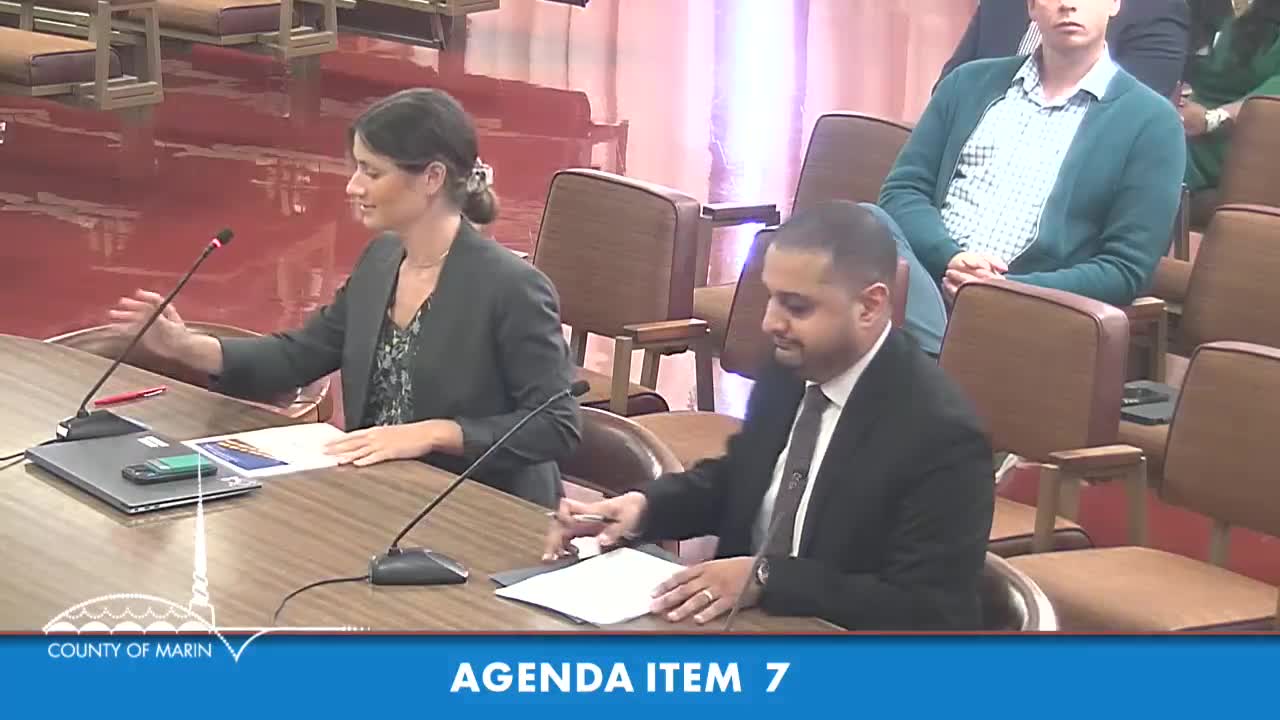
Talia Smith, director of Legislative and Intergovernmental Affairs, and Ahmed Ishmael, chief fiscal officer for Health and Human Services, presented an informational report that outlined changes in the bill and their projected local effects. Smith said HR1 was passed through budget reconciliation and that significant implementation uncertainty remains pending federal and state guidance. "This presentation is intended to accompany an informational report... there is significant uncertainty still in how this bill will actually be implemented," Smith said.
Ishmael summarized local exposure: approximately 54,000 Marin residents currently rely on Medi‑Cal, about 11,000 of whom have unsatisfactory immigration status; the Congressional Budget Office estimated a $3.4 trillion increase to the national deficit over 10 years and the county described a phased set of local impacts beginning in 2026 and increasing through 2028. The county warned that immigrant emergency funding would be reduced, work requirements for benefits could begin in 2027, retroactive coverage and eligibility protections could shrink, and SNAP (CalFresh) administration funding would be cut, increasing county administrative burden.
Ishmael said those changes would likely increase uncompensated care at clinics and hospitals, raise emergency room reliance, and shift costs to local providers. "At the community level, more residents lose coverage, skip preventive care, and delay treatment. This drives more emergency room visits and increased uncompensated care," Ishmael said. County staff published an informational dashboard developed with UC Berkeley’s Goldman School of Policy and CSAC to model Medi‑Cal impacts.
Healthcare providers and community clinics told the board they are preparing for losses. Tracy Mendez, CEO of Aliados Health (representing the county’s four federally qualified health centers), said roughly 6,000 current patients could lose coverage by 2027 and estimated about $7 million in lost revenue across the FQHCs, not including increased administrative costs for patient navigation. "By 2027... about 6,000 of our current patients will either lose their medical coverage or have much less comprehensive coverage... that impact to the health centers will be about $7,000,000 a year," Mendez said.
Other clinic leaders echoed the concerns. Brenda Shipp of Buran Community Clinic said enabling services and specialty care for uninsured and low‑income patients could be at risk. Sven Sigurdsson of Petaluma Health Center urged continued county support for West Marin clinics and said his organization is preparing alternative, non‑federally supported sites to ensure access. Mark Shotwell of Ritter Center said the proposed federal changes would have "profound negative impact" on people the center serves and on local safety‑net capacity.
County staff also described HR1’s changes to clean‑energy and tax policy. Smith said the bill eliminated certain federal tax credits created by the Inflation Reduction Act — affecting home energy retrofits and a $7,500 federal EV tax credit — and said the loss of those credits could reduce uptake and local contractor work in the clean‑energy sector. The bill also increased funding for immigration enforcement and tightened eligibility for certain tax credits for families without Social Security numbers, the presenters said.
Board members and staff discussed mutual aid planning, clinic coordination, and outreach to keep people enrolled. The board did not take action; staff said they are forming internal and county‑wide workgroups with FQHCs and community partners to prepare outreach, maintain enrollment and mitigate service disruptions.