Get Full Government Meeting Transcripts, Videos, & Alerts Forever!
Get email alerts on the Hilltop Bia topic
No spam. Unsubscribe anytime.
Tacoma committee hears opposition and questions on proposed Hilltop Business Improvement Area
Summary
Residents, business owners and the citys consultant debated a proposed Hilltop Business Improvement Area that would assess property owners to fund neighborhood services; presenters said the first-year assessment would fund a $604,000 budget, while speakers raised concerns about cost, transparency and displacement.
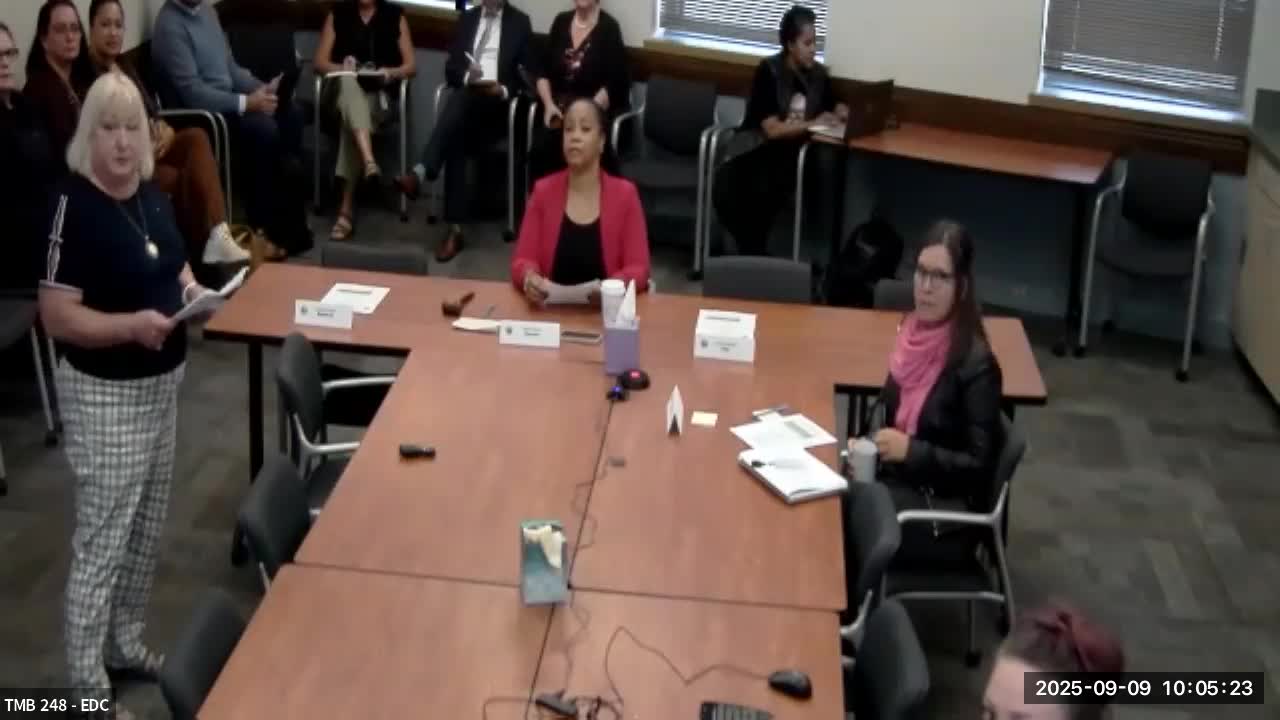
The Tacoma Economic Development Committee spent its Sept. 9 meeting focused on a proposed Hilltop Business Improvement Area (BIA) after residents and business owners urged greater transparency and protections for renters and legacy businesses.
The BIA proposal presented by consultant Andres Mantilla of Uncommon Bridges would cover about 506 parcels and an estimated 212 ratepayers, with a proposed first-year budget of $604,000. "We're looking in Hilltop about 506 parcels. That's about 212 rate payers for a budget of $604,000," Mantilla told the committee as he summarized community outreach and the draft business plan.
The proposal would assess property owners, not tenants, using a value-based formula with two residential ceilings: a market-rate residential ceiling of $65 per unit per year and a subsidized-residential ceiling of $30 per unit per year. Mantilla said the team was working with the city to identify which buildings qualify as subsidized housing and that a 12-year MFTE (multi-family tax exemption) property would not be counted as subsidized under the proposed approach.
Why it matters: supporters say a BIA can provide steady, local funding for cleaning, safety, marketing and small-business support; opponents warn it can accelerate rent increases and displacement if assessments are passed on to tenants or prompt private-sector-led priorities that do not reflect long-term resident needs.
Public commenters at the meeting pressed those concerns. Annika Taylor, who identified herself as self-employed and the operator of an acupuncture clinic in Tacoma, said the assessment would be a permanent burden on small property owners and criticized the proposals accountability provisions: "Handing $605,000 the first year to a nonprofit, especially during a period of economic uncertainty is the height of idiocy," Taylor said, adding the plan "does not propose any form of financial accountability."
Cassandra Williams, owner of Love by the Slice Baking and Catering Company and a Hilltop native, said she supported neighborhood investment but sought clearer protections for Black and Brown residents and legacy businesses: "I want to make sure that those households and those families are not negatively impacted by this," Williams said.
Jennifer Lacey, interim executive director of Hilltop Action Coalition, said the outreach process lacked transparency and that the proposal risked pushing unhoused residents from one neighborhood to another without providing meaningful services: "This ordinance simply will continue that cycle of harm," she said.
David Schroedel, executive director of the Downtown Tacoma Partnership, asked the committee to note how the downtown BIA operates and defended his organizations record of community events and outreach. He said the downtown partnership was formed in 1988 and "was renewed most recently in 2018 with 99% support with a 74% turnout," and urged the Hilltop process to seek similar community buy-in.
Mantilla and city staff described changes made to the draft based on community meetings: the boundary and assessment formulas were revised, a legacy-business fund was added at 5% of the draft budget, an administration line was proposed at 11%, hospitality/outreach at about 21%, and a local-hire commitment of up to 70% of contract services was included. The team also proposed a "grounding period" in year one: if the petition reaches the legal threshold and council approves, the first year would be used to form or select a nonprofit to administer services, develop the detailed workplan and bylaws, and only then issue assessments.
Committee members pressed for clearer representation on the proposed ratepayer board. The draft calls for a governing board of nine to 13 members with seats for two community-group representatives, a Hilltop Neighborhood Business District Association seat, two medical-property-owner seats, north-end and south-end property-owner seats, residential property-owner representation and four at-large members. Several councilmembers and residents asked whether the makeup gave disproportionate influence to large property owners and hospitals and whether the board should require members to live or operate within the district.
Council members also asked how the city and consultants would make outreach materials accessible; Mantilla said a Google Drive with meeting minutes, the draft business plan, parcel data and a community feedback chart had been circulated to a core list of more than 130 people, and he said Uncommon Bridges would post materials on its website while the city explores whether it can host documents on the official site.
No formal action was taken. City staff said the petition process requires a 60% threshold to move forward and that any ordinance creating the BIA would be returned to council with an opportunity to set or modify details. The committee agreed further discussion and a follow-up meeting with legal counsel and additional community outreach would be appropriate before any ordinance is introduced.
The committee scheduled future items on neighborhood business programming and economic development planning; the BIA presentation was the only substantive item on the Sept. 9 agenda.