Get Full Government Meeting Transcripts, Videos, & Alerts Forever!
Get email alerts on the Senior Services topic
No spam. Unsubscribe anytime.
Skagit County proclaims September National Senior Center Month as officials and residents warn 2026 budget gap threatens services
Summary
The Skagit County Board of Commissioners proclaimed September 2025 as National Senior Center Month and heard multiple speakers describe the county's senior centers and Meals on Wheels program while officials said rising costs will create a $1.7 million pressure on the 2026 general fund.
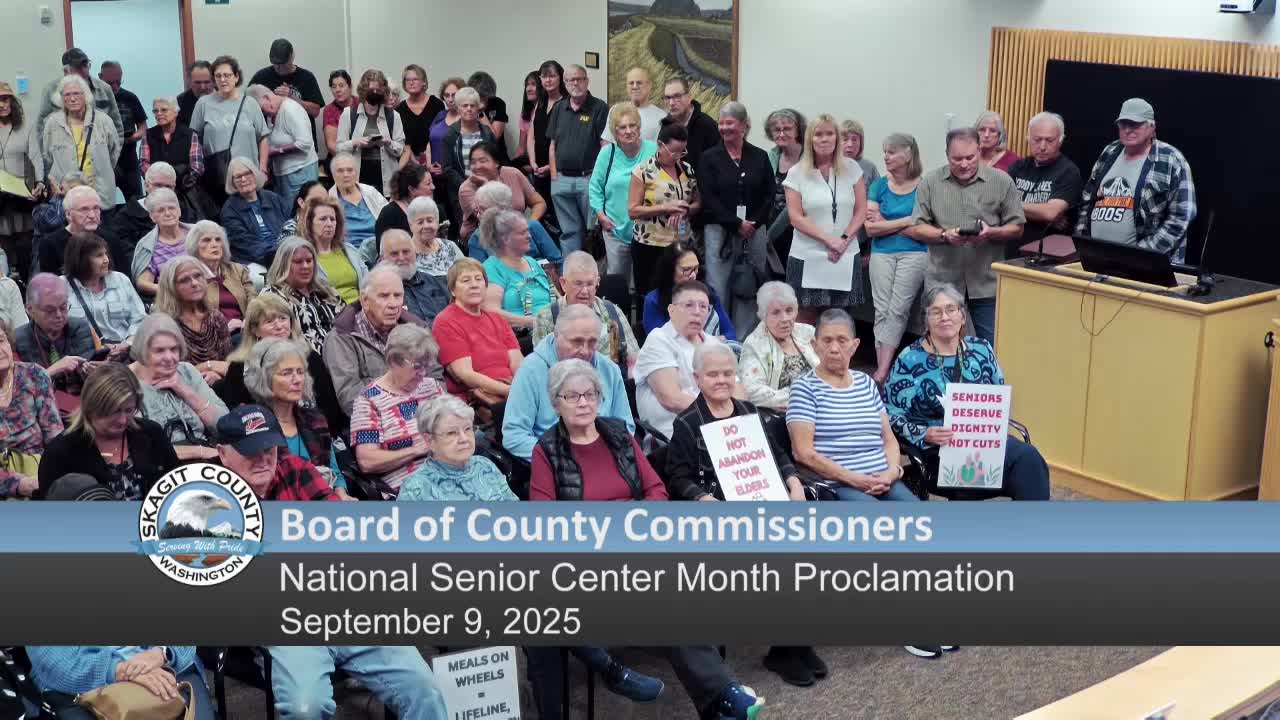
SKAGIT COUNTY, Wash. — The Skagit County Board of Commissioners on Sept. 9 proclaimed September 2025 as National Senior Center Month and heard more than a dozen speakers describe the role of senior centers and the Meals on Wheels program as county officials warned of a $1.7 million pressure on the 2026 County General Fund.
Renee Nelson, Senior Program Manager for Skagit County, told commissioners "We are not closing senior centers or eliminating Meals on Wheels program" but said the county faces "a very difficult budget reality in 2026" and that "the cost of senior service programs ... is estimated to cost the County General Fund over $1,700,000 in 2026." She said staff are "working with public health on a few options to consider" and that none of the options under discussion would close the centers or end home meal delivery.
The nut graf: Senior centers and the Meals on Wheels program serve thousands of local residents, provide regular wellness checks and social contact, and rely on volunteers and limited public funding. County and community speakers stressed the programs' local reach and urged the board to consider funding and operational options before budget decisions are finalized.
Nelson summarized services and scale: Skagit County supports four full senior centers (Anacortes, Burlington, Mount Vernon and Sedro-Woolley) and funds two additional sites in La Conner and Concrete; the centers run congregate lunches, classes and local nutrition programs. Nelson said the centers served a record "over 57,000 congregate meals" last year and that home-delivery drivers made deliveries covering "from Conway to Bow and Marblemount to the Deception Pass Bridge," serving "over 127,000 meals" countywide in the prior year. She said the county remains one of the few in Washington still providing hot daily meals rather than frozen entrees and noted county distribution of 670 farmers market benefit cards and a summer produce delivery program for homebound clients.
Volunteers and staff described personal benefits and program needs. Jackie Kress, Burlington Senior Center coordinator, said, "I have the best job in the world," and told a personal story about long-term volunteers and the social benefits the centers provide. Carl Wolfswinkle, Anacortes senior center manager, and Reva, a volunteer of nearly 30 years, described centers' role after the COVID-19 shutdowns in reconnecting isolated residents. Crystal Hobbs, Mount Vernon Senior Center coordinator, and Ellen Schweigert, senior center coordinator for the City of Sedro-Woolley, described high volunteer hours and community programming.
Area advocates and volunteers highlighted the Meals on Wheels delivery as both nutrition and welfare check. Chris, a Burlington kitchen staff member, said the center and kitchen "do 600 meals a day" and explained many recipients take part of a delivered meal home for a second meal. Pat Nicholson, a Burlington volunteer, said volunteers also run local fundraisers, deliver air conditioners and provide holiday support for housebound residents.
Tribal and partner organizations described service linkages. Lona Wilbur, representing the Swinomish Senior Center, said county staff provide farmers market vouchers and Meals on Wheels deliveries to Swinomish tribal elders. Nelson and other staff said Northwest Regional Council and existing federal aging dollars are part of the funding and oversight landscape; county commissioners noted federal aging funding has not increased with inflation and now covers a smaller share of program costs.
Residents urged the commissioners to involve the community in planning. Jerry Douglas and other Mount Vernon participants called for a senior-led group to advise on a replacement or relocation for the aging Mount Vernon facility; Douglas noted the Mount Vernon building is owned and operated by the city and has recurring infrastructure issues. Several speakers urged exploring nonprofit partnerships and local foundation support, pointing to the Anacortes Senior Activity Center Foundation as an example.
Commissioners responded that the county is exploring alternatives but must weigh legal and procurement constraints of government operation. Commissioner Browning said, "there was never a plan to close the community centers, nor was there a plan to shut down the food service," and described Meals on Wheels deliveries as a critical contact point for vulnerable residents. Commissioners said the county is one of four Washington counties still operating Meals on Wheels directly and that they are reviewing options, including nonprofit delivery, cooperative city partnerships and kitchen capacity limits.
The board passed the proclamation by voice vote after Commissioner Browning read the text and the motion was seconded. Commissioners announced a dedicated 2026 budget public hearing scheduled for Dec. 1 and invited continued written comments to the commissioners' office.
Ending: Speakers emphasized the program's human impact and volunteer base while county officials said they will explore alternatives ahead of the December budget process. The proclamation recognizes the county's senior centers and volunteers while the county seeks solutions to a projected 2026 funding shortfall.