Get Full Government Meeting Transcripts, Videos, & Alerts Forever!
Get email alerts on the On Site Sewage topic
No spam. Unsubscribe anytime.
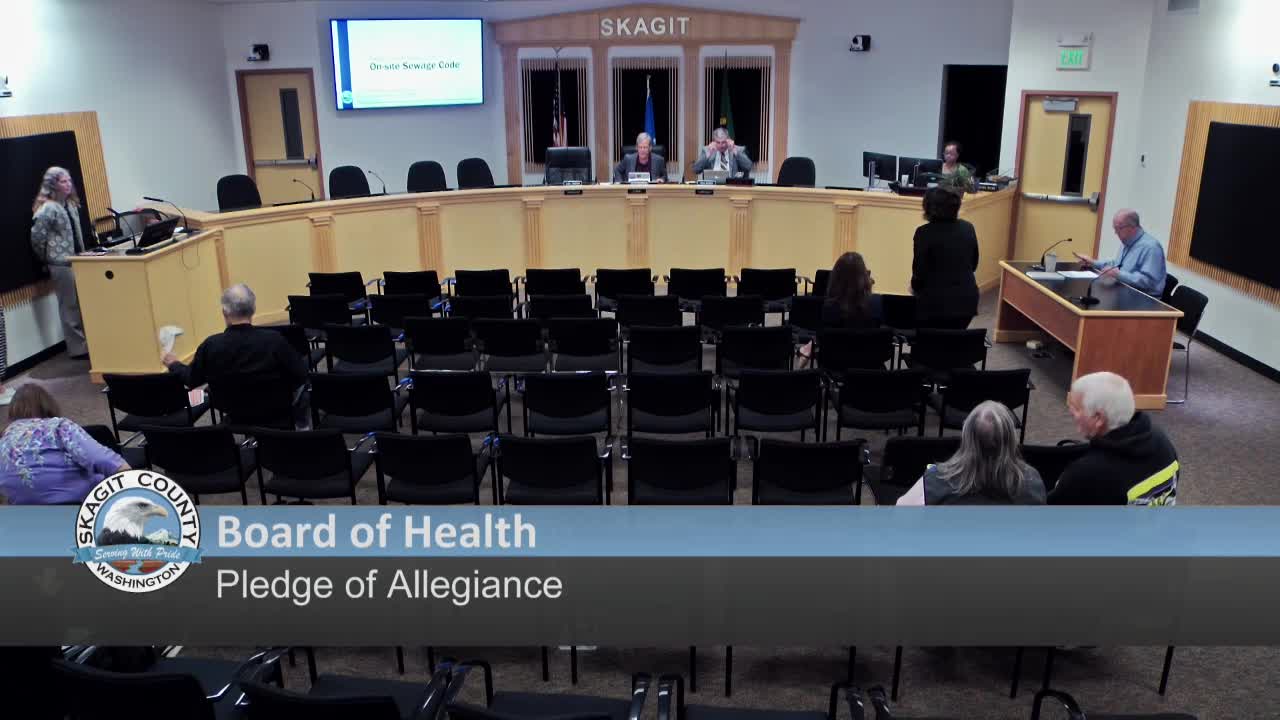
Skagit County Board of Health approves updates to on-site sewage code; adoption set for Oct. 1
Summary
The Skagit County Board of Health voted Sept. 9 to adopt amendments to Skagit County Code 12.05 governing on-site sewage systems after a multi-year review that included public comment and a SEPA review. The board set the ordinance to take effect Oct. 1.
The Skagit County Board of Health on Sept. 9 approved amendments to Skagit County Code 12.05, the county’s on-site sewage (septic) code, following a multi-year review that included technical advisory input, public comment and a State Environmental Policy Act (SEPA) review. The board voted to adopt the ordinance and set an effective date of Oct. 1, 2025.
The code revisions incorporate updates the state Board of Health adopted in January 2024 and preserve several local provisions Skagit County has long used, presenters told the board. “The state board of health did an update to the on-site septic regulations for the state, and then of course part of that, once they adopted in January 2024, then it comes to the local board of health,” said Keith Higman, Director, Skagit County Health Department. Higman and public-health staff summarized the local review and outreach.
Why it matters: the updates align county rules with the state’s on-site sewage requirements while retaining local requirements intended to protect public health in Skagit County’s mix of incorporated and unincorporated areas. Staff said the revisions clarify inspection timing, wet-season review procedures and coordination with cities in Growth Management Act (GMA) areas.
County staff described a multi-step review that began in 2024. A technical advisory group of system designers and installers reviewed draft language and suggested changes. Staff held work sessions with the board from February through May 2025, took written and verbal public comment in June–July 2025 and held a public hearing in July. The county completed a SEPA non-project review, which concluded Aug. 29, 2025.
Presenters described how the local code interacts with state rules. “All of our local regulations…have to be as stringent as the WAC,” a health department presenter said, using the Washington Administrative Code standard that local rules cannot be less strict than state rules; the county may adopt more stringent local provisions when needed. Staff said many changes were housekeeping or clarifying language; others codified routines Skagit County has practiced for years, such as an operation-and-maintenance program and routine monitoring of some systems.
Staff discussed specific operational points that will be reflected in the adopted code. The county will require a wet-season review when soil indicators or modeling suggest the water table may be within 12 to 18 inches of the ground surface; staff said the rule aims to ensure at least 12 inches of vertical separation between the bottom of a drainfield and the seasonal high water table. When a wet-season review is required, staff said they would conduct approximately monthly observations during the wet season to determine actual water-table conditions. The presenter explained that historical indicators in soil profiles can show relic (historic) water-table levels; when designers provide historical floodplain or other documentary evidence, staff may treat that information as part of the evaluation.
Inspecting new or repaired systems was another focus. Staff said the county’s code requests 48 hours’ notice for final inspections but that the department has, in practice, accommodated shorter notice and arranged schedules when installers provide multi-day plans. “We make ourselves available…with 24 hour notice,” the presenter said, adding that the county has staffed final inspections all summer and is training additional staff to increase availability.
On coordination with cities, staff said the code requires review of repairs and work occurring within city limits and that the county coordinates with cities and urban-growth-area authorities when sewer connections are feasible. The department noted that, in some cases, connecting to existing sewer infrastructure is the preferred public-health outcome, but that distance or cost can make hookup infeasible; the health officer retains authority in those cases to require appropriate protective measures.
The board’s action: a commissioner moved to adopt the ordinance amending Skagit County Code 12.05; the motion was seconded by another commissioner. The motion passed with ayes recorded and with Commissioner Janicki absent; the board set the ordinance’s adoption date as Oct. 1, 2025.
What wasn’t decided: staff said the board adopted the proposed code amendments as presented and set the effective date; no additional policy directions or alternative deadlines were recorded in the meeting.
Looking ahead: staff will implement the amended code provisions, continue coordination with cities on GMA repairs, and train additional environmental health staff to perform final inspections and wet-season observations.