Get Full Government Meeting Transcripts, Videos, & Alerts Forever!
Get email alerts on the Public Transit topic
No spam. Unsubscribe anytime.
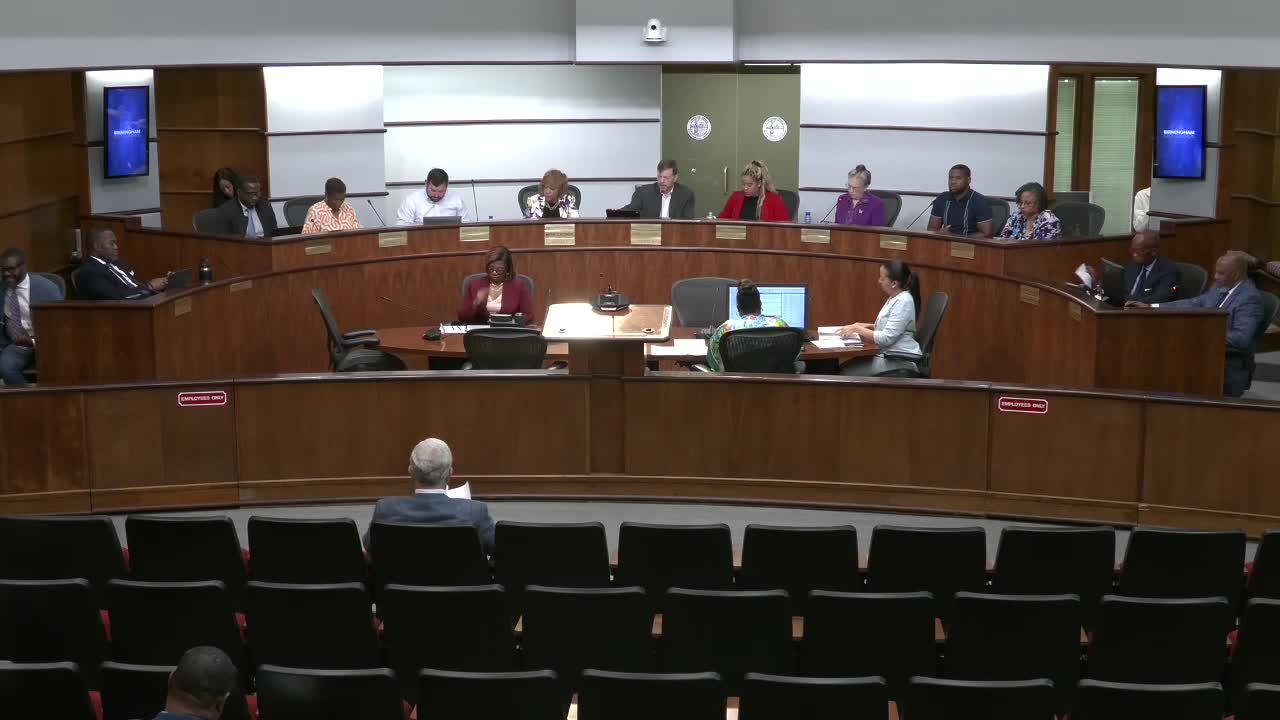
City Council approves up to $14 million transit agreement with BJCTA after questions on app and service reliability
Summary
The Birmingham City Council on Tuesday approved a resolution authorizing the mayor to execute a public transportation services agreement with the Jefferson County Transit Authority (BJCTA) that provides up to $14 million in city funding for transit operations.
The Birmingham City Council on Tuesday approved a resolution authorizing the mayor to execute a public transportation services agreement with the Jefferson County Transit Authority (BJCTA) that provides up to $14 million in city funding for transit operations in the city, including $11 million for fixed-route and paratransit services and $3 million for bus rapid transit (BRT) services.
Councilors pressed BJCTA officials for details on service reliability, the timeline for a promised centralized mobile application and whether reallocations of service would amount to cuts in some neighborhoods. Councilor Hunter Williams said the app has been promised for years and pressed for accountability on delivery: “I’ve been hearing about the app for years. So it, by nature, is delayed,” Williams said during the discussion.
BJCTA officials said the agency had added contract language on a mobile app slated for implementation in January 2026 and described current progress on scheduling and testing. A BJCTA representative told the council the system’s historical on-time performance had been about 58% but had improved and was “around 75%” at the time of the meeting. The agency said phase 1 of the mobile application is expected by January 2026 and that it is in a testing and implementation stage.
Councilors also asked what additional funding would be required to reach service goals discussed in BJCTA’s “70/30” plan; BJCTA representatives said an additional $2 million would be needed to reach that enhanced service target. City staff and BJCTA emphasized the present contract does not include that additional funding and that further budget decisions would be made during the city’s regular budget process.
Several council members sought assurances that reallocations would not become unannounced service cuts. BJCTA said it was reallocating service to match workforce demand rather than cutting service, and noted Federal Transit Administration rules require 60 days’ public notice for service changes. The agency also described plans to expand bus shelters and mobility hubs subject to FTA criteria and available capital funds.
Director Shaw of BJCTA described the planned centralized app as replacing multiple single-purpose applications: “All of those apps are gonna go away. The centralized app that we’re working on is gonna be implemented…You’ll have one application that’ll be a lot more user friendly,” Shaw said.
After the discussion the council voted to approve the resolution. The official motion text read: “A resolution approving and authorizing the mayor to execute a public transportation services agreement between the City of Birmingham and Jefferson County Transit Authority under which the BJCTA will provide public transportation services within the city limits,” with compensation not to exceed $14,000,000.
The council debate included questions about micro-transit providers, the BRT route, and whether proposed VIP/market-rate services would be funded from the $14 million. BJCTA and city staff told the council that no local funds in the present agreement would be spent on the VIP pilot; the VIP concept is being developed separately as a business plan and would not draw from the $14 million allocated under the approved resolution.
The approved contract commits the city to the service agreement and specifies deliverables such as the mobile app date; it does not itself appropriate the additional $2 million the agency said it would need to implement the fuller 70/30 service plan.
Council action: resolution approved. Individual roll-call votes were not recorded in the meeting text for this item; the official meeting minutes record the motion and that the item passed.