Get Full Government Meeting Transcripts, Videos, & Alerts Forever!
Get email alerts on the Public Housing Restructuring topic
No spam. Unsubscribe anytime.
Miami-Dade commissioners approve county-controlled entity to manage public-housing portfolio
Summary
The commission approved creating a special-purpose entity that would allow the Board of County Commissioners to serve as the governing board for entities that acquire and manage county-owned public housing properties, a change county leaders say is needed to comply with HUD and avoid creating numerous independent boards.
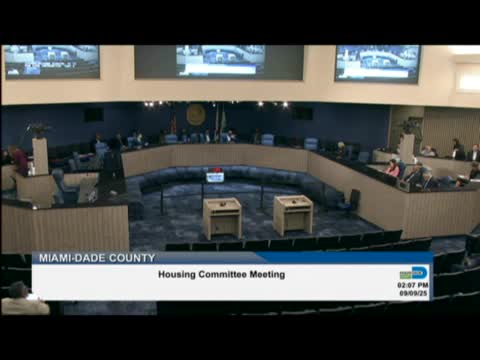
Commissioners on the Miami-Dade County Board of County Commissioners approved a measure to create a special-purpose entity that would allow the county commission itself to serve as the governing board for entities that acquire and manage county-owned public housing properties, Commissioner Higgins said during a committee meeting.
Commissioner Higgins described the proposal as a response to a multi-year housing crisis tied to the Miami Beach Community Development Corporation portfolio, saying the county “owned 16 buildings” that at one point threatened to displace “360 some families.” She told colleagues the county has worked with HUD and the state ethics commission and received written permission to proceed with a governance structure in which the Board of County Commissioners would serve as the board of the special-purpose entities.
Supporters said the change would let the county avoid creating a dozen separate nonprofit boards for individual properties, reduce administration costs and risk, and make some county-owned properties eligible for financing tools — including HUD programs and, potentially, tax credits — that are otherwise available to housing authorities operating under chapter 421 of the Florida Statutes. Terrence, a county staff member who spoke for the administration, summarized the proposal succinctly: “It is creating a special purpose entity to acquire the properties on Miami Beach.”
Why it matters: County leaders said the approach aims to protect existing residents of the affected buildings, bring county-owned properties into compliance with HUD requirements, and provide the county with tools to finance renovations or redevelopments without handing control to outside boards that might not be accountable to the commission.
Concerns and conditions: Commissioners pressed staff on limits and safeguards. Several members asked whether the vehicle could be narrowed to cover only the Miami Beach portfolio; proponents said the portfolio is larger than four properties and that limiting the vehicle could make it impractical. Commissioners also raised retirement-law questions tied to shared county employees serving both the county and the new entities. The committee was told staff will review relevant Florida Retirement System (FRS) rules and, if needed, recommend statutory or administrative changes before the item returns to the full board.
An amendment adopted by the committee clarified that additional properties would be added only if a district commissioner sponsored the inclusion, a safeguard several commissioners requested to prevent properties being added without local notice or support.
Action taken: The item was moved as amended and approved by voice vote in committee. The committee directed staff to brief commissioners and to return a substitute item to the full Board of County Commissioners; the matter was scheduled for the October 9 board meeting.
Context: Speakers repeatedly contrasted Miami-Dade’s structure with other Florida jurisdictions that operate separate public housing authorities under chapter 421 of the Florida Statutes, whose boards and governance permit creation of subsidiaries to own and redevelop public housing. Commissioners cited a past episode involving a development corporation (MDHA development corp) and a federal HUD intervention as part of the rationale for keeping control of county-owned properties within the commission’s oversight.
Next steps: County staff said they will meet individually with commissioners to explain technical issues, prepare any needed amendments to address FRS or other legal constraints, and produce a substitute item for the October 9 board agenda.